Kim Yu-won of Naver Cloud: “In the Face of Borderless AI Attacks, Only Solidarity Can Save Us”
IT DAILY ·
✦ AI Summary
Kim Yu-won, CEO of Naver Cloud, said in his keynote speech at CSK 2026 that cybersecurity in the AI era requires borderless defense and solidarity among nations.
He noted that the time from vulnerability discovery to an actual attack has been shortened from 90 days in the past to about 45 minutes, and said the era of blocking AI attacks at human speed is coming to an end.
He also said Naver Cloud has participated for two consecutive years in the South Korean coalition team for 'Locked Shields,' the international cyber defense exercise organized by the NATO Cooperative Cyber Defence Centre of Excellence, and was selected as the final operator for the government's 'cybersecurity-focused AI foundation model' development project.
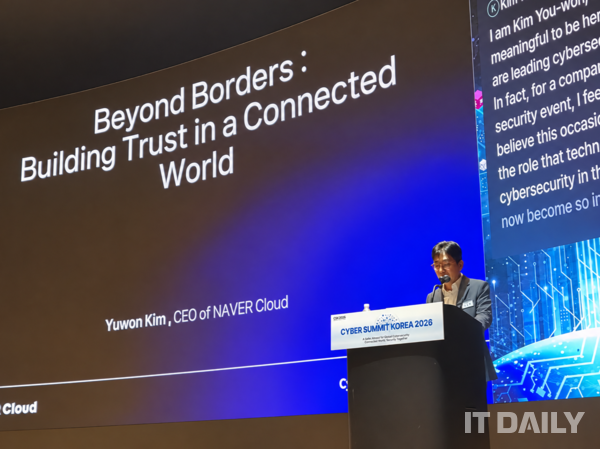
Kim Yu-won, CEO of Naver Cloud, delivered the keynote address at 'Cyber Summit Korea (CSK) 2026,' held on the 17th at COEX in Seoul. His presentation was titled 'Beyond Boundaries: Building Trust in an Age of Hyperconnectivity.'
Kim said attackers know no borders, and defense should know no borders as well. He explained that a single country has limits when it comes to blocking a full-scale attack.
Kim then said that responding to the AI era requires sharing capabilities, and that 'solidarity' — joining forces to secure cybersecurity in the AI era — is necessary. He stressed the importance of solidarity among nations for cybersecurity in the AI era. The photo was taken by reporter Kim Ho-jun.
The arrival of AI is changing the shape of cybersecurity. On the attacker side, AI is being used to create deepfakes, generate phishing sites, and automate malware creation and vulnerability discovery. As a result, the scope of security is also expanding to include AI service-linked prompts, model theft, data poisoning, model poisoning, and AI supply chain attacks. The task is also shifting toward securing AI itself while also using AI for defense.
The biggest change is attack speed. Kim said the time from vulnerability discovery to an actual attack has been shortened from 90 days in the past to about 45 minutes. He went on to explain that an attack can end before a person has time to analyze it and devise countermeasures. He also said the era in which AI attacks could be blocked at human speed is coming to an end.
In response to these changes, governments and companies around the world are putting regulations in place and establishing governance, while also expanding investments in AI-based defense technologies. Naver Cloud is participating in the South Korean coalition team for 'Locked Shields,' the international cyber defense exercise organized by the NATO Cooperative Cyber Defence Centre of Excellence, and took part for the second consecutive year. Through these activities, Naver Cloud is supporting nationwide efforts.
Kim cited NVIDIA-led 'Open Secure AI Alliance' as an example of solidarity in the private sector that goes beyond cooperation among countries. He explained that more than 120 companies participate in the consortium, sharing AI security technologies and vulnerability information, and that Naver is also taking part.
Kim then introduced a domestic cooperation case: the government's project to develop a 'cybersecurity-focused AI foundation model.' Also known as Tteokpamo, the project brings together private-sector AI and security capabilities while the government supports infrastructure resources such as GPUs to develop a Korea-specific security-focused AI model.
In this project, Naver Cloud is the lead company in a consortium of 33 companies and institutions and was selected as the final operator for Tteokpamo. With government support, the consortium will receive 256 NVIDIA B200 GPUs for 10 months, and Naver Cloud has additionally committed 4,000 of its own B200 GPUs to begin pretraining the model.
Kim said security is directly tied to competitiveness in Korean industries such as semiconductors, finance, and power. He added that a model with a deep understanding of industrial settings is needed, and described the cybersecurity-focused AI as infrastructure for national competitiveness, not technology for individual companies.
In line with that, Naver Cloud plans to push to expand the global market for its cybersecurity-focused AI. It also aims to run security AI in the AI factory it is building together with NVIDIA, and it proposed a goal of expanding each site into a hub for cyber defense cooperation.
Kim said safety should not be a privilege for only a few. He also expressed his determination to play a role at the center of a global cybersecurity alliance.
CSK 2026, held the same day, was co-hosted by the National Intelligence Service and the National Security Research Institute, and its theme was 'One Step Ahead for Global Cybersecurity: A Connected World, Security Together.' The opening ceremony was attended by delegations from 56 overseas intelligence and security organizations from 31 countries, as well as key figures from the domestic and international cybersecurity sectors, who discussed global cybersecurity cooperation.
During the event period from the 16th to the 18th, the main program will run alongside the international cyber exercise 'APEX 2026,' in which about 300 people from 23 countries will participate. The final round of the 'Cyber Attack Defense Competition (CCE) 2026' will also take place at the same time, with more than 50 teams in the general, public, and youth divisions taking part.
Source: IT DAILY · Kim Ho-jun
Original: https://www.itdaily.kr/news/articleView.html?idxno=241689
References
This article was produced with the help of an automated content generation algorithm.
Source: IT DAILY
View originalThis article was summarized and organized by BizCrush based on the original article from IT DAILY. For exact quotations and full details, please refer to the original article.