KT to Lease 5G Enterprise Work Network 'Eggs,' Lowering Wireless Network Buildout Costs for Companies
IT DAILY ·
✦ AI Summary
KT has launched its '5G Work Network Leasing Egg' for businesses and public institutions.
The company is shifting from a model in which customers buy and manage terminals themselves to a leasing model, with KT taking care of overall operations.
KT aims to lower the barrier to adoption for 5G work networks by reducing upfront terminal costs and maintenance burdens.
KT is switching its dedicated terminal provision model for enterprise 5G work networks from sales to leasing. The strategy shifts away from the existing structure in which companies bought terminals directly and managed inventory and failures themselves, toward a service model in which the carrier handles overall operations. The goal is to lower the initial barrier to adoption for 5G work networks.
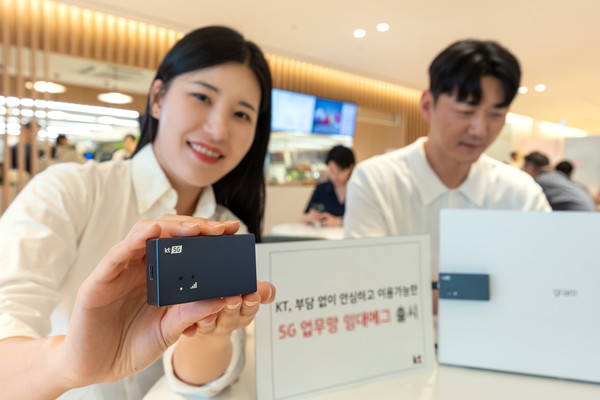
On the 17th, KT announced the launch of its '5G Work Network Leasing Egg' for businesses and public institutions. The service changes the way companies use 5G work networks by moving from a model in which they buy and manage terminals themselves to a leasing format, while placing the operational burden on the carrier.
A 5G work network is an enterprise wireless service that connects a client's internal network and KT's wireless network through a private-line-based closed network. By connecting a portable router called an 'Egg' to a laptop, employees can access the company's internal work network from field sites or business locations.
This is different from VPN access that goes through a mobile hotspot or a public internet connection. The key distinction is that the company's internal network is directly connected to the mobile network through a dedicated line.
The main targets are institutions and companies that need to work outside the office but restrict access to internal systems over the internet. KT launched the service with these businesses and public institutions in mind.
The core of the new product lies not in the 5G terminal itself, but in leasing and integrated operations. Previously, companies bought work terminals, distributed them to users, and managed inventory levels, status, and failures on their own.
Instead of the old model in which companies bought and managed terminals themselves, the product focuses on allowing them to apply for and use only the number of units needed when using the 5G Work Network Leasing Egg. As a result, they can reduce the upfront costs of purchasing terminals.
It also makes it easier to operate terminal numbers in line with organizational restructuring or changes in field staffing. Companies can adjust the number of terminals to fit the scale they need.
KT supports the entire process, from service activation to terminal operations and incident response. Even when terminal failures or disruptions occur, KT helps with the handling process, reducing maintenance and administrative work that had fallen to the client's information technology (IT) staff.
Terminal usage fees are billed together with the 5G work network line charge. Accordingly, there is no need to sign separate contracts and settle accounts for the communication line and terminal costs, and KT said this can simplify budgeting and spending procedures for businesses and public institutions.
KT cites the spread of remote and on-site work alongside changes in corporate workspaces, as well as rising demand for access to internal systems at places where fixed wired network installation is difficult, such as construction sites, logistics sites, temporary offices, and business trip locations, as the background for introducing the leasing model. KT expects that, in line with these environmental changes, leasing-type Eggs will be useful for organizations whose on-site operations and terminal demand fluctuate over certain periods.
KT is also focusing on the fact that public institutions have work hubs spread across headquarters, regional offices, and affiliated organizations, and that building wired networks separately for each distributed hub takes significant time and money. Accordingly, the company says a configuration that uses leasing-type Eggs together with hub-based work networks is suitable for wide-area institutions and subordinate organizations.
The service KT provides is called '5G Work Network Hub Type.' Targeted at wide-area institutions and subordinate organizations, the service connects multiple organizations through a hub-based network and provides individual employees and field workers with access tools via leasing Eggs, enabling shared use of a single work network infrastructure.
KT plans to further enhance enterprise-dedicated network functions based on 5G Standalone (SA) infrastructure and expand app slicing in the future. App slicing is a function that allocates network resources separately by application, and KT's goal is to provide a connectivity environment tailored to the work characteristics of each industry.
Jeon Myung-joon, head of the Enterprise Service Division in KT's Enterprise Business Unit, said the 5G Work Network Leasing Egg was designed to support the introduction of services without the upfront burden of purchasing terminals and to reduce repetitive management tasks such as handling terminal failures and settling fees. Based on that, Jeon said KT will provide a secure and stable network environment and efficient operations services so customers can focus on their core work.
Source: IT DAILY · Lee Jae-young
Original: https://www.itdaily.kr/news/articleView.html?idxno=241682
References
This article was produced with the help of an automated content generation algorithm.
Source: IT DAILY
View originalThis article was summarized and organized by BizCrush based on the original article from IT DAILY. For exact quotations and full details, please refer to the original article.