LG Uplus, Hyundai Elevator Advance AI-Based Remote Monitoring System
IT DAILY ·
✦ AI Summary
LG Uplus and Hyundai Elevator have signed an MOU to advance elevator remote monitoring.
Hyundai Elevator will apply LG Uplus' M2M service to the communication segment of MIRI, its smart remote monitoring platform.
The two companies will also review proof-of-concept work for an AI voice recognition-based emergency call service, as well as security monitoring and a cloud-based security platform.
LG Uplus and Hyundai Elevator said on the 17th that they had signed a memorandum of understanding to advance an AI-based remote monitoring system by combining wireless services and cooperation in AI and security for elevator remote monitoring. The two companies signed the MOU on the 15th.
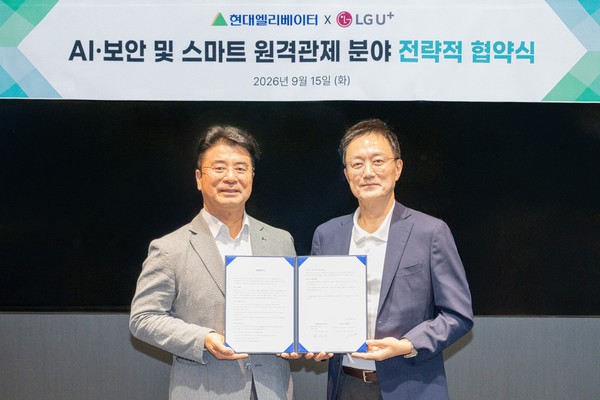
The two companies held an MOU ceremony on the 15th at the Hyundai Group Building in Jongno-gu, Seoul, for cooperation in wireless services and AI and security for a smart remote monitoring platform. Im Jang-hyuk, head of LG Uplus' Enterprise Customer Group, and Choi Seok-gyu, head of Hyundai Elevator's Service Business Division, attended the ceremony and posed for a commemorative photo.
Under the partnership, the two companies will expand elevator monitoring from remotely checking device status to determining emergency situations based on passengers' voice analysis. They will also develop a system that first analyzes emergency calls with AI before passing them on to staff dedicated to urgent situations.
Hyundai Elevator will apply LG Uplus' machine-to-machine (M2M) service to the communication segment of the elevators in its smart remote monitoring platform, MIRI. As part of the cooperation, the two companies will also conduct a proof of concept for an AI voice recognition-based emergency call service and review the application of security monitoring and a cloud-based security platform.
A key point of the partnership is the application of AI voice recognition technology to elevator emergency call devices. Elevator emergency call devices are used to request help from outside when passengers are trapped or in an emergency.
In actual operations, however, reported cases also include prank calls, malfunctions and simple inquiries. As a result, there are concerns that handling prank calls, malfunctions and simple inquiries could delay responses to emergency reports.
The two companies plan to pursue a way for AI to conduct a first-pass analysis of emergency call content. AI will respond to simple inquiries and malfunctions, while calls that require rescue or immediate confirmation will be transferred to dedicated staff. When emergency calls concentrate, the plan is to deploy counseling staff first to urgent reports, with the goal of improving response speed.
Because elevator emergency calls are directly tied to user safety, AI design is especially important, and the goal is to avoid missing emergency situations. However, the passenger's condition can be a variable, making it difficult to speak accurately because of fear or injury, and surrounding noise can also be a variable, potentially causing voice recognition errors.
Accordingly, the core of the proof of concept is to establish criteria for distinguishing emergency and non-emergency cases, and it will also include procedures for transferring the call to a counselor when AI judgment is uncertain. This is because accurately analyzing emergency situations with AI alone is not enough.
It is also necessary to expand the scope of management to include communication disruptions and cyberthreats. If communication between the elevator and the control center is unstable, it may be difficult to relay reports, and remote response may also be difficult.
Accordingly, the two companies plan to apply LG Uplus' M2M service between MIRI and the elevator to improve the stability of remote monitoring communications. They will also expand cooperation into security by reviewing the application of LG Uplus' security monitoring service to MIRI and the application of its cloud-based network and integrated security platform, U+SASE, to MIRI.
As elevators remain constantly connected to communication networks and cloud monitoring systems, the scope of management is expanding beyond physical breakdowns to network failures and cyberthreats. In line with this shift, this partnership is meaningful in combining a single remote monitoring framework for communications, AI and security.
The two companies jointly developed MIRI View in 2023. MIRI View is equipped with AI CCTV inside the elevator to detect screaming, falls and prolonged stays, and to deliver the detected information to the control center. While the existing MIRI View detected abnormal behavior based on video, the new emergency call service expands the scope to voice analysis as well.
Im Jang-hyuk, executive vice president and head of LG Uplus' Enterprise Customer Group, said the partnership represents innovation in elevator remote monitoring systems through an organic combination of stable wireless communications, AI and security. He added that LG Uplus will work with Hyundai Elevator to identify innovation tasks that improve customer safety and convenience.
Choi Seok-gyu, executive vice president and head of Hyundai Elevator's Service Business Division, said the standard for elevator competitiveness in the future will extend beyond machine performance to stable connectivity and the ability to respond quickly and accurately in a crisis. He added that the company plans to improve safety and convenience by combining AI, communications and security capabilities with elevator services in line with that shift.
Source: IT DAILY · Lee Jae-young
Original: https://www.itdaily.kr/news/articleView.html?idxno=241686
References
This article was produced with the help of an automated content generation algorithm.
Source: IT DAILY
View originalThis article was summarized and organized by BizCrush based on the original article from IT DAILY. For exact quotations and full details, please refer to the original article.