Defense Industry AIDC Public-Private-Academia Council Officially Launched ... K-Defense AI Transformation Accelerates
TECHWORLD ·
✦ AI Summary
The 'Defense Industry AIDC Public-Private-Academia Council' was officially launched on the 17th at the main auditorium of the National Assembly Library in Seoul to support the AI transformation of the defense industry.
The council is a permanent policy platform that discusses how to build, operate, and jointly use a defense-specific artificial intelligence data center (AIDC), secure the security of defense data, and provide an environment for AI development, training, and verification.
Future tasks include improving systems and security frameworks, establishing models for building, operating, and jointly using a defense AIDC, and expanding access to AI infrastructure for small and mid-sized defense companies.
The 'Defense Industry AIDC Public-Private-Academia Council' has officially launched to support the AI transformation of the defense industry. The council was launched with the goal of supporting AI transformation in the defense sector, and discussions on building a shared, national-level infrastructure are also expected to accelerate.
The council serves as a permanent policy platform to discuss how to build, operate, and jointly use a defense-specific artificial intelligence data center (AIDC). It aims to secure the security of defense data, provide an environment for AI development, training, and verification, and support AI transformation on the industrial front line.
Shared infrastructure is expected to be discussed as a way to safely use defense data that includes military secrets and core technologies, while supporting AI development and verification. This is likely to accelerate the creation of a foundation for safely using defense data that requires security, as well as an environment for AI development and verification.
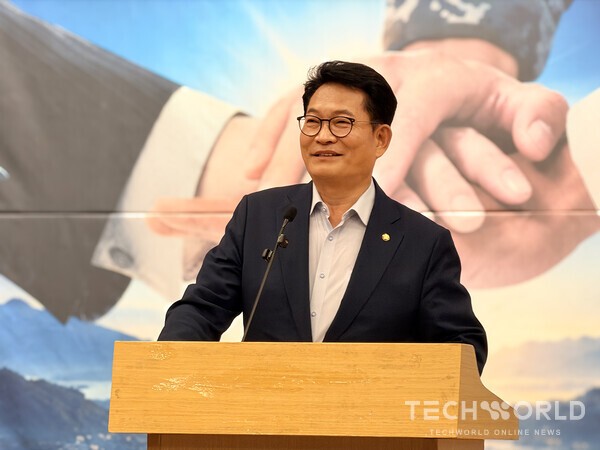
On the 17th, the launch ceremony for the 'Defense Industry AIDC Public-Private-Academia Council for the Leap Forward of K-Defense AX' was held at the main auditorium of the National Assembly Library in Seoul. The event was co-hosted by lawmakers Park Sun-won and Huh Sung-moo and organized by Myongji University and Changshin University, with lawmaker Song Young-gil, Kim Il-dong, vice commissioner of the Defense Acquisition Program Administration, and officials from the National Assembly, government, the military, defense companies, and universities in attendance.
Recently, the defense industry has been shifting from a manufacturing-centered weapons system business to a structure in which AI and data capabilities determine competitiveness across R&D, production, maintenance, and exports. As a result, the importance of using AI and data throughout the defense industry process is growing.
However, because the defense industry handles military secrets and core technologies, there are limitations to using general commercial cloud services. There were also concerns that the cost burden of independently building high-performance GPU and security infrastructure is significant.
For this reason, small and mid-sized defense companies are in a situation where they cannot secure their own AI infrastructure, and the need for a defense-specific data center that can be used jointly is growing. There was also concern that responses at the individual company level have limitations.
As future tasks, the council plans to push ahead with improvements to systems and security frameworks for the safe use of defense data, as well as the establishment of models for building, operating, and jointly using a defense AIDC. It also listed as tasks the expansion of access to AI infrastructure for small and mid-sized defense companies, linking the defense industry with domestic AI, AI semiconductors, and cloud services, and training AI specialists for defense and the defense industry.
At the launch ceremony, lawmaker Park Sun-won emphasized the importance of AI transformation to secure sustainable competitiveness for K-Defense. In remarks at the ceremony, Park defined AI transformation as the key to K-Defense's future competitiveness.
Park said K-Defense's sustainable competitiveness cannot be maintained through manufacturing and export capabilities alone. He also said AI transformation (AX) is a factor that will determine success or failure.
Park said the defense AIDC is not simply a construction project, but the foundation for a virtuous cycle in which data can be safely trained on, applied in the field, and fed back into export competitiveness. He described the defense AIDC as a base that links data training and field application to export competitiveness.
Park also said trust must come before speed, and systems must come before slogans. He also expressed his intention for the National Assembly to fulfill its responsibility so that field demands are linked to policy and legislation.
Lawmaker Huh Sung-moo presented AI and data capabilities as the next competitive edge for K-Defense. Huh said the next battleground for K-Defense's leap into one of the world's four major defense powers is AI and data capabilities.
He also said that for the entire K-Defense value chain to achieve AI transformation without leaving anyone behind, a safe and non-discriminatory shared infrastructure at the national level is essential. He identified K-Defense's next competitive advantage in AI and data capabilities, as well as the national shared infrastructure that will support them.
As the construction of a defense-only AI data center is being pursued at the Changwon National Industrial Complex, the complex is taking on a catalytic role. In connection with this, plans were presented to pursue regulatory easing and to pursue institutional reform.
There was also a plan to establish a policy support ecosystem to help companies with their AI transformation. Lee Yong-chul, commissioner of the Defense Acquisition Program Administration, stressed that the level of AI and data acquisition, safe use, and linkage between weapons systems and production sites will determine the future competitiveness of K-Defense.
Emphasizing the council's practical role as a policy platform, Lee Yong-chul said the council should go beyond exchanging opinions and become a platform that identifies field issues and links them to policy and institutions. Accordingly, the council plans to operate subcommittees after its launch.
The subcommittee areas are systems, talent development, technology infrastructure, industrial demand, and security. Through these subcommittees, the council plans to flesh out field issues and propose policy and institutional improvements to the National Assembly and the government. It also plans to continue discussions on building shared infrastructure for the AI transformation of the defense industry.
Source: TECHWORLD · Park Kyu-chan
Original: https://www.epnc.co.kr/news/articleView.html?idxno=407072
References
This article was produced with the help of an automated content generation algorithm.
Source: TECHWORLD
View originalThis article was summarized and organized by BizCrush based on the original article from TECHWORLD. For exact quotations and full details, please refer to the original article.