[AI Brief] Flitto Builds AI Translation System "Otok" at Hanwha Ocean and Hanwha Systems Shipyards
IT DAILY ·
✦ AI Summary
Flitto built an AI translation environment at Hanwha Ocean and Hanwha Systems shipyards to strengthen safety communication with foreign workers.
Flitto said it applied translation models reflecting shipbuilding terminology and dialects and slang, along with noise-environment customization features.
As a result, it improved the accuracy of work instructions and safety training, and the usage rate among foreign workers in the pilot run was about 96%.
IT Daily's "AI Brief" is a section that compiles major AI news from Korea and abroad.
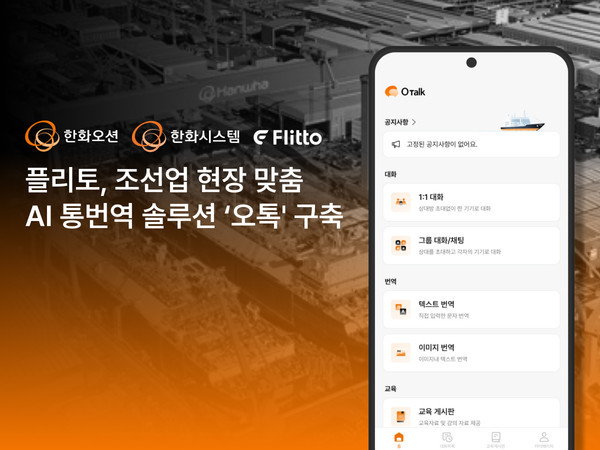
Flitto has built an AI translation environment tailored to shipyard operations at Hanwha Ocean and Hanwha Systems shipyards to strengthen safety communication with foreign workers.
Flitto applied a translation model that reflects shipbuilding terminology, a translation model that reflects dialects and slang, and noise-environment customization features.
As a result, it improved the accuracy of work instructions and safety training.
Flitto said on the 16th that it had built "Otok," an AI translation solution customized for Hanwha Ocean, and that it had begun in earnest to improve communication quality with foreign workers and strengthen industrial safety through the system.
Otok is an AI translation solution tailored to shipyard operations. Hanwha Ocean's AX division planned it based on on-site requirements, and Hanwha Systems and Flitto took part in building it. The solution's main purpose is to address the difficulty of immediate communication between Korean and foreign workers at shipyards. In particular, frequent use of slang and heavy dialect accents on site was identified as a problem that could reduce work comprehension.
To that end, Flitto built a customized glossary based on on-site data and requirements provided by Hanwha Ocean and advanced the AI translation model. It also reflected voice data in 7 major languages, including Korean, English, Vietnamese, and Thai, in its training scope. Although recognition was difficult in the early stages of building the solution, its practicality improved as recognition of on-site pronunciation with Gyeongsang Province accents improved.
Based on these improvements, Otok's real-world usability improved further. Flitto said the usage rate among foreign workers who participated in the pilot run was about 96%.
Hancom and Daegu Public Facilities Management Corporation are pushing ahead with AI-based administrative innovation. Hancom said on the 16th that it had signed an MOU with Daegu Public Facilities Management Corporation on the 15th to implement innovative AI-based administrative services. The agreement aims to verify the potential use of AI in public facility management by linking unstructured data such as reports and work manuals accumulated by the corporation with Hancom's AI technologies.
The goal of the agreement is to apply Hancom's AI technologies to the corporation's administrative work, improve work efficiency, enhance practical convenience, and build a data-driven digital administrative innovation model. To this end, the two organizations will conduct a PoC for applying AI technologies to administrative work by November 30.
In this process, Hancom will support the use of LLMs and vision AI, and will be responsible for system design, technology development, and service development. Based on this, the two organizations will push ahead with implementing AI-based innovative administrative services suited to public facility management administration.
They will review ways to link unstructured documents with Hancom AI solutions and examine the potential for applying AI to public facility management knowledge. In addition, they plan to verify answer accuracy and confirm features specialized for administrative work.
They will also jointly identify AI-based intelligent services aimed at improving public service quality and cooperate in using public data held by the corporation. They also set a plan to explore various joint projects using AI technologies.
As a separate case, Deeple used its acoustic AI inspection solution in an automotive connector fastening robot process. The goal is to secure inspection accuracy, and the photo source is Deeple.
Deeple said on the 16th that it would supply "Listen AI" to an automotive fastening robot process and work to improve the accuracy of connector fastening inspections by robots. The plan adds sound and vibration analysis to existing vision inspection to reduce false positives and detect fastening anomalies in real time.
"Listen AI" is an AI inspection solution based on acoustic analysis. It has functions for real-time quality inspection of drive components such as motors, gears, and bearings on industrial mass-production lines, as well as functions for measuring fastening sounds of connectors, bolts, and similar parts. The solution is used to inspect the condition of manufacturing facilities, equipment, and robots, and for predictive maintenance.
Listen AI has been introduced to the connector fastening line in an automotive assembly process. The target process is the assembly of body parts and interior and exterior materials.
Listen AI achieved a true defect detection rate of 99.9%. True defects are within the range audible to humans. Listen AI also recorded a false defect detection rate of more than 99%. False defects are within a range that is difficult for people to hear.
Deeple plans to secure the target accuracy within 2 to 3 months and apply it to the mass-production line at 100%.
The photo caption is Fortytwo Maru. Fortytwo Maru announced on the 16th that it had obtained government certification for two generative AI solutions, along with official certification under the government's "AI Product and Service Verification System." Its "LLM42 v.1.1" is a domain-specific lightweight language model, and "RAG42 v.1.3" is a high-precision retrieval-augmented generation solution. "LLM42 v.1.1" and "RAG42 v.1.3" simultaneously obtained certification under the government's verification system in line with the follow-up amendments to the Basic AI Act.
With this certification, Fortytwo Maru secured preferential qualification for public procurement. Based on this, the company plans to expand business with central government ministries, local governments, and public institutions.
When AI products and services obtain verification, they receive various forms of preference throughout public procurement procedures. These preferences include relaxed requirements and procedures for participation in Multiple Award Schedule contracts, higher evaluation points for credibility in general competitive bidding, exemption from delivery performance requirements in SW unit-price contracts, higher threshold amounts for second-stage competition in MAS, and use as reference material in technical evaluations when selecting innovative prototypes.
Uclicks said on the 16th that it had launched the "Gemini Enterprise Training Program" to help companies strengthen their capabilities in using generative AI and AI agents. The goal is to support practical corporate AI use.
Uclicks operates a regular "Gemini Enterprise" training program for corporate employees. The program is designed around helping users learn practical applications of generative AI and AI agents, based on actual business environments for corporate customers, and it is built around hands-on training.
The training provides practical exercises centered on real work and aims to improve capabilities in using generative AI and AI agents. The curriculum includes practice in searching internal documents, summarizing documents, drafting work documents, and using AI agents.
The Gemini Enterprise training is not limited to engineers and technical staff, but is designed for employees across various departments, including non-technical workers. The scope of Gemini Enterprise support is also geared not only toward engineers and technical staff but toward covering everything from highly specialized tasks to everyday work.
The focus of this training is practical AI use tailored to each participant's work. It is designed so employees from different departments can apply AI to their own tasks.
The photo caption is Buzzni. Buzzni said on the 16th that it had expanded the features of its AI short-form content production service, "Biscuit AI."
Through this feature expansion, Buzzni broadened the range of video production. A new feature called "Create Clip" was added to Biscuit AI, and the function is made up of 11 detailed tools.
The "Rhythm Cut Editing" feature automatically generates a 5-second fast-cut ad clip when one photo is uploaded. The "Avatar Clip" feature creates a clip in which an AI avatar speaks the entered script. The "Avatar Challenge" feature generates a clip in which an avatar follows a link to a trending challenge video on SNS.
The "App Demo" feature composites smartphone screenshot screens. This feature also displays touch actions such as tapping and scrolling.
Source: IT DAILY · Yang Seung-gap
Original: https://www.itdaily.kr/news/articleView.html?idxno=241658
References
This article was produced with the help of an automated content generation algorithm.
Source: IT DAILY
View originalThis article was summarized and organized by BizCrush based on the original article from IT DAILY. For exact quotations and full details, please refer to the original article.