Agent Field Trip Finds Problems on the Ground, Then AI Builds the Solution
TECHWORLD ·
✦ AI Summary
GDG Incheon held an on-site AI hackathon, "Agent Field Trip: Incheon," in the Dongincheon area of Incheon on the 12th.
Participants walked through Dongincheon to find and organize problems before implementing, revising, and testing services with AI agents.
The GDG Incheon Award went to the team "That Place, Then," which built a service to record and preserve the 140-year history of the Dongincheon area.
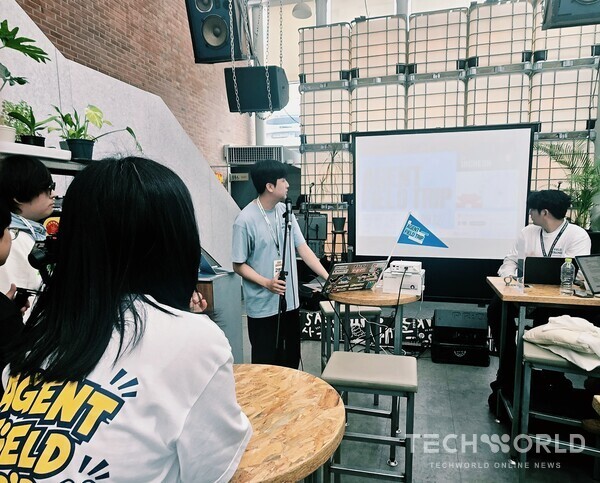
Hackathon participants who had been coding in front of their laptops moved out onto the streets. GDG Incheon (Google Developer Groups Incheon) hosted an on-site AI hackathon, "Agent Field Trip: Incheon," in the Dongincheon area of Incheon on the 12th. The event was held with support from Mondrian AI, Naver Cloud, and the Incheon Tourism Organization, among others.
This hackathon was run in a format that began with participants walking through Dongincheon in person to find and organize problems, then using those findings to build AI-based services. The starting point was on-site observation, and participants visited the old downtown area, including Chinatown, Jayu Park, and Sinpo International Market. While examining issues related to accessibility for people with mobility limitations, tourism, and traditional markets, participants took photos and notes on the street and used those records to define problems.
After setting their service direction based on problems identified on the ground, participants implemented them as AI-based services. The AI agent handled implementation, modification, and testing. During field activities, participants instructed the AI agent via smartphone, while laptops were set up at the base camp.
The event stood out from conventional hackathons, which are held in one place within a limited time frame. Rather than gathering in one spot and writing code directly as before, participants first walked the site to find and organize problems, then used smartphones outside to instruct the AI agent and continue the implementation process.
The workflow involved participants sending the problems they identified on site, along with photos and requirements, via mobile, while AI carried out development. Participants then reviewed the results and requested further changes and testing. They built their services in about 3 hours.
The organizers focused more on the problems participants discovered and how they were reflected in the service than on the completeness of the final output. Final deployment did not have to be complete, and working screens and demo videos were also accepted. The emphasis was on the process by which ideas were turned into services within a short time.
As a result, participants focused less on writing code themselves and more on deciding what to build and verifying AI-generated results. Mondrian AI provided its AI agent platform, Runyour Agent, as development infrastructure. Without setting up a complex separate development environment, participants connected GPT, Claude, and Gemini and other LLMs via API.
At the event, Mondrian AI provided each team with 300,000 credits for AI model use. The amount deducted varied by model. The latest, high-performance models consumed relatively more credits. Participants selected the models they needed based on the nature of the task.
Participants repeated the cycle of implementing, revising, and testing functions based on materials collected on site. In the process, the team discovered problems in the field and immediately turned them into implementations.
One participant said they took part because the format was interesting: unlike a typical hackathon, it involved going out into the field to find problems and immediately turning them into services. They also said it was impressive that even someone who is not a developer can explain the function they want to an AI agent, check the results, and build a service themselves.
The GDG Incheon Award on the day went to the team "That Place, Then," which implemented a service to record and preserve the 140-year history of the Dongincheon area.
After visiting the open port district and Chinatown in person, the "That Place, Then" team recognized a problem: historical location information remained scattered throughout the site, and historical background was also written on signboards, but tourists passed by the signs and the local story was not sufficiently conveyed. They focused on the fact that there was a gap between historical information and visitors' actual experience.
Using that as the starting point for the service, the team proposed location-based exploration of nearby historical sites. They also designed the service so that when users take photos on site, they can view the historical information and past appearance of the same place together, and they made it possible to check changes in a location through a function that compares current photos with archival records. Based on this, they envisioned a way to connect Dongincheon's history into a single tourism experience.
The team also considered the reliability of historical information. Since generative AI could arbitrarily create images of the past and potentially distort history, they proposed using archival materials accumulated at places such as the Open Port Museum and the Modern Architecture Exhibition Hall.
Walking through the Dongincheon area themselves, participants confirmed accessibility issues that do not appear in map data alone, and they turned those on-site mobility, tourism, and commercial district issues into a service.
Participants who walked the Cheong-Il Japanese Concession to Jayu Park route focused on the difference between the shortest path shown on the map and the actual walking environment. Although the mapped distance was about 5 minutes, the real route had many stairs, and there were sections that were difficult for wheelchair users and people who have trouble walking to pass through. Participants inspected stairs, slopes, and walking space directly.
They built a route recommendation service based on accessibility standards for people with mobility limitations. The service did not simply present the fastest route; it also reflected comparison items such as whether there were stairs, how gentle the slope was, and whether walking space was secured. The goal was to support the selection of routes that could actually be traveled.
Participants also proposed a future feature that would apply different accessibility criteria by mobility type, including wheelchair users, older adults, stroller users, and people using crutches.
Services that use local on-site information to change mobility, shopping, and tourism experiences continue to emerge. In Dongincheon, a service was introduced to address mobility issues from the perspective of the physical burden on ordinary users. The service directly checks the hills and stairs in Dongincheon and uses elevation information to suggest less strenuous routes in addition to the shortest path. It also includes a function that lets users choose conditions such as stairs and modes of transportation.
At Sinpo International Market, a market exploration service centered on food and make-at-home menus was implemented. When a user selects a menu, the service connects them with stores that sell the necessary ingredients and also links them to shops where they can buy finished products. Recipes are provided as well.
In Chinatown, a tourism-content service using alleys appeared. The service presents clues in the form of plaques and parts of murals, and only opens the quiz when users walk through the alleys themselves and find the locations. Rather than merely displaying tourism information on a screen, it was designed to make users stop on site and observe their surroundings directly.
Participants confirmed that visitor flows in Chinatown were concentrated on some of the main streets. They directly interviewed local merchants and tourists to understand the on-site situation.
Based on that, they proposed a plan that links restaurants, cafes, and photo studios with stamps and missions. The idea was presented as a way to encourage movement into nearby commercial districts.
Participants also proposed an Incheon tour-course recommendation service that reflects traveler preferences and length of stay. The service provides local restaurant and transportation information together, and it also includes a function that connects solo travelers with other visitors for meals.
In this hackathon, the development method changed, and so did the role of people. The structure applied was one in which the participant discovered problems on site and decided the service direction, while the AI agent handled implementation. People then reviewed the results and gave instructions for revisions and testing again.
Participants instructed the agent via smartphone, and AI performed the work in the development environment at the base camp. As a result, participants did field research and development in parallel rather than staying in front of laptops, and even non-developers such as planners and designers took part in service creation in the same way.
The event reduced the time needed to draft code, allowing participants to spend the saved time on field research, problem definition, and feature design. During this process, participants with no development experience used AI agents, and the possibility of turning ideas into services that actually work was also confirmed.
A Mondrian AI official said that the event produced immediate on-site ideas and cases of fully realized services built using AI agents, adding that the event proved the potential of "vibe coding." The official said the company would continue to support easy AI agent building through Runyour Agent, help solve a variety of problems, and push ahead with technical support and ecosystem expansion.
Source: TECHWORLD · Kim Seung-gi
Original: https://www.epnc.co.kr/news/articleView.html?idxno=406974
References
This article was produced with the help of an automated content generation algorithm.
Source: TECHWORLD
View originalThis article was summarized and organized by BizCrush based on the original article from TECHWORLD. For exact quotations and full details, please refer to the original article.