Hyundai Motor Group Presents Hydrogen’s Role in Jeju, Says It Complements EVs Rather Than Competes With Them
TECHWORLD ·
✦ AI Summary
Hyundai Motor Group took part in the '2026 Jeju Green Hydrogen Global Forum with the Distributed Energy Forum,' held from the 14th to the 16th at the Jeju International Convention Center, and shared ways to link renewable energy with hydrogen and use hydrogen mobility.
Shin Seung-gyu, vice president of Hyundai Motor Group, said storing hydrogen produced from renewable energy and using it when needed can increase the flexibility of the energy system.
Hyundai Motor Group positioned FCEV as a complement to BEV rather than a competitor and highlighted their value in long-distance and heavy-duty transportation, as well as high-utilization sectors such as buses, taxis, and logistics trucks.
Hyundai Motor Group took part in the '2026 Jeju Green Hydrogen Global Forum with the Distributed Energy Forum,' held from the 14th to the 16th at the Jeju International Convention Center, and shared directions for the energy transition linking renewable energy and hydrogen, as well as ways to use hydrogen mobility. At the Jeju forum, the group explained hydrogen in connection with a renewable-energy utilization system and positioned hydrogen fuel cell electric vehicles (FCEV) as a complement to battery electric vehicles (BEV), not a competitor.
Hyundai Motor Group particularly emphasized the role of hydrogen mobility in long-distance and heavy-duty transportation. It also stressed the role of hydrogen mobility in sectors that require high utilization rates, such as buses, taxis, and logistics trucks.
In a congratulatory address at the opening ceremony on the 15th, Shin Seung-gyu, vice president of Hyundai Motor Group, said that as renewable energy adoption expands, a stable energy supply and an efficient utilization system need to accompany it. He also explained that hydrogen produced from renewable energy can be stored and used when needed, and that hydrogen storage and use through this process enhances the flexibility of the energy system.
Shin said that the combination of renewable energy and hydrogen is the foundation for realizing new possibilities in the energy transition, and expressed his commitment to jointly shaping the future of the Republic of Korea's hydrogen economy through close cooperation with Jeju Province.
Jeju Province is expanding the foundation for clean hydrogen production and utilization. Jeju began a 250kW electrolyzer demonstration in 2017, and its 3.3MW electrolyzer complex in Haengwon-ri, Gujwa-eup has been producing about 200 kg of hydrogen per day since September 2024. Hydrogen produced at the Haengwon electrolyzer complex is being supplied to hydrogen buses and hydrogen passenger cars on the island.
Jeju Province plans to introduce a cumulative total of about 370 hydrogen mobility units by 2027. Specifically, it plans to bring in 290 passenger cars, 76 buses, and 3 trucks. Hyundai Motor Group and Jeju Province began cooperation on building an eco-friendly vehicle ecosystem in 2021 and are continuing collaboration in hydrogen and vehicle-grid integration (V2G) areas.
On the same day, Hyundai Motor Group participated in the session titled 'Strategy for Expanding the Clean Hydrogen Demand Market: From Low-Carbon Power to Industry and Mobility.' There, the group presented 'A Strategy for Urban Mobility Resilience Based on FCEV' and proposed that FCEV and BEV should be used in parallel according to their technical characteristics rather than as rivals.
Hyundai Motor Group said FCEV are valuable in areas that require fast refueling, long driving range, and high utilization rates. It cited long-distance and heavy-duty transportation, buses, taxis, and logistics trucks as application areas.
The group suggested that power-hydrogen complementary energy infrastructure is needed to address rising electricity demand, constraints on distribution network expansion, and concentrated charging demand at specific times of day.
It also explained that if FCEV, which do not rely directly on electric charging during vehicle operation, are used in essential transportation sectors, they can enhance urban mobility resilience together with BEV. A Hyundai Motor Group official said hydrogen mobility is an alternative that complements electricity-based mobility in areas requiring stable operation, such as long-distance transportation and disaster response.
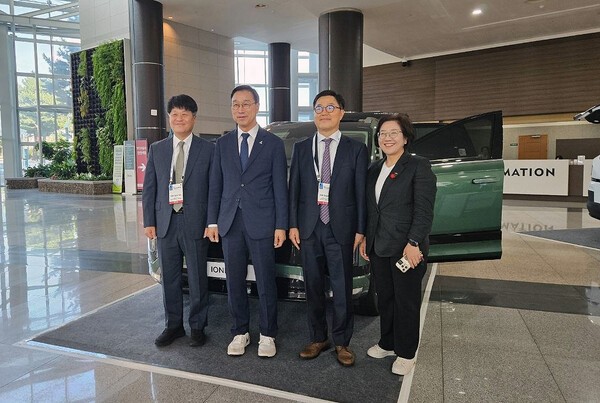
Hyundai Motor Group displayed hydrogen fuel cell electric vehicle 'The All New Nexo' and electric vehicle 'Ioniq 9' in the forum exhibition space, and introduced hydrogen mobility and electrification technologies. In addition, a Hyundai Motor Group official said the company plans to review the potential for renewable energy-hydrogen integrated utilization and intends to contribute to expanding the clean hydrogen demand ecosystem.
Source: TECHWORLD · Kim Seung-gi
Original: https://www.epnc.co.kr/news/articleView.html?idxno=407028
References
This article was produced with the help of an automated content generation algorithm.
Source: TECHWORLD
View originalThis article was summarized and organized by BizCrush based on the original article from TECHWORLD. For exact quotations and full details, please refer to the original article.