Suseong Inoti Strengthens Data-Classification Security in eWalker DLP
TECHWORLD ·
✦ AI Summary
Suseong Inoti said on the 16th that it has strengthened the data-classification-based security functions of eWalker DLP.
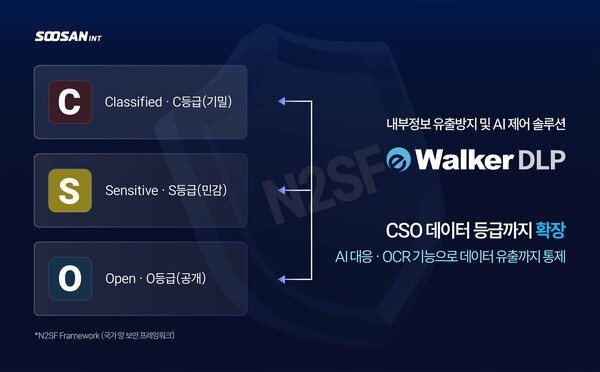
The enhancement is intended to address the National Network Security System (N2SF), adding CSO(Classified·Sensitive·Open) classification recognition and policy criteria for preventing leakage.
The company said it will strengthen data-centric security capabilities and support public institutions in safely transitioning to N2SF by linking the N2SF CSO classification system with eWalker DLP.
Suseong Inoti said on the 16th that it has strengthened the data-classification-based security functions of its internal information leakage prevention and AI control solution, eWalker DLP. The enhancement is intended to address the National Network Security System (N2SF) and expands the existing eWalker DLP solution to better support identifying data by importance and applying security policies, both of which are core to the N2SF environment. As a result, CSO(Classified·Sensitive·Open) classification recognition has been added, and policy criteria for preventing data leakage based on the N2SF CSO classification system can now also be incorporated.
With this functional expansion, customers can have CSO classifications assigned to documents by separately operated data identification and classification solutions recognized in eWalker DLP. The recognized CSO classifications can then be applied to anti-leakage policies, and the classification results can be used to control actual external transfer. Suseong Inoti said this enables the company to respond to the application of security policies by data importance, which is required in the N2SF environment.
For example, if a document classified as 'Confidential (C)' in a data identification solution is about to be sent outside through an employee's email or the web, eWalker DLP can recognize the classification. It can then block or warn on the transfer according to preconfigured policies. The company said this approach allows CSO classifications assigned to documents to be linked with external transfer control policies.
The company said it has added a function to eWalker DLP that uses N2SF's CSO classification results as additional policy criteria. While preserving existing policies based on security administrator settings, the new feature also uses CSO classification results in policy decisions.
eWalker DLP is a network-based information leakage prevention solution that analyzes in real time personal information and important corporate and institutional information moving across the network. It also detects and blocks such data according to policies set by security administrators. Separate from data-classification integration, it also provides functions to analyze and control various data formats and multiple leakage paths.
It also supports OCR-based detection of sensitive information, enabling it to detect, analyze, and, if necessary, block personal information and important data in ordinary images, images embedded in documents, scanned documents, and screen captures. In addition, it analyzes prompts and attachments sent to dozens of generative AI services, including ChatGPT, Gemini, and Claude, and detects, blocks, and logs leaks of personal information, project documents, technical materials, and trade secrets. It also provides AI DLP(Data Loss Prevention) functionality by default for controlling information leaks in generative AI environments.
Suseong Inoti CEO Jeong Eun-a said that in an N2SF environment, understanding data importance is more important than simple network separation, and applying security policies by importance is also important. She added that eWalker DLP has its own capabilities for data detection, analysis, and leakage control, and said the company will strengthen data-centric security capabilities and support public institutions in safely transitioning to N2SF by linking the N2SF CSO classification system with eWalker DLP.
Source: TECHWORLD · Kim Hye-jin
Original: https://www.epnc.co.kr/news/articleView.html?idxno=407029
References
This article was produced with the help of an automated content generation algorithm.
Source: TECHWORLD
View originalThis article was summarized and organized by BizCrush based on the original article from TECHWORLD. For exact quotations and full details, please refer to the original article.