Chmistry Research Institute and SK Innovation Join Forces to Develop Cooling Materials for AI Data Centers
AI TIMES ·
✦ AI Summary
According to AI TIMES, the Korea Research Institute of Chemical Technology and SK Innovation Environmental Science & Technology Institute be…
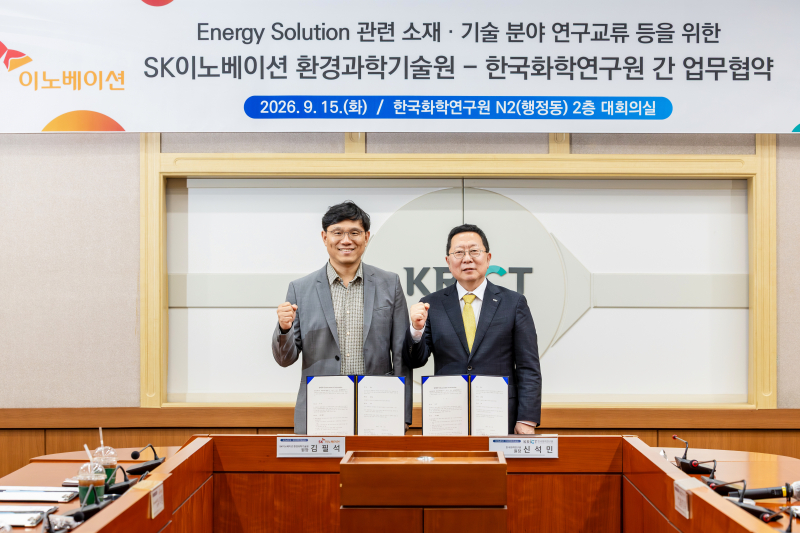
According to AI TIMES, the Korea Research Institute of Chemical Technology and SK Innovation Environmental Science & Technology Institute began joint development on September 15 of next-generation cooling material technologies to reduce power use in AI data centers. The two sides are planning phased research centered on two-phase cooling, in which a liquid refrigerant absorbs heat and turns into a gas, with the goal of ultimately verifying performance and power efficiency in a 500kW-class environment. The collaboration stems from the view that the heat problem in data centers, intensified by the spread of high-performance GPUs, is difficult to solve with conventional air cooling alone. The joint tasks include thermal management, development of cooling and heat-dissipation materials, high-efficiency and eco-friendly material technologies for power infrastructure, and the identification and execution of related national research and development projects. In particular, they are preparing an approach that combines AI and chemical materials research to screen promising refrigerant candidates and move on to actual synthesis, purification, and evaluation of key physical properties. The article highlights a collaboration that spans everything from refrigerants to materials and system verification, underscoring the industrial potential of data center cooling technologies.
Perspective
The significance of this collaboration lies in elevating cooling from a supporting facility function to a core technology that can determine data center competitiveness. As the challenge of reducing power use grows, heat management methods become a variable that shapes cost, efficiency, and deployment speed at the same time. In particular, the approach of linking materials research and real-world verification in one continuous process is noteworthy because it increases the chances that research results will make their way into practical use. Ultimately, it is a signal that the bottleneck in AI expansion is shifting from compute performance alone to cooling and power efficiency.
This perspective is BizCrush's own commentary and is not part of the reporting by AI TIMES.
This article was produced with the help of an automated content generation algorithm.
Source: AI TIMES
View originalThis article was summarized and organized by BizCrush based on the original article from AI TIMES. For exact quotations and full details, please refer to the original article.