KT Cloud: “We Will Complete a 1 GW AIDC Framework by 2031” ... Targeting Exploding AI Demand
IT DAILY ·
✦ AI Summary
KT Cloud held "kt cloud summit 2026" on the 15th and unveiled an infrastructure strategy linking cloud and AIDC, along with its vision for AX support.
KT Cloud said it will push a "Single Cloud Experience," "Composite Cloud," and "Composite AI" framework around "kt cloud PLATFORM," while setting a goal of supplying more than 1 GW of next-generation AIDC by 2031.
The event featured Gyeongbuk Provincial Government's public AX case, the AIDC supply roadmap, and the KT-SGC Energy network and energy partnership.
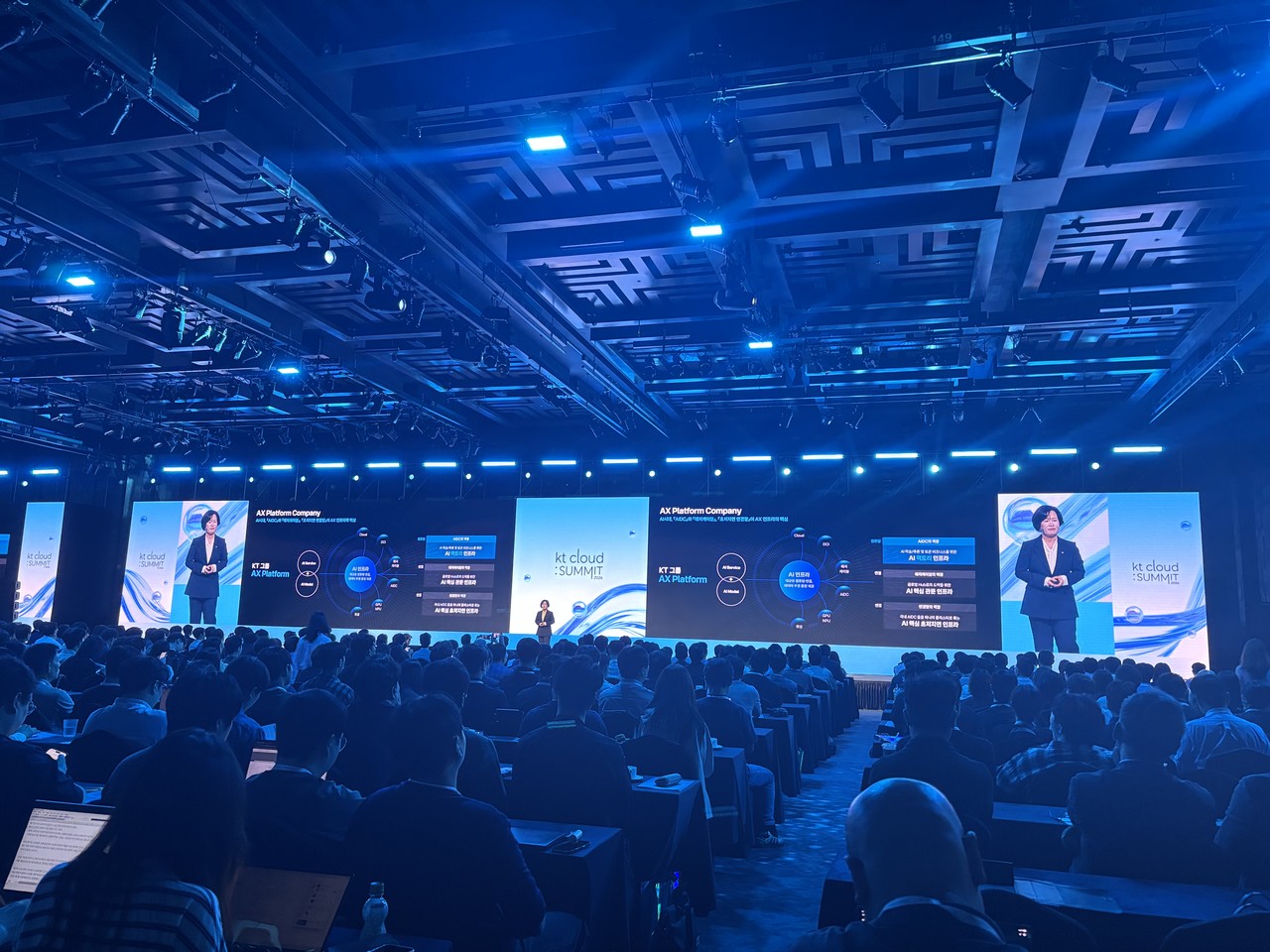
KT Cloud held its annual technology event, "kt cloud summit 2026," on the 15th at the Grand InterContinental Seoul Parnas in Gangnam-gu, Seoul, and unveiled its infrastructure strategy that links cloud and AIDC, along with its vision for AX support. The event was held under the slogan "AX for Your Business," and more than 1,500 people, including public officials, corporate representatives, and IT experts, attended.
At the event, KT Cloud said it is bringing together its technology and operations capabilities across cloud and AIDC and announced its vision as an "AX infrastructure partner" to support AX execution for companies and the public sector. Kim Bong-gyun, CEO of KT Cloud, delivered a presentation at the event.
KT Cloud said it has its own in-house developed "kt cloud PLATFORM" and will advance its strategy around that platform. It also plans to establish a "Composite AI" framework to connect distributed infrastructure.
KT Cloud's strategy is aimed at supplying more than 1 GW of next-generation AIDC by 2031. Through this, it set out a goal of securing exploding AI demand ahead of competitors.
The event photo was taken by reporter Kwon Young-seok. The photo shows Kim Bong-gyun, CEO of KT Cloud, speaking at the event.
In his welcoming remarks, Kim Bong-gyun said advances in AI technology are rapidly accelerating the pace of change in daily life and business. He described the change as being at the level of "a total transformation."
Kim said KT's vision in this trend is that of an "AX platform company." He added that KT Cloud is in charge of core AX infrastructure such as cloud and AIDC, and that it is playing a role in supporting customers' AX execution.
At the event, Gong Yong-jun, head of KT Cloud, took the stage for a presentation. The photo credit was listed as KT Cloud, and the subtitle was "Beyond Multi and Hybrid, Toward Composite AI."
Gong Yong-jun, the first keynote speaker, presented under the theme "Beyond Cloud: The Rise of Composite AI." In his talk, he focused on changes in the cloud architecture paradigm.
Gong explained that it is clear that no single vendor cloud can handle all enterprise workloads. He said enterprise environments are evolving into complex setups combining different clouds and on-premises systems, much like concrete gains new strength when heterogeneous elements are fused together.
KT Cloud is building a "Single Cloud Experience" framework that controls accounts, permissions, policies, and monitoring for various infrastructures through a single window, and it plans to complete the framework by 2027.
Beyond this infrastructure-connection stage, KT Cloud is pursuing a "Composite Cloud" that optimally combines resources by workload and business purpose, and it envisions evolving further into "Composite AI," which organically connects data, computing resources (GPU and NPU), AI models, and agents.
In this process, Gong highlighted the performance of the company's recently completed cloud platform, "kt cloud PLATFORM." KCP is based on cloud-native architecture and integrates management of virtual machines (VMs) and containers, while implementing a multi-availability-zone (AZ) architecture that lowers recovery time objective (RTO) to near-zero levels.
Reference cases based on partnerships with domestic AI semiconductor and model companies were introduced. In that process, a successful case of settling GPU infrastructure and AI API for K Bank was presented.
Also introduced were successful cases of settling GPU infrastructure and AI API for Chonnam National University and for Jeonbuk National University. Successful cases of GPU infrastructure and AI API for the Korea Racing Authority and the Small Enterprise and Market Service were also presented.
Next, Kim Min-seok, head of policy at the Gyeongbuk Provincial Government, took the stage. His presentation topic was "In the AI Era, the Future of Public AX Created by Gyeongbuk."
Kim Min-seok emphasized bold execution in the public sector. He said Gyeongbuk's DNA is closer to execution than conservatism, and explained that just 97 days after ChatGPT was released, the province introduced "Chat Gyeongbuk," a policy-support AI service, at administrative sites.
Kim also said Gyeongbuk has power, data centers, cloud, industrial sites, and good AI models all in place. He added that Gyeongbuk, as a "small Korea," is the optimal place to first test public AI.
Gyeongbuk Province worked with KT and KT Cloud to build the "Gyeongbuk AI Cloud Data Center (Gyeongbuk AI CDC)" in the new city of the Gyeongbuk Provincial Government, and it began full service on July 1.
At the same time, an association involving more than 40 local ICT companies was launched, with the purpose of strengthening the local ecosystem.
Kim said about 65% of the computer systems of provincial, city, and county-affiliated institutions will be integrated and moved to the cloud, and explained that a plan to connect distributed data into a single system is also being pursued.
Kim also set out a goal of innovating 4 major public services, naming data-driven policy-making, AI agent administration, preemptive disaster prediction and response, and precision care for vulnerable groups as the 4 innovation areas.
At the event, Choi Ok-jin, head of KT Cloud's DC division, presented "Beyond Heritage, Designing the Future of AIDC" and unveiled a roadmap for ultra-large infrastructure supply and next-generation technology capabilities in the AIDC segment, setting a goal of supplying more than 1 GW of AIDC across more than 20 sites by 2031. Photo credit: KT Cloud.
KT Cloud said it is pursuing a dual strategy for the Seoul metropolitan area and non-metropolitan areas based on actual demand. Depending on demand characteristics, it is taking a cluster expansion strategy by hub in the Seoul metropolitan area, operating Yeouido as a finance-specialized hub, Mok-dong as a B2B hub, Bucheon as a hub responding to global big tech demand, and Ansan and Yongin as dedicated hubs for AI GPU. In non-metropolitan areas, it is pursuing a strategy centered on Busan's southeast and southwest regions, explaining that the southeast region is a promising site for global submarine cables and the southwest region has strong power and scalability.
In non-metropolitan areas, it said it applies a method of securing tenants in advance and then gradually expanding from the 40 MW range to hundreds of MW. By year, Bucheon will be supplied sequentially in 2027, Gasan, Gunsan, and Yongin will be supplied sequentially in 2028, and Ansan AIDC will be supplied sequentially in 2029. It added that about 200 MW has already been secured and that a 1.2 GW pipeline is under way.
KT Cloud also presented a technical solution for accommodating ultra-high-density AI servers. To that end, it designed a chip direct cooling (D2C) system through in-house engineering and said it has completed the first domestic commercial supply of the D2C system to a global hyperscaler customer.
KT said it is advancing the design, construction, and operation technologies for data centers to implement AIDC. The target for high-power rack environments is more than 100 kW per rack, and it completed a 140 kW-level proof of concept using its self-developed load equipment. It also shortened the analysis period by 30% compared with outsourcing by applying pre-simulation based on computational fluid dynamics (CFD).
KT is also pursuing the construction of a 40 MW modular data center to shorten construction time. It also said it is implementing predictive maintenance based on "AIDC Ops," an advanced version of its in-house data center management solution (DIMS).
On the operations automation side, it introduced Boston Dynamics' quadruped robot "Spot." The partner for introducing "Spot" is Hyundai AutoEver, and KT is pursuing proof of concept for autonomous patrol and inspection using "Spot." It is also pursuing "physical AI DC."
Following this trend of advancing data centers, there was also a related presentation combining KT's hyper-connected network with SGC Energy's infrastructure. KT announced a network and energy partnership for realizing AIDC. Jeon Myeong-jun, head of KT Enterprise Service Division, presented the details at the event, and the photo credit was listed as KT Cloud.
Jeon Myeong-jun introduced the ultra-low-latency network strategy and emphasized the importance of connectivity infrastructure. The industry also quoted that a data center without connectivity is just an expensive warehouse.
To respond to the surge in overseas AI traffic, KT set a goal of securing more than 50% of domestic submarine cable demand by 2031. To that end, it is pushing to establish a landing station in Jeju and is also considering new landing stations in the southwest and southeast regions. In addition, KT plans to build "AI Highway," a dedicated ultra-low-latency network for GPU synchronization between distributed AIDC sites, and connect centers nationwide into a single cluster.
KT plans to expand edge infrastructure capable of ultra-low-latency inference by utilizing more than 3,500 local offices nationwide. In this way, KT is pursuing the securing of submarine cable demand and the review of new landing stations while also expanding the interconnection network between AIDC sites and edge infrastructure.
SGC Energy is pushing ahead with Gunsan AIDC, which will be built with 40 MW of IT capacity and 60 MW of power supply. Gunsan AIDC is scheduled to break ground in October and is aiming to begin commercial operation in the first quarter of 2028. SGC Energy plans to expand capacity to 300 MW in the future, and it has also set a strategy to build a dedicated power plant for data centers in line with cumulative capacity expansion. The purpose of the dedicated power plant is to maximize power cost competitiveness and supply stability. SGC Energy is also pursuing a strategy of applying prefabrication methods with the goal of dramatically shortening construction time. Hwang Se-hoon, executive vice president of SGC Energy's holding division, presented a modular AIDC model combined with energy expertise.
CEO Kim emphasized a plan to combine KT Cloud's accumulated cloud and AIDC technologies and operating experience with KT Group's core AX infrastructure and the specialized technologies of its partners. Based on this, he said the company will accompany customers through the entire process, from strategy development to infrastructure construction, operation, and advancement, while supporting tangible business outcomes from AX.
Source: IT DAILY · Kwon Young-seok
Original: https://www.itdaily.kr/news/articleView.html?idxno=241624
References
This article was produced with the help of an automated content generation algorithm.
Source: IT DAILY
View originalThis article was summarized and organized by BizCrush based on the original article from IT DAILY. For exact quotations and full details, please refer to the original article.