In the Agentic AI Era, Networks Need AI Speed: Equinix Proposes Network Automation Strategy
IT DAILY ·
✦ AI Summary
Equinix said enterprise networks need to shift from human-centered manual operations to an AI-based automation structure in line with the spread of agentic AI.
Omdia forecast that global new AI network traffic will grow at an average annual rate of 85% over the next 10 years, while growth related to the distribution of high-capacity AI content such as XR will reach 151%.
Equinix proposed a distributed AI hub and 'Equinix Fabric Intelligence' as its response strategy, and introduced the 'AI Discovery Hub' at its HK6 data center in Hong Kong and its collaboration with FuriosaAI.
As the use of agentic AI spreads, some are arguing that enterprise networks also need to move away from human-centered manual operations. The thinking is that enterprise networks need to shift to an AI-based automation structure. The reason given is that AI agents carry out tasks across data, cloud, and applications. Accordingly, the gist of the argument was that connected networks also need to evolve to match AI's required speed and methods.
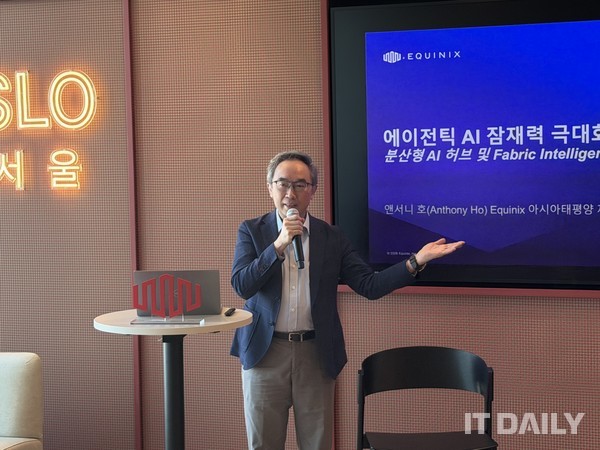
Equinix held a media briefing at its Yeouido, Seoul office building on the 15th and emphasized these points. The briefing was organized to introduce changes in network infrastructure driven by the spread of AI workloads, Equinix Fabric-based AI connectivity strategy, and the direction for infrastructure expansion in the AI inference era.
At the media briefing at Equinix's Yeouido, Seoul office building that day, Anthony Ho, Equinix Asia Pacific product management director, delivered the presentation.
Equinix said it expects traffic burdens on existing networks to increase as AI spreads, and judged that the current human-centered operating model for enterprise networks could create multiple issues as agentic AI expands. As supporting evidence, Omdia projected that global new AI network traffic will grow at an average annual rate of 85% over the next 10 years, while network traffic growth related to the distribution of high-capacity AI content such as extended reality (XR) was projected at 151%.
Accordingly, Equinix cited the following challenges that need to be addressed in existing network operations: human-centered operations reliant on tickets, scripts, and experts; global service rollouts that take a long time to connect services and establish security; network infrastructure that makes it difficult to support the growth of agentic AI; and delays in detection and response caused by fragmented telemetry.
Anthony Ho, Equinix Asia Pacific product management director, explained that in the current wave of AI expansion, the importance of AI infrastructure supporting AI is increasing beyond individual GPUs or models. He said that as AI becomes more widespread, the importance of how AI is connected is also growing.
In response, Equinix proposed a distributed AI hub as its strategy. It described the distributed AI hub as a framework-like structure that encompasses private and public data, open and closed models, and the AI partner ecosystem.
As a real-world example of this strategy, Equinix introduced the 'AI Discovery Hub' at its HK6 data center in Hong Kong. It said the 'AI Discovery Hub' includes participants such as HPE, NVIDIA, Dell, and Schneider Electric, and has been built as an environment that helps companies test and validate applications before deploying AI at scale.
Equinix highlighted 'Equinix Fabric Intelligence' as a way to shift network operations to an AI-based model. The components of 'Equinix Fabric Intelligence' were presented as the 'Fabric Super Agent,' the 'Model Context Protocol (MCP) server,' the 'Fabric Application Connector,' and 'Fabric Insights.' The service was introduced as a configuration for turning network operations into an AI-centric system.
Among them, the 'Fabric Super Agent' supports natural language-based network setup. Users can make configurations through inputs such as 'I want to connect Seoul and New York,' and can also check in natural language whether a cloud provider is present in a specific New York data center and how much the connection will cost. Through this, the deployment period was said to be reduced from weeks to minutes.
The MCP server supports discovery, requests, and execution of Equinix Fabric network functions through a company's existing AI agents. Equinix provides network functions through the MCP server. As a result, customers can perform network provisioning using existing AI tools.
Ho said the effects of Fabric Intelligence include faster network deployment, simplification, accelerated AI adoption, and resolving problems before they occur. He explained that the value delivered through Fabric Intelligence is an AI network aligned with AI speed.
Equinix also introduced its cooperation with FuriosaAI on the day. The photo showed Equinix Korea country manager Jang Hye-duk and FuriosaAI product manager Yoon Ji-hoon.
FuriosaAI is currently deploying its servers in Equinix's Europe data centers and is conducting proof-of-concept (PoC) projects for local customers. FuriosaAI began mass production this year of its second-generation AI semiconductors for data centers and is expanding its business direction into Europe and other regions. As demand for local product validation grows, the need for local infrastructure is also increasing.
Yoon Ji-hoon, FuriosaAI product manager, explained that Equinix's global data center infrastructure, connectivity services, and operational experience were decisive in the collaboration process. He said Equinix provides colocation services, interconnection, and Fabric, and has expertise in data center power efficiency and operations.
Source: IT DAILY · Yang Seung-gap
Original: https://www.itdaily.kr/news/articleView.html?idxno=241621
References
This article was produced with the help of an automated content generation algorithm.
Source: IT DAILY
View originalThis article was summarized and organized by BizCrush based on the original article from IT DAILY. For exact quotations and full details, please refer to the original article.