[Report] “Light and Smart”: StradVision Proves Its Vision AI Competitiveness With Test Drives and Data Demo
IT DAILY ·
✦ AI Summary
On the 8th, an AWS-StradVision media tour was held at StradVision's Dongtan office in Hwaseong. The event featured a large-scale driving data processing and verification demo, as well as test drives in vehicles equipped with core autonomous driving software. StradVision emphasized its response to the mass-production car market and the India and China markets with FrontVision and SurroundVision.
On the 8th, an AWS-StradVision media tour was held at StradVision's Dongtan office in Hwaseong. The event was organized to showcase StradVision's next-generation autonomous driving technology and data strategy.
The event was structured to demonstrate StradVision's autonomous driving technology and data processing capabilities on site. The program featured a large-scale driving data processing and verification data demo, presenting how massive driving information is processed and verified.
This was followed by test drives in vehicles equipped with StradVision's core autonomous driving software, allowing participants to experience real-road and parking conditions and see how the software is applied in actual driving and parking situations. StradVision's core product lineup is built around its AI-based object recognition software, "SVNet," and includes flagship solutions such as "FrontVision," which handles driving safety with a single front camera, and "SurroundVision," which uses four cameras around the vehicle to map a 360-degree environment.
FrontVision is implemented with a single front-facing camera and detects vehicles ahead, pedestrians, lane markings, and traffic signs. Based on this, it enables AEB and LKA functions. SurroundVision works by combining video from cameras mounted on all sides of the vehicle, detecting surrounding obstacles and blind spots, and calculating a safe space for movement. This supports automatic parking functions.
StradVision has secured a foothold in the mass-production car market with its solutions. StradVision software has been adopted in more than 50 global mass-produced vehicle models and in more than 5 million cumulative vehicles, and its road-environment performance verification has also been completed. SurroundVision has secured mass-production projects with global Tier 1 and OEM customers, and the company is in the final stages of development with a goal of applying it to mass-produced vehicles by the end of this year.
More recently, demand for StradVision software has been rising in large markets such as India and China. In India, legislation is being pushed to make the installation of autonomous driving and safety functions such as ADAS mandatory for new mass-produced vehicles. As a result, India's push for legislation is creating a market environment that is expanding business opportunities for StradVision.
Kwon Tae-san, COO of StradVision, said the Indian market represents a different paradigm in terms of scale. StradVision has secured more than 20 India-related mass-production projects, and it plans to wrap up development on those projects by the end of this year. It then plans to move into large-scale mass production starting in 2027.
Kwon, COO, explained that global safety regulations are tightening and that automakers have diverse hardware requirements. He said StradVision software can respond to those various hardware demands and is drawing attention as a practical alternative in global markets, including India and China.
The article included a photo of the FrontVision test drive vehicle's screen. The photo credit was Kwon Young-seok. The test drive took place on actual roads and in an outdoor parking area, and the experience was designed to help participants feel how StradVision's Vision AI technology is implemented in vehicles.
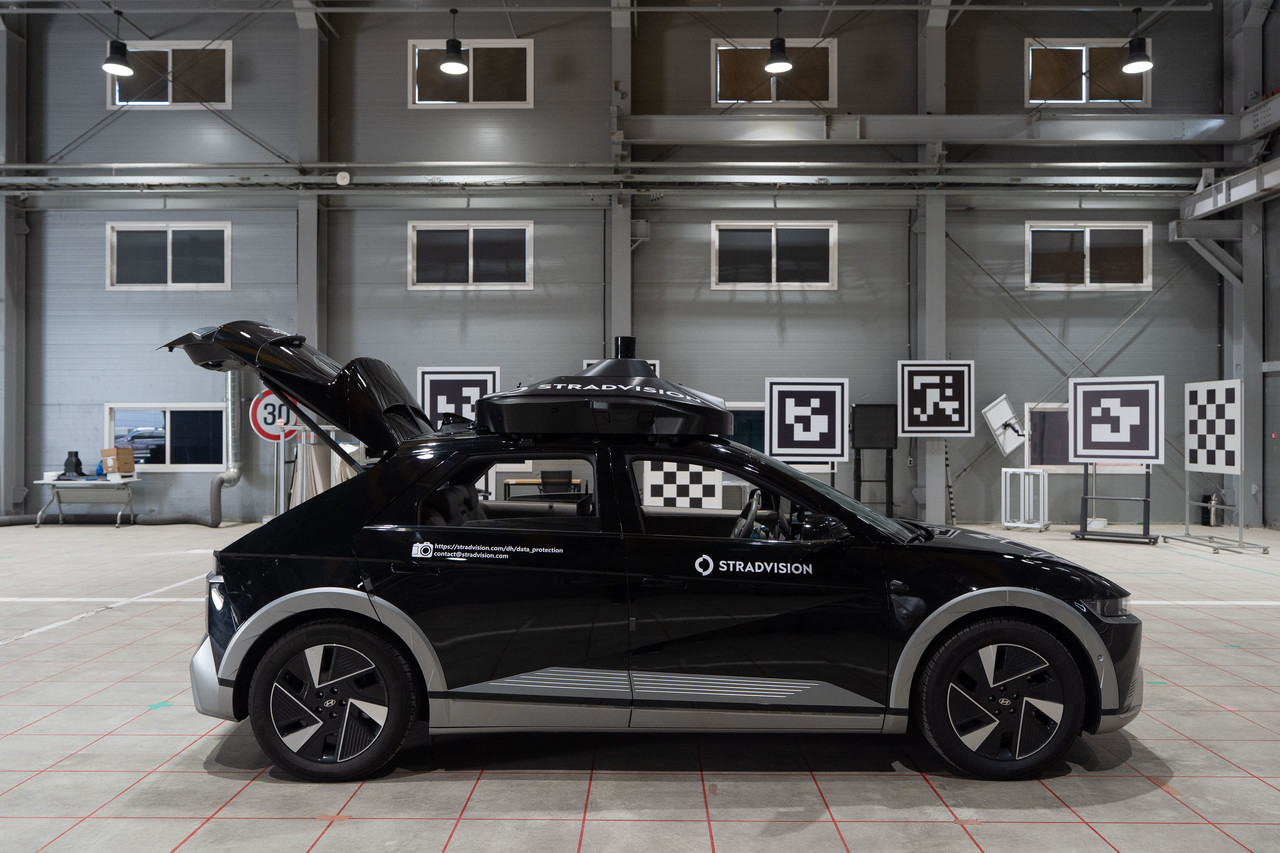
Next, participants boarded the FrontVision test drive vehicle. The FrontVision test drive vehicle was equipped with a single front-facing camera, which analyzed road conditions in real time while driving.
On the right side of the in-vehicle display, real driving footage from the front camera was shown, and AI recognized various objects such as pedestrians, preceding vehicles, lane markings, and traffic lights. Recognition was performed using bounding-box-based methods, allowing objects to be captured precisely. On the left side of the in-vehicle display, these recognition results were integrated, and the road environment around the vehicle was reconstructed in real time as digital graphics.
FrontVision technology is drawing strong interest in the Indian market. India's road environment mixes regular vehicles with motorcycles and livestock such as cows and dogs. This leads to sudden situations caused by unexpected appearances of livestock and other animals, and accidents are frequent.
The Indian government is pushing legislation to make ADAS installation mandatory in new mass-produced vehicles in order to reduce accidents. As a result, safety software such as FrontVision, along with object identification and collision-avoidance functions, is drawing attention. The photo caption refers to the SurroundVision test drive vehicle screen, and the photo credit is Kwon Young-seok.
The test drive also included SurroundVision, and autonomous searching for an empty parking space was demonstrated in a complex parking environment. The vehicle was equipped with four cameras on the front, rear, left, and right sides, and the cameras provided a three-dimensional analysis of the surrounding environment to show the process of calculating Free Space, which is the open area the vehicle can enter. Parking spaces were identified based on a comprehensive assessment of parking bay lines, curbs, pillars, and clearance from adjacent vehicles, and the system completed parking smoothly.
The current primary use case for SurroundVision was presented as automatic parking assistance. It was also explained that SurroundVision can broaden its potential applications beyond parking lots and can be used for low-speed autonomous driving in stop-and-go urban congestion. In addition, it was noted that the system could help respond to vehicles making sudden lane changes in rear-side blind spots that are difficult to detect with only a front camera's field of view, as well as help prevent pedestrian collisions at intersections, suggesting that SurroundVision could expand into an all-around driving safety platform.
The background behind StradVision's stable driving performance, confirmed through the test drive, was its data processing infrastructure and verification strategy. According to the photo caption, a StradVision official presented the data strategy, and the photo was taken by Kwon Young-seok.
StradVision held a data strategy presentation and demo on the first floor of the office. At the event, the company disclosed the process of large-scale driving data processing and the completion of its AI model.
Two major challenges in developing autonomous driving vision models were identified as vast data volume and securing edge cases. The amount of video data from a single driving vehicle for 1 hour reaches about 690GB, and traditional methods have relied on manual human labeling and review.
However, the existing approach had limitations in responding to growing customer demands and global regulations. In response, StradVision built an auto-labeling pipeline for automatic cleansing and labeling of source data, and the on-site demo showed AI-based automatic classification and labeling of multiple road-video objects, along with a feedback loop that retrains the model using the auto-labeling results.
StradVision said it has achieved more than a 90% automation rate in its data pipeline and improved data-processing productivity by 7 times. It also said it is advancing edge-case supplementation through auto-labeling and Synthetic Data.
As a way to address hazardous cases that are difficult to secure on real roads, the company presented a combination of "Synthetic Data" and precise "simulation." Example scenarios for Synthetic Data generation included rare sudden appearances of large camels and cows in domestic urban areas, nighttime severe weather, and collision risks related to abrupt lane changes. The Synthetic Data method generates scenarios based on 3D assets and then uses them to train the model.
In the verification stage for the completed model, a virtual simulation environment is applied. Weather, vehicle behavior, and pedestrian movement were presented as the control factors for the simulation. Simulation verification is structured to pre-validate by repeatedly reproducing dangerous situations.
StradVision said Synthetic Data currently accounts for about 5% of its total training data. The company plans to expand the share of Synthetic Data to 30% by next year.
The photo shows StradVision's Dongtan office. The photo credit is Kwon Young-seok. What follows is a summary of the main Q&A from the media tour site that day.
In India and China, the automotive industry has recently seen automakers and Tier 1 suppliers facing intense cost-cutting pressure and supply chain risks, leading them to favor affordable low-power chips over expensive high-performance chips. In response to a question about the secret behind its performance in global markets such as India and China, the speaker pointed to this market environment.
The speaker cited chip compatibility and ultra-lightweight capabilities as the key factors behind the company's success. StradVision software has completed porting and verification on more than 30 SoCs from global semiconductor companies such as Texas Instruments (TI), Ambarella, and Samsung Electronics. StradVision also holds more than 150 U.S. patents and, it was explained, has optimization technology that both minimizes deep learning model size and maintains recognition accuracy.
He also said StradVision software is not tied to any specific chip and can run lightly and quickly on any low-power SoC that automakers want. The speaker cited compatibility and operating performance across low-power SoCs as the decisive factor in expanding orders in the India and China markets.
He said that if one looks only at responses to certain severe weather conditions such as heavy fog and torrential rain, lidar has an advantage over optical cameras. However, he said lidar sensors cost more than USD 200 per unit, have a 360-degree rotating mechanical structure, and face durability and maintenance cost issues, making it difficult to equip mass-market vehicles with lidar broadly.
He then explained that cameras are very inexpensive and easy to apply to vehicle design. He added that camera sensor performance has improved recently, and image signal processing (ISP) technology and vision deep learning algorithms have also advanced dramatically.
Based on these advances, the speaker said camera-based technology can restore rain, snow, and low-light nighttime conditions through software and can also remove noise. He said that for implementing autonomous driving Level 2 to 3 in the mass-market passenger vehicle segment, camera-based solutions are the most realistic answer in terms of performance and cost.
The company currently focuses on FrontVision for front-facing use and SurroundVision for parking as its main products. Its next step is to develop a next-generation product line called "MultiVision." MultiVision aims to support hands-off driving based on integrated processing of 8 to 11 cameras.
In the short term, the goal is to complete the first stage of MultiVision development by the first half of next year. The company then plans to begin mass-production sales efforts targeting global OEMs.
In the long term, the company plans to expand its business scope based on the lightweight algorithms and cloud data pipeline capabilities accumulated through vehicle software. The target industries for expansion are robotics, smart infrastructure, and defense. Through this, the company aims to expand into adjacent physical AI industries and, over the medium to long term, grow into a leading company in the global mobility AI ecosystem.
Source: IT DAILY · Kwon Young-seok
Original: https://www.itdaily.kr/news/articleView.html?idxno=241613
References
This article was produced with the help of an automated content generation algorithm.
Source: IT DAILY
View originalThis article was summarized and organized by BizCrush based on the original article from IT DAILY. For exact quotations and full details, please refer to the original article.