"AI's Role in Messaging Will Change" SKT Proposes Combining AI Agents With RCS
IT DAILY ·
✦ AI Summary
As AI expands its scope of work into real-world actions such as reservations and payments, the role of text messaging is also expected to broaden.
SK Telecom proposed a path in which users confirm and make the final decision through text messages before an AI agent carries out a task, along with an RCS-based approval structure.
The discussion was also covered at the GSMA RCS group face-to-face standardization meeting held at SKT Tower in Seoul from the 15th to the 18th and at the AI special session on the 17th.
As AI expands its scope of work into real-world actions such as reservations and payments, the role of text messaging is also expected to broaden.
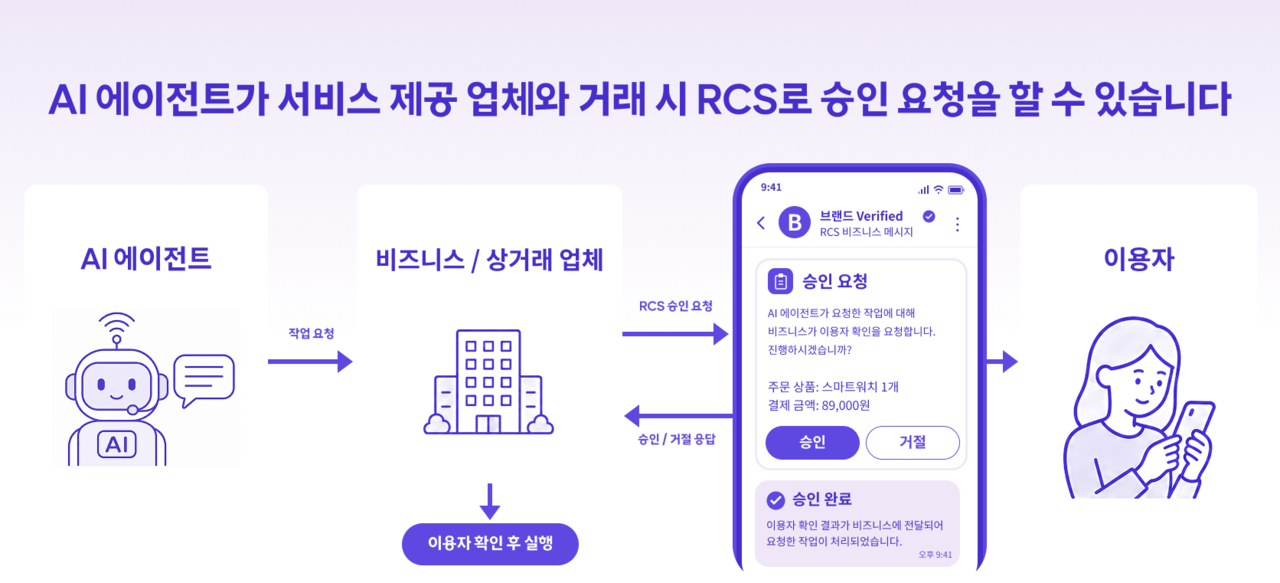
In this context, SKT is considering a path in which users confirm and make the final decision through text messages before an AI agent carries out a task. SKT also presented an AI Agent Approval structure based on RCS.
These discussions are also expected to be covered at a GSMA meeting. A face-to-face standardization meeting of the GSMA RCS group is being held from the 15th to the 18th at SKT Tower in Seoul. One agenda item is expected to be ways to combine AI and Messaging services.
RCS (Rich Communication Services) is a next-generation Messaging standard that offers a range of features, including photo and video sharing, in the default messaging app on smartphones.
The GSMA RCS group is a GSMA-affiliated council that discusses RCS technical standards and service specifications. The council is composed of global telecom carriers, device manufacturers, platform providers, and business messaging providers. This meeting was hosted by SKT.
Executives from 16 companies, including global carriers such as AT&T, T-Mobile, Vodafone, and Orange, as well as Apple, Google, and Samsung Electronics, and 33 officials from the GSMA secretariat attended the meeting. The participants discussed the role of Messaging in the AI era with the 16 global companies.
In addition to the regular standardization agenda at the GSMA RCS group level, this meeting also included an AI special session. SKT proposed the AI agenda to GSMA, and the special session was held for one day on the 17th. The special session was titled "AI and the Evolution of Messaging."
Participating companies shared their technical and service experiences and discussed the Messaging functions and roles needed in the AI era. They also discussed the direction of combining RCS and AI agents, AI trust and user control, improving the process for AI-based brand registration, and AI-based spam response for business messaging.
A key issue in the discussion of the connection between AI and RCS is user control. Before a real transaction is finalized, the importance of AI agent preparation and user confirmation and approval procedures is growing.
The information users confirm includes key details such as order contents and payment amounts. Before an actual transaction, the procedure in which users directly check and approve such key information is being emphasized as important.
However, confirmation procedures within AI services can be affected by malfunctions or external manipulation. There is also the difficulty that approval methods differ by AI agent, making it hard for users to judge whether a request is legitimate.
In response, SKT proposed a standard agenda item called "AI Agent Approval over RCS." The proposal uses RCS as a separate user decision channel outside the AI service.
Using an RCS approval channel makes it possible to verify whether the company requesting approval is in fact that company. This is because only pre-registered and verified companies are allowed to display their names and logos.
The service is designed so that information can be checked and approval can be completed within the message itself. Because a product image and an "Approve" button can be included at the same time in the message, users can respond immediately without moving to a separate app. One example given was an AI agent's request to pay for a product.
Users can review the order details and payment amount in an RCS message and then approve execution. This preserves the convenience of AI delegation while creating a structure in which users make the final judgment at the transaction confirmation stage.
The result of the approval request is stored in the conversation list of the smartphone's default messaging app. The stored result can be checked again later.
SKT has accumulated strengths in connectivity and authentication, and it is pushing to combine those capabilities with AI. The goal is to build an "AI trust infrastructure." SKT operates its own RCS network and services.
SKT has continued to reflect the global standardization of functions needed in Korea. At a meeting in Seoul last May, it proposed Rich Text Formatting, a message-formatting feature, and Rich Text Formatting was reflected in Universal Profile 4.0, the RCS standard specification, earlier this year. This meeting is being held in Seoul for the second consecutive year and broadens the scope of discussion to include the combination of RCS and AI. In addition, it is seeking opportunities for technical exchange and cooperation with global carriers, manufacturers, and Messaging providers.
Yoo Kyung-sang, head of SKT AI CIC, said that as AI expands its delegated work, the importance of contact points where users directly confirm and make final decisions is increasing. He added that the company plans to push ahead with ways to develop Messaging into a trust-based channel connecting AI agents and users, and that it will flesh out standardization discussions with global partners to that end.
Source: IT DAILY · Seong Won-young
Original: https://www.itdaily.kr/news/articleView.html?idxno=241601
References
This article was produced with the help of an automated content generation algorithm.
Source: IT DAILY
View originalThis article was summarized and organized by BizCrush based on the original article from IT DAILY. For exact quotations and full details, please refer to the original article.