Apple Integrates Next-Gen Siri Across OS, Letting AI Carry Out App Actions
IT DAILY ·
✦ AI Summary
Apple announced that it will roll out next-generation Apple Intelligence and a fully revamped Siri AI across its new operating systems in stages.
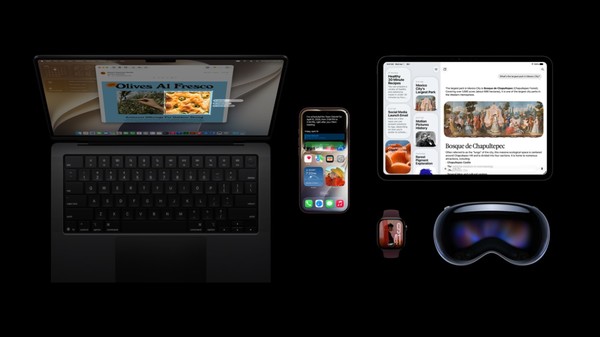
The targets are iOS 27, iPadOS 27, macOS 27, watchOS 27, visionOS 27, and tvOS 27, and the devices are Mac, iPhone, iPad, Apple Watch, and Apple Vision Pro.
The new OS includes natural language-based actions, screen and environmental awareness, personal context features, and parental controls.
Apple on the 14th announced a rollout plan to bring next-generation Apple Intelligence and a fully revamped Siri AI to its new operating systems. The rollout targets iOS 27, iPadOS 27, macOS 27, watchOS 27, visionOS 27, and tvOS 27, and will be carried out in stages. Through this, Apple is broadening the scope of AI integration with OS and applying next-generation AI across the OS.
The devices covered are Mac, iPhone, iPad, Apple Watch, and Apple Vision Pro. The new OS will include next-generation Apple Intelligence, and the next-generation AI is designed to recognize personal context and on-screen content. It also includes features that carry out necessary actions in apps.
The fully revamped Siri AI expands Siri's capabilities from information search and responses to carrying out app actions. Siri AI uses personal information from Messages, Mail, and Photos, and extracts contextually relevant information for requests. It also recognizes content displayed on the screen, responds to questions related to what is on screen, and can search for information on the web.
Siri AI also generates natural language-based automation. It is also designed to perform necessary actions across apps throughout the system. By combining next-generation AI and Siri AI in the new operating systems, Apple said it is extending AI capabilities across devices and the system as a whole.
Apple has expanded features that combine visual information and natural language across devices and apps. The iPhone Camera app now includes a 'Siri mode' that lets users check information about objects seen through the camera and carry out actions related to those objects. 'Visual Intelligence' now lets users ask Siri about objects shown on iPhone, iPad, and Mac screens. On Vision Pro, users can search based on the surrounding environment in their field of view and can also perform actions based on that environment.
Apple has also extended the flow of asking for information or carrying out tasks based on the camera, screen, and surrounding environment into natural language-based actions. Natural language-based action features have been applied to 'Shortcuts' and Safari. In the Shortcuts app, describing the desired task allows Apple Intelligence to assemble the necessary steps and generate automation. The existing Shortcuts approach required users to manually build individual task steps, and natural language-based generation and editing have now been added to Shortcuts.
In Safari, users can describe a desired function to generate custom extensions. Apple has also added alerts for restocks on specific web pages, alerts for price drops on specific web pages, and alerts for user-specified changes. It also provides a feature that classifies open tabs by topic based on their content.
Apple is using next-generation Apple foundation models through custom development based on collaboration with Google's Gemini models, and has integrated them into Apple's OS. It has also expanded AI features based on a combination of on-device processing and 'Private Cloud Compute.'
As AI features that use personal information and screen content expand, Apple has adopted a combined on-device and server-processing structure. Regarding this, the company said that when Private Cloud Compute handles AI requests, it does not store personal data, and Apple itself cannot access that data.
Based on this structure, features that use personal context have been added to Mail, Phone, and Calendar. When making a business call, the Phone app searches for related information such as verification codes and reservation numbers and displays them in the app, and when entering event details in Calendar, it identifies contacts and locations to create or modify an event. Smart replies for Mail and Messages have also been introduced, and those smart replies reflect the user's writing style.
Apple is adding 'spatial frame reset' and 'expand' features to the Photos app in the new OS. 'Spatial frame reset' adjusts the viewpoint after shooting, while 'expand' is an image-generation-based screen expansion feature. The 'Cleanup' feature has also been improved to help remove unwanted elements.
'Image Playground' supports generating realistic images similar to photos. Apple also plans to support the SynthID standard. The purpose is to identify images generated and edited with Apple Intelligence.
Siri AI will be available on iPhone, iPad, Mac, Apple Watch, and Vision Pro. It is currently available as an English beta version. Korean, French, Japanese, Portuguese, and Spanish will be added sequentially starting in October.
The new OS also adds parental controls. Parents can manage whether their children use apps and websites and whether they communicate with new contacts. For images and videos, a feature that detects and blocks graphic violence content will be applied. The Screen Time feature lets users set the total daily usage time for apps such as games and social media.
Source: IT DAILY · Kim Byeong-ju
Original: https://www.itdaily.kr/news/articleView.html?idxno=241606
References
This article was produced with the help of an automated content generation algorithm.
Source: IT DAILY
View originalThis article was summarized and organized by BizCrush based on the original article from IT DAILY. For exact quotations and full details, please refer to the original article.