Confort Lab Teams Up With Daquest and UNi on Factory AX Platform 'ARLO'
TECHWORLD ·
✦ AI Summary
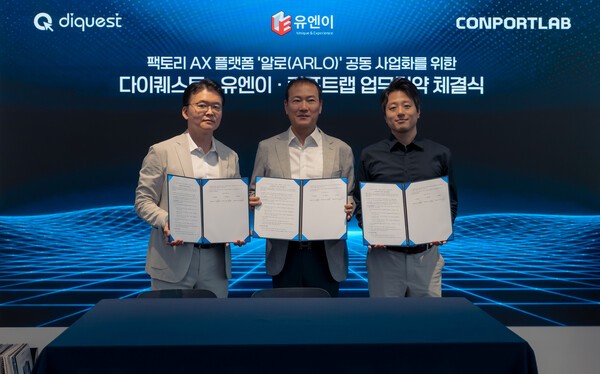
Confort Lab signed a three-way MOU with Daquest and UNi for the joint commercialization of the factory AX platform "ARLO."
Confort Lab will supply its manufacturing AI OS, "PORTA," based on ARLO, while Daquest will handle the language model and RAG-based anomaly cause analysis and question-answering, and UNi will provide 3D digital twin and spatial information capabilities.
The three companies plan to verify platform integration and business viability through a pilot project within this year, then begin full-scale deployment from 2027.
Confort Lab announced that it has signed a three-way MOU with Daquest and UNi for the joint commercialization of the factory AX platform "ARLO." Under the agreement, the three companies will push forward the joint commercialization of ARLO, while Confort Lab will supply its manufacturing AI OS, "PORTA," based on ARLO.
According to Confort Lab, PORTA is provided in OS form and offers a standard environment for on-site equipment connectivity, data modeling, operational management functions, and AI agent execution. It is positioned as an alternative to building new AI systems for each factory, instead installing a standardized OS and adding only the functions needed.
PORTA consists of on-site equipment connectivity, data storage, modeling, equipment, quality, production and energy operational management functions, and an AI agent execution environment, all integrated into a single no-code environment. Confort Lab emphasized that this no-code environment allows staff who understand the site to configure the system directly without developers.
The setup was presented as a structure in which Confort Lab handles ARLO OT data collection supply and the ARLO OS layer, while Daquest and UNi's functions are integrated on top of that foundation. Daquest is part of the Saltlux Group, which has a track record of developing its own large language models. Daquest will be responsible for providing the language model and delivering RAG-based anomaly cause analysis and question-answering technology.
UNi will provide 3D digital twin capabilities based on factory drawings and spatial information-based monitoring and control functions. Accordingly, Daquest's AI analysis and question-answering functions and UNi's digital twin and spatial information capabilities will be combined on top of the Confort Lab foundation. Confort Lab said it plans to improve the completeness of the AI layer by teaming up with partners that have group-level language model capabilities.
The three companies will launch a pilot project within this year. The pilot is intended to verify platform integration and business viability. Based on the results, the three companies plan to begin full-scale deployment from 2027.
The three companies also plan to jointly participate in government and local government support programs related to manufacturing AX, pursue joint sales based on pilot references, and move ahead in earnest with business expansion. Confort Lab said it sees the agreement as part of a shift in its product supply structure.
Kim Ki-joong, CEO of Confort Lab, said the success or failure of AI in manufacturing sites depends more on building the AI work environment than on model performance. He explained that equipment data must be linked with product and action histories, work instructions must also be recorded in the system, and only under such conditions can AI narrow down the scope of a root cause. He added that Confort Lab plans to expand manufacturing AX supply by handling the foundation and letting partners add their own strengths.
Source: TECHWORLD · Lee Gwang-jae
Original: https://www.epnc.co.kr/news/articleView.html?idxno=406919
References
This article was produced with the help of an automated content generation algorithm.
Source: TECHWORLD
View originalThis article was summarized and organized by BizCrush based on the original article from TECHWORLD. For exact quotations and full details, please refer to the original article.