Yoorak Launches
TECHWORLD ·
✦ AI Summary
Yoorak announced the launch of DFAS Arc, an AI-based automated data classification solution.
Its target market is N2SF, and Yoorak plans to expand its position in data management on that basis.
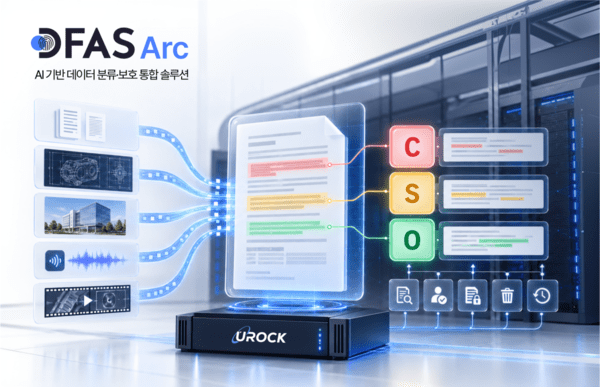
DFAS Arc analyzes data meaning and context with AI to automatically classify it into CSO grades, while managing follow-up security measures such as encryption and deletion, as well as audit trails.
Yoorak announced on the 15th the launch of DFAS Arc, an AI-based automated data classification solution. Its target market is the National Security Framework for Network Security, or N2SF. After entering the N2SF market, Yoorak says it plans to expand its presence in data management on that basis.
DFAS Arc is a solution that provides integrated support across the entire data management process. It analyzes the meaning and context of data using AI and automatically classifies it into CSO (confidential, sensitive, public) grades. Key functions include automated CSO classification based on laws and regulations, as well as integrated analysis of structured and unstructured data.
DFAS Arc also automates follow-up security measures such as grade-specific encryption and deletion, while managing the basis for decisions and approval and processing histories. Its support scope includes decision grounds, approval history, encryption, deletion and audit logs. It also supports integration with existing security solutions such as DLP and DRM, as well as closed-network and on-premises environments.
The system is designed to perform document classification based on semantic interpretation rather than simple search, and to present grade classifications grounded in relevant legal provisions and internal regulations. Through this approach, it speeds up mass data classification for staff and, after human review and final grade approval, reduces variations in judgment and the possibility of misclassification.
It can then analyze unstructured data beyond documents, including design drawings, images, video and audio. By analyzing design drawings and technical image information, it determines whether something is industrial secret material, and it confirms what was said by converting speech in meeting recordings and videos into text. It also analyzes images and drawings embedded in documents individually to identify the location of sensitive information, then encrypts confidential and sensitive materials by grade after classification. Data whose retention period has expired, or that is unnecessary, is deleted in an irrecoverable manner after an approval process by the person in charge.
The entire process, from classification to action, is recorded in an audit trail. Audit records are retained for 5 years by default, and when needed, they can be used as supporting materials for N2SF security review, internal audits and compliance responses.
DFAS Arc is offered as an on-premises solution and as a portable version equipped with a lightweight AI model. Yoorak plans to first expand DFAS Arc to the public sector.
Yoorak plans to later expand the scope of application to manufacturing companies that hold national core technologies and industrial secrets, as well as to the financial and healthcare sectors. It also plans to supply it in API and module form to organizations operating their own systems and to security companies, with the aim of expanding integration with existing security products such as DLP, DRM and document management systems. In the long term, it is also pursuing entry into overseas public-sector markets with strong demand for closed-network AI, as well as overseas defense markets.
Yoo Bong-seok, CEO of Yoorak, said the company applied closed-network AI, integrity and traceability technologies accumulated in digital forensics to the data classification sector. He also said the company differentiated the solution so that classification results, decision grounds and follow-up security measures can be managed in an integrated way. He added that Yoorak plans to start with the public-sector N2SF transition market and expand into fields that manage critical information such as industrial secrets and personal information, while aiming to establish itself as a standard classification engine for data-centric security environments.
Source: TECHWORLD · Kim Hye-jin
Original: https://www.epnc.co.kr/news/articleView.html?idxno=406932
References
This article was produced with the help of an automated content generation algorithm.
Source: TECHWORLD
View originalThis article was summarized and organized by BizCrush based on the original article from TECHWORLD. For exact quotations and full details, please refer to the original article.