Google Retrains Computer Vision With Reward-Based Criteria
AI TIMES ·
✦ AI Summary
According to AI TIMES, Google proposed, through U.S. Patent No. 12731392, a method for retraining computer vision models so they are not tra…
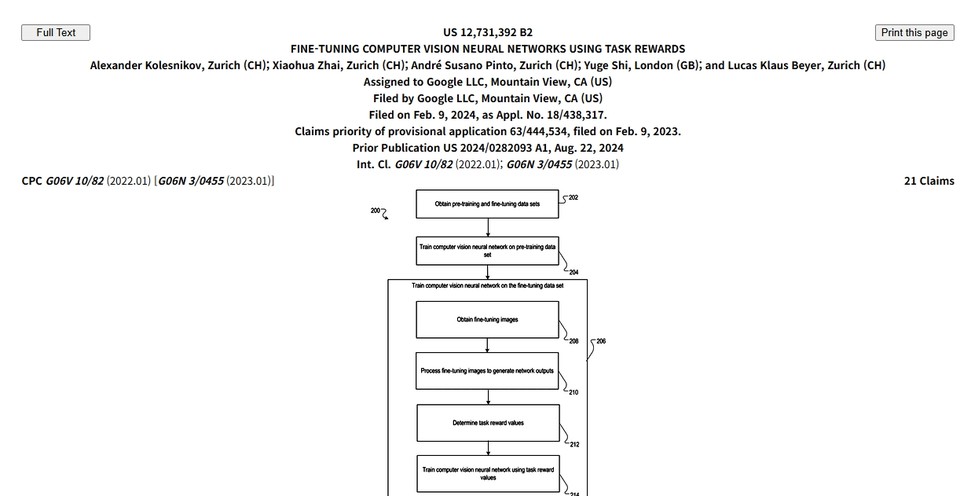
According to AI TIMES, Google proposed, through U.S. Patent No. 12731392, a method for retraining computer vision models so they are not trained only to match ground-truth data but are instead rewarded for actual work performance. The patent, introduced on September 14, focuses on fine-tuning after pretraining with reinforcement learning so that the model directly targets evaluation criteria that matter in the field. The key idea is that accurately mimicking labels in training data and performing well in real-world environments can be different things. Accordingly, it opens a path to linking training with criteria that better reflect on-the-ground performance across tasks such as object detection, image segmentation, and colorization. In particular, it notes that a reward function does not have to be differentiable, arguing that human judgments or composite performance assessments can also be pulled into training objectives. The article interprets this as a sign that the alignment trend in generative AI is spreading to computer vision and physical AI, and says that in the future, competitiveness may depend less on the size of the model itself than on how well goals are designed as rewards.
Perspective
The significance of this issue is that the competitive axis of vision AI is shifting from accuracy-centered to goal-achievement-centered. In that case, technical advantage is likely to be determined not only by the ability to accumulate more ground-truth data, but also by how well failure costs and success criteria in the field are reflected in the learning structure. In the end, the boundaries between model development, evaluation, and deployment are becoming tighter, and the trend appears to favor those who better understand real operating environments.
This perspective is BizCrush's own commentary and is not part of the reporting by AI TIMES.
This article was produced with the help of an automated content generation algorithm.
Source: AI TIMES
View originalThis article was summarized and organized by BizCrush based on the original article from AI TIMES. For exact quotations and full details, please refer to the original article.