Hankom Unveils AI Workforce Platform ‘Nomadian,’ Targets U.S. Startup Market
IT DAILY ·
✦ AI Summary
Hankul and Computer Co. unveiled the AI workforce platform 'Nomadian' on the 14th and began targeting the U.S. startup market.
Nomadian is a SaaS platform used on the web without separate installation, and Hancom plans to release a beta version in the U.S. in December and launch an official subscription service next year.
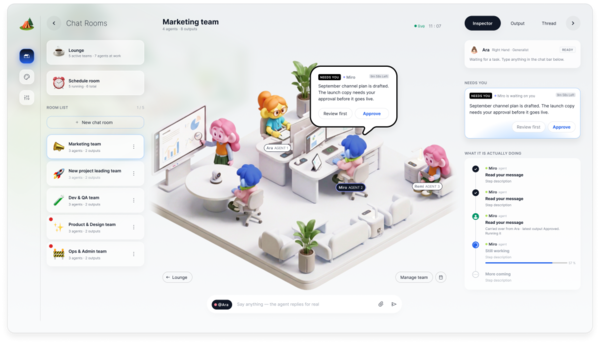
Nomadian features job-based AI teams, a 3D office and the user's final approval rights, and it stops just before irreversible tasks such as sending emails and e-signatures to request user approval.
Hankul and Computer Co. unveiled the AI workforce platform 'Nomadian' on the 14th and began targeting the U.S. startup market. Hancom presented it as a platform that configures AI agents like employees and divides real work among them. To that end, Hancom has formed a dedicated TFT and is carrying out the 'Nomadian Project.'
Nomadian is a web-based SaaS platform that requires no separate installation and can be used on the web. Hancom plans to release a beta version in the U.S. in December and has drawn up a business plan to launch an official subscription service next year.
Nomadian was designed around three core features. The three main planning features are job-based AI teams, a 3D office where work processes are visible, and the user's final approval rights.
The platform is structured to manage the work processes of multiple AI agents in a 3D virtual workspace. In addition, the user retains final approval rights.
Nomadian allows users to hire AI employees. Available roles include data analyst, content marketer and email marketer. When a user selects a role, the relevant work tools are connected at the same time. If there is no agent for the desired role, the user can create and assign one directly. When the user gives a one-line instruction, Nomadian breaks it down into tasks and distributes them to each AI team member.
The workspace for AI employees is a 3D virtual office called a 'room.' Hancom said AI employees move around in character form. In the room, users can check who is in charge, what tools are being used, the scope of work in progress and who the output will be delivered to. Brand guidelines and work rules are also stored in the room. By saving brand guidelines and work rules, repeated instructions are unnecessary. As an example, the owner of an online shopping mall could hand over promotional content and restocking-notice email tasks to the AI team at 11 p.m. and leave work.
Nomadian applies a safeguard that leaves final approval to the user. The tasks covered include irreversible actions such as sending emails and e-signatures. In such cases, the AI employee stops just before the action and requests the user's approval. As a result, the user can review the draft the next morning and simply approve it.
Nomadian is being developed on Hancom's agentic OS, which coordinates and controls multiple agents based on technologies accumulated over 36 years in the document software field and commercialized AI agents. Hancom is evolving its commercialized AI agents into an agentic OS for coordinating and controlling multiple agents. The company said Nomadian is the first AI workforce platform to bundle agents for producing output such as documents, spreadsheets and presentation materials into a team and implement them in a 3D space.
Hancom said it designed Nomadian for the U.S. market and confirmed demand for AI agents in the U.S. The company cited U.S. Census Bureau data showing that there are 30.4 million nonemployer businesses operating without employees, and that their annual sales reach USD 1.8 trillion. It also said that in a January-February 2026 survey of companies participating in Goldman Sachs' '10,000 Small Businesses' program, 76% of small-business owners said they use AI, but only 14% said they use AI for core tasks. In the same survey, 48% said it was difficult to choose the right tools, and 49% said they lacked technical staff.
Hancom believes that while tools are currently being used in the market, they are insufficient to complete the full work process. The company said what this market needs is not additional tools, but people who can connect multiple work tools and finish the job.
Hancom is discussing market-entry and commercialization plans with local companies in the U.S. under the Nomadian banner. It also plans to incorporate pricing models, distribution channels and local regulatory requirements after validating the product during the beta period.
Hancom plans to expand its business to Korea and Europe after the U.S. launch. Kim Yeon-soo, CEO of Hancom, said there are more than 30 million businesses in the U.S. operating without employees, and that Nomadian provides those businesses not with simple work tools but with AI employees and teams that can work alongside them.
Kim said Nomadian is a product based on 36 years of accumulated document source technology and the company's own agentic OS. He added that the goal is to pioneer a market where individuals quickly become companies and to set the standard for the global AI workforce market.
Source: IT DAILY · Yang Seung-gap
Original: https://www.itdaily.kr/news/articleView.html?idxno=241594
References
This article was produced with the help of an automated content generation algorithm.
Source: IT DAILY
View originalThis article was summarized and organized by BizCrush based on the original article from IT DAILY. For exact quotations and full details, please refer to the original article.