Artificial Analysis Founder: South Korea's AI Trails the U.S. and China, but It’s Not Just About Intelligence
IT DAILY ·
✦ AI Summary
George Cameron said at LG Sciencepark in Magok, Seoul, that South Korean AI models trail leading models in the U.S. and China in terms of Intelligence.
He said model competitiveness depends not only on Intelligence, but also on cost, regional and language-specific capabilities, and the ability to operate in in-house environments.
He also said South Korea's AI ecosystem has grown quickly, but a gap with the world's top models still remains.
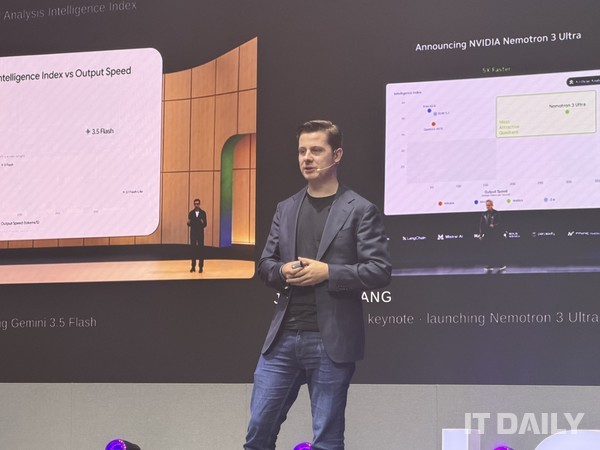
George Cameron, cofounder of Artificial Analysis, offered an assessment of the current state of South Korea's AI at the "LG AI Talk Concert 2026" hosted by LG AI Research at LG Sciencepark in Magok, Gangseo-gu, Seoul, on the 14th. He said South Korean AI models are behind leading models in the U.S. and China in terms of Intelligence.
He said, however, that model competitiveness is not determined by Intelligence alone. Speaking at the LG AI Research event, George Cameron compared the level of South Korean AI with leading models in the U.S. and China and said the criteria for judging competitiveness are not limited to Intelligence.
Artificial Analysis is a global benchmarking organization that independently evaluates AI models. Its scope includes language models and agent Intelligence, as well as image, video, voice, and music models, and hardware and inference performance.
Artificial Analysis analyzes more than 500 AI models. Major AI companies such as OpenAI, Anthropic, and Google cite its evaluation results.
Based on Artificial Analysis's comparisons of leading models by country, the cofounder said South Korea's AI growth rate was impressive. He said South Korea is currently among the top three countries globally and one of the top three countries in AI today.
The cofounder said South Korea has a robust AI ecosystem in both infrastructure and talent. He said investment in related talent has translated into South Korea's rapid AI growth, and added that he had seen the AI ecosystem in South Korea develop rapidly over the past year.
He also said that Korean AI companies, including LG, and the government's sovereign AI foundation model project have contributed to this development. He added, however, that a gap with the world's top models still remains.
The cofounder pointed out that companies do not choose models based on Intelligence alone. He explained that actual adoption decisions also take into account cost, the ability to use them in-house, region, and language-specific capabilities.
While saying that South Korea's AI ecosystem has made fast and impressive progress, the cofounder said its level of Intelligence still trails leading models in the U.S. and China. He pointed out that Intelligence is only one axis of evaluation, and that cost, local capabilities, and flexible use in in-house hardware and systems are also part of the equation.
As AI use expands, efficiency is becoming more important in model selection. According to an Artificial Analysis study, the cost of performing the same task can differ by more than 100 times depending on the model. That has led to criticism that using the highest-performing frontier model across all work is not always the rational choice.
The cofounder said that as AI moves into large-scale use, companies need to consider the trade-off between Intelligence and per-task cost. He added that options are expanding beyond the most intelligent models to include models with sufficient performance and efficiency.
In Artificial Analysis's data on Intelligence trends in AI models by country, South Korea was marked with a blue line, and South Korean AI models have shown a sharp recent rise in Intelligence, indicating a trend of catching up with the U.S. and China.
In this environment, the scope of future agent use was expected to expand. In particular, coding agents are spreading quickly in software development and are expected to expand into enterprise knowledge work in the future.
Accordingly, the number of real-world work cases handled by agents was also expected to increase. Examples of real work cases included document drafting and sending emails.
In line with this, strategic directions for South Korea's next leap forward in AI were also proposed. The core of the strategy is to pursue industry-specific specialization and general Intelligence in parallel, with manufacturing presented as an important use case for South Korea. Accordingly, it was suggested that South Korea needs to focus on important use cases such as manufacturing while also developing general model Intelligence in parallel.
The cofounder said he hopes South Korea can focus on important specific use cases without missing out on artificial general Intelligence (AGI). He also explained that the general Intelligence of language models is the foundation that makes more specific capabilities possible.
As AI development shifts toward actual task execution, there are calls for changes in model evaluation criteria as well. In a trend where AI handles tasks such as writing and sending emails, creating presentations, and analyzing data, a new benchmark could be the degree to which AI can autonomously handle corporate work.
Speaking about the direction of agent development, the cofounder said that while the existing approach has been for agents to respond to human instructions, the future approach could be one in which they continuously monitor situations and proactively carry out necessary actions. For example, if a problem occurs in a manufacturing process, the agent could detect and address it, and then report what it did afterward.
Source: IT DAILY · Yang Seung-gap
Original: https://www.itdaily.kr/news/articleView.html?idxno=241590
References
This article was produced with the help of an automated content generation algorithm.
Source: IT DAILY
View originalThis article was summarized and organized by BizCrush based on the original article from IT DAILY. For exact quotations and full details, please refer to the original article.