Hancom Launches AI Workforce Platform “Nomadian,” Targets U.S. Solo Entrepreneurs
TECHWORLD ·
✦ AI Summary
Hancom on the 14th unveiled its AI workforce platform, “Nomadian,” and outlined plans for a beta launch in the U.S. in December and a formal subscription service launch in 2027.
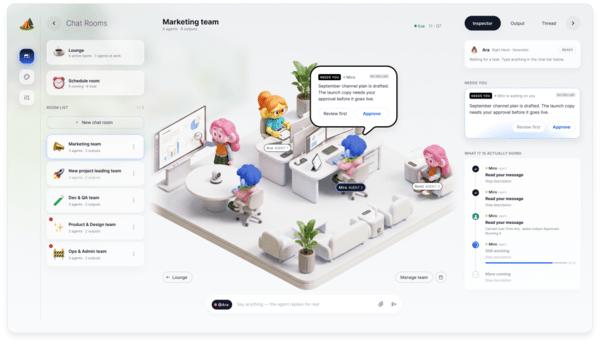
Nomadian is a web-based SaaS that organizes and operates work teams with AI agents. Users can select roles or create and deploy agents, and the platform breaks down tasks, assigns them, and lets users track progress in the 3D virtual workspace “Room.”
Hancom plans to first introduce Nomadian to the U.S. market based on its agentic OS and multi-agent collaboration features, then expand the business to Korea and Europe.
Hancom on the 14th unveiled its AI workforce platform, “Nomadian,” and laid out its launch schedule for the U.S. market. Nomadian is a platform built around the concept of organizing and operating work teams with AI agents. Hancom plans to hold a beta launch in the U.S. this December and to roll out a formal subscription service in 2027.
Nomadian is offered as a web-based SaaS with no installation required. The platform was developed on Hancom’s own agentic OS.
Users can choose roles such as data analyst, content marketer, and email marketer, and the relevant work tools are linked once a role is selected. Users can also directly create and deploy agents for the roles they need.
When a user assigns a task, Nomadian breaks it down and distributes the subdivided work to each AI agent. Each agent completes its assigned task and passes the output to the next stage. This process is managed by overseeing the work of multiple AI agents in a 3D virtual workspace, while the user retains final approval authority. Users can check progress in the 3D virtual office “Room.”
In Room, users can check the tools used by each agent, as well as the progress of tasks and the process of handing off outputs. It also includes a brand guide storage feature and a work rules storage feature, designed to reduce the need to reset repetitive tasks.
For tasks that are difficult to reverse, such as email sending and e-signature work, a user approval process is applied. To that end, the system incorporates a stop design immediately before AI agents execute tasks and proceeds only after the user gives final approval.
This control was implemented by applying Hancom’s agentic OS on top of the Nomadian foundation. The agentic OS includes multiple AI agent creation functions, multiple AI agent execution functions, role-distribution orchestration functions, permission management functions, and user approval control functions, forming an integrated control structure for orchestration, permission management, and user approval.
Hancom said it has been pushing to expand existing AI agents into a form of collaboration among multiple agents, and that it has extended document generation, table generation, and presentation material generation functions for existing AI agents into team configurations involving multiple agents. It also said it implemented this team configuration in a 3D workspace, adding that Nomadian is the first AI workforce platform to combine multiple-agent team configurations with a 3D workspace.
Hancom is conducting field verification of related technologies at companies. According to Hancom, it is currently running agentic OS PoC projects with a number of companies, including Namyang Dairy Products. It has also built an AI knowledge search system for BGF Group.
Hancom is also securing use cases in the public sector. It supplied Hancompedia and Hancom Assistant for the first phase of the National Assembly big data platform project. It applied an AI document-writing solution at Korea Western Power. It supplied Hancom Assistant, linked with Korea Hydro & Nuclear Power’s in-house generative AI platform, “HiNuri.”
Based on these field verifications and deployment results, Hancom is targeting the U.S. as the first market for Nomadian. Citing U.S. Census Bureau data, Hancom said there are 30.4 million nonemployer businesses in the U.S. It also said the annual revenue of U.S. nonemployer businesses amounts to USD 1.8 trillion.
Hancom also cited the rising share of solo founders in the U.S. According to Carta data, the share of solo founders among new U.S. startups rose from 23.7% in 2019 to 36.3% in the first half of 2025.
AI adoption is growing rapidly, but a gap remains in adoption for core business tasks. In a survey Goldman Sachs conducted earlier this year, 76% of U.S. small-business owners said they use AI, but only 14% said they use AI for core business operations.
Against this backdrop, Hancom plans to target the market with a task-sharing model among multiple AI agents. The company plans to adjust pricing based on user feedback during the U.S. beta period, and it will also adjust distribution channels and local regulatory requirements. After that, Hancom plans to expand its business to Korea and Europe.
Kim Yeon-soo, CEO of Hancom, said Nomadian is not just a simple work tool, but one that provides AI employees and teams to work alongside users. He also said Hancom has 36 years of accumulated core document technologies, and stated that the company plans to target the global AI workforce market based on its own agentic OS.
Source: TECHWORLD · Kim Seung-ki
Original: https://www.epnc.co.kr/news/articleView.html?idxno=406902
References
This article was produced with the help of an automated content generation algorithm.
Source: TECHWORLD
View originalThis article was summarized and organized by BizCrush based on the original article from TECHWORLD. For exact quotations and full details, please refer to the original article.