Thinkforbl Launches AI Reliability Hackathon, the Second Traithon
TECHWORLD ·
✦ AI Summary
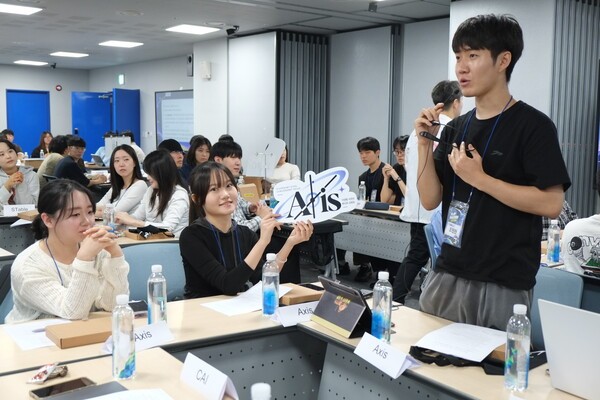
Thinkforbl and TRAIN Korea held an orientation for the AI reliability hackathon, the second Traithon, at Omnibus Park on the Songsim Campus of The Catholic University of Korea in Seoul on the 12th, kicking off the competition schedule.
A total of 149 undergraduate and graduate students from 36 universities nationwide are taking part in 37 teams, and they will develop a clickbait detection AI model using AI Hub data and the SKT AI model "A.X."
The competition will move from preliminaries and the main round to the final round and awards ceremony in December, and the top 6 teams will receive certificates, prize money, and internship opportunities linked to hiring at IT companies.
Thinkforbl has kicked off the AI reliability hackathon, the second Traithon. Thinkforbl and the Korean Network of the Trusted AI Global Network (TRAIN Korea) held an orientation on the 12th to officially launch the competition schedule. The orientation was titled "Play Traithon Festival 2026," and the venue was Omnibus Park at the Songsim Campus of The Catholic University of Korea in Seoul.
A total of 149 undergraduate and graduate students from 36 universities nationwide are taking part in 37 teams. Their majors are diverse, including computer science, software, AI, history, business, mathematics, and languages.
The competition will move from preliminaries and the main round to the final round and awards ceremony in December. Participants will work on a task to develop a clickbait detection AI model using AI Hub data and SKT AI model "A.X".
Participants will spend three months developing the AI model. They will also conduct risk analysis, human oversight, and verification of the grounds for judgment, completing the full process of ensuring reliability.
This competition will exclude model performance itself from the evaluation and focus on how service design and reliability assurance procedures are reflected in actual development and verification, rather than on finished performance. Participants must determine the service direction and analyze users, impacts, and risk factors. They must also establish a reliability assurance plan and implement and verify that plan during the actual development process. For the first time, the competition will include in its evaluation the process of securing the real operational stage of AI agent system reliability.
Accordingly, participants must design an operating structure in which AI makes autonomous judgments and actions, then hands judgments over to humans when necessary. In this process, they must set the scope of AI's autonomous judgment, define conditions for human review, and establish intervention thresholds. They must also prepare a dashboard for checking the decision-making process.
The evaluation criteria will heavily weigh the development process in addition to the level of the final output. In particular, whether teams identify gaps between expectations and actual results during development, and how they revise their judgments and designs in response, will be key evaluation criteria.
The evaluation will reflect expert preliminary assessments and peer reviews among participating teams. It will also assess not only whether outputs were shared, but also whether trial-and-error experiences and decision-making processes were shared with other teams. It will further evaluate whether such sharing with other teams led to new attempts or changes in judgment.
Competition operations have been changed to increase experience sharing and collaborative learning among teams rather than mentoring that simply provides answers. Unlike last year, when team-by-team mentor-led answer sessions were the norm, the competition has strengthened group mentoring and learning that share the experiences and judgments of multiple teams.
In the preliminary round, reliability activities such as impact assessment, risk management, transparency, and human oversight are applied. In the main round, the content applied in the preliminary round is developed into actual implementation and verification stages.
Participants record the gaps between expectations and actual results during the process. They then refine their designs based on those records.
The top 6 teams in the final round will receive certificates and prize money. The prize money reflects international standard numbers related to AI reliability, and ranges from KRW 525,900 to KRW 4.2001 million. Winning teams will also be offered internship opportunities linked to hiring at IT companies.
Thinkforbl said that it will give applicants who meet the eligibility requirements among the main-round qualifiers an opportunity to take the CTAP general-level (FL) exam, a private AI reliability expert certification. Park Ji-hwan, CEO of Thinkforbl, said that AI reliability cannot be secured simply by understanding the standards. He added that the program aims to cultivate practical AI reliability talent that can identify risks in real projects, make evidence-based judgments, and change designs when necessary.
Source: TECHWORLD · Kim Seung-gi
Original: https://www.epnc.co.kr/news/articleView.html?idxno=406901
References
This article was produced with the help of an automated content generation algorithm.
Source: TECHWORLD
View originalThis article was summarized and organized by BizCrush based on the original article from TECHWORLD. For exact quotations and full details, please refer to the original article.