Kakao Impact Foundation Holds Climate Tech Startup Summit in Jeju
TECHWORLD ·
✦ AI Summary
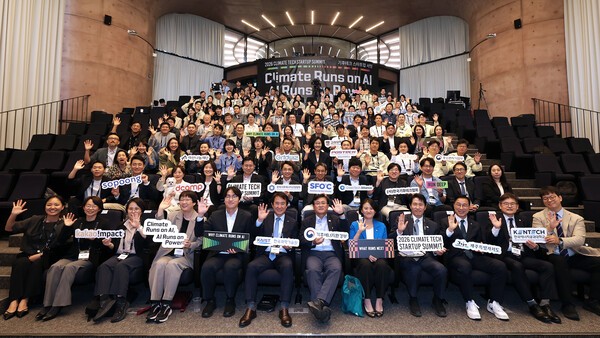
Kakao Impact Foundation, together with Sopoong Ventures, held the '2026 Climate Tech Startup Summit (CTSS)' in Jeju from the 10th to the 12th.
The summit focused on the theme 'AI Moving the Climate, Energy Moving AI,' discussing AI-driven climate response and power demand issues arising from the expansion of AI infrastructure.
The event drew more than 150 government, business, and academia participants, and 11 organizations declared the launch of 'Korea Climate Week.'
Kakao Impact Foundation announced on the 14th that it held the '2026 Climate Tech Startup Summit (CTSS)' in Jeju with Sopoong Ventures, discussing ways to connect the climate tech, AI, and energy industries. The event took place from the 10th to the 12th and was co-hosted by Kakao Impact Foundation and Sopoong Ventures.
This year's summit was themed 'AI Moving the Climate, Energy Moving AI.' The event was structured to discuss, in one place, AI-driven climate response and the power demand issues arising from the spread of AI infrastructure such as data centers.
More than 150 government, business, and academia officials attended the event. Attendees included Climate and Energy Minister Kim Sung-hwan, standing vice chairperson of the National AI Strategy Committee Ha Jung-woo, Jeju Governor Oh Young-hun, lawmaker Park Ji-hye, lawmaker Lee Hak-young, and KAIST President Bae Choong-sik.
Official partners for the summit included the Ministry of SMEs and Startups, the Ministry of Climate, Energy and Environment, the Asan Nanum Foundation, and GridWiz.
In the opening keynote on the first day, KAIST Green Growth and Sustainability graduate school associate professor Jeon Hae-won introduced changes in climate policy analysis and decision-making using AI. In a keynote later that day, Ha Jung-woo, standing vice chairperson of the National AI Strategy Committee, pointed to energy issues arising from the spread of AI. Ha cited the growing power demand of data centers and competition to secure computing resources as the gist of his remarks.
Marking the summit's 5th anniversary, 11 public, private, and academic organizations declared the launch of 'Korea Climate Week.' Korea Climate Week aims to expand cooperation centered on climate tech startups and technology. Its cooperation targets are policy, capital, companies, and research institutions.
Korea Climate Week also aims to connect the domestic climate tech ecosystem with overseas markets, and is targeting its first event in September 2027. Participating organizations include Kakao Impact Foundation, Sopoong Ventures, Asan Nanum Foundation, D.camp, and Climate Solutions. Related associations and universities and research institutions also joined the list of participating entities.
Over the 3-day event, climate tech startup pitching sessions, global case sessions, investment and capital sessions, energy transition sessions, and Climate AI sessions were held. In addition, the final pitching round and awards ceremony for the 'Climate Tech Startup Challenge' also took place. The challenge was jointly organized by the Ministry of SMEs and Startups, the Korea Institute of Startup and Entrepreneurship Development, and KAIST.
On the final day of the event, a policy session was held. Yoo Jin, senior secretary for climate, energy, and environment at the presidential office, took part in the session, which focused on reviewing policy directions for the climate tech industry and ways to expand the ecosystem.
The government side also said Minister of Climate, Energy and Environment Kim Sung-hwan would support climate tech startups so that their technological capabilities can expand to the global stage. He also expressed the ministry's intent to build the relevant foundation and fulfill its responsibilities.
On the private sector side, Kakao Impact Foundation Chairperson Ryu Seok-young said cooperation among entrepreneurs, researchers, investors, and policymakers has continued in Jeju for 5 years. He added that he hopes such cooperation will expand beyond Korea into the global climate tech ecosystem.
Separately, Kakao said it is pushing to expand the use of renewable energy with a goal of net-zero by 2040. Its Jeju office has converted all of its electricity use to renewable energy since 2022. Data Center Ansan implemented energy efficiency measures in 2025, reducing greenhouse gas emissions by about 4,753 tons annually. Kakao introduced a solar power purchase agreement (PPA) this year and applied it to Data Center Ansan.
Source: TECHWORLD · Kim Seung-gi
Original: https://www.epnc.co.kr/news/articleView.html?idxno=406895
References
This article was produced with the help of an automated content generation algorithm.
Source: TECHWORLD
View originalThis article was summarized and organized by BizCrush based on the original article from TECHWORLD. For exact quotations and full details, please refer to the original article.