Red Hat Named a Leader in the 2026 Gartner Magic Quadrant for Container Management
IT DAILY ·
✦ AI Summary
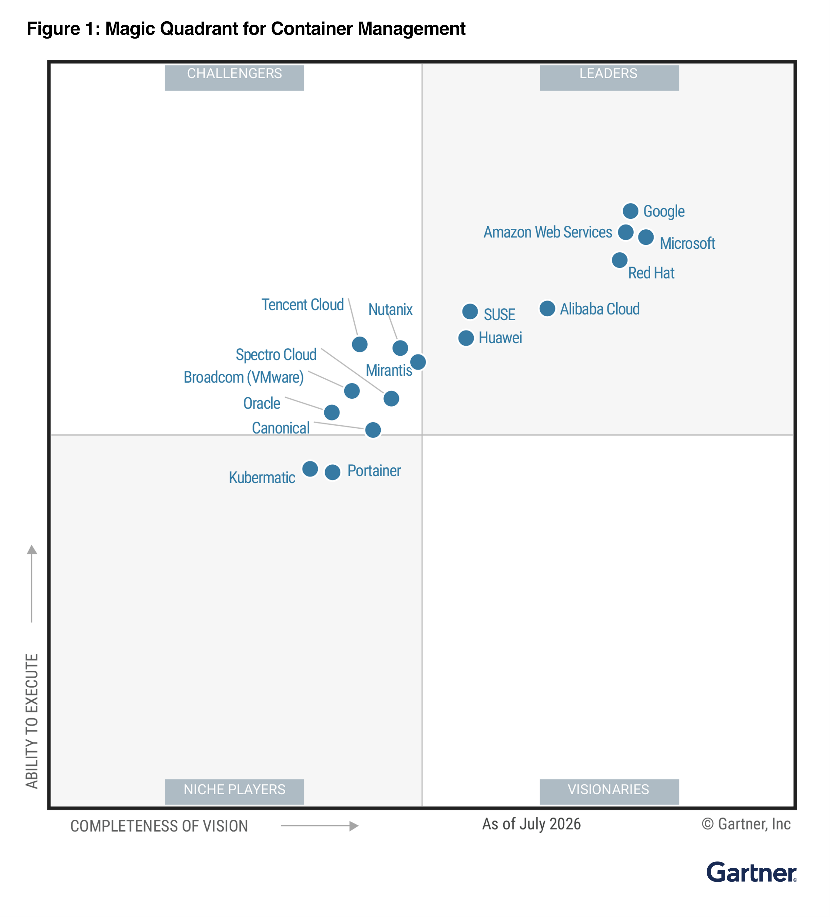
Red Hat said on the 14th that it had been named a Leader in the 2026 Gartner® Magic Quadrant for Container Management based on Red Hat OpenShift.
The recognition reflects acknowledgment of Completeness of Vision and Ability to Execute, and Red Hat has been included in the Leader quadrant for 4 consecutive years.
Red Hat OpenShift is an enterprise-grade container management platform that supports on-premises data centers, major public clouds and the edge, and it manages containers, virtual machines (VMs) and AI workloads in an integrated way.
Red Hat said on the 14th that it had been named a Leader in the 2026 Gartner® Magic Quadrant for Container Management based on Red Hat OpenShift.
The recognition reflects acknowledgment of Completeness of Vision and Ability to Execute. With this evaluation, Red Hat has been included in the Leader quadrant for 4 consecutive years.
Red Hat said the expansion of modern container infrastructure and the adoption of AI are increasing across diverse cloud environments. It said this is making it more important to build platforms with consistency, security and resilience.
The article included a photo of the 2026 Gartner Magic Quadrant for Cloud Native Application Platforms.
Red Hat OpenShift is an enterprise-grade container management platform that supports on-premises data centers, major public clouds and the edge. The platform is designed for platform engineers and operations teams, and it manages containers, virtual machines (VMs) and AI workloads in an integrated way.
The Gartner report evaluated vendors based on container management capabilities, overall strategy and cloud native execution. On that basis, Gartner cited Red Hat OpenShift's Kubernetes-based flexibility and its ability to provide a comprehensive container management ecosystem as strengths of Red Hat.
Red Hat supports consistency across both self-managed environments and fully managed cloud services. These include Red Hat OpenShift Service on AWS, Microsoft Azure Red Hat OpenShift, Red Hat OpenShift Dedicated on Google Cloud, and Red Hat OpenShift on IBM Cloud.
Red Hat continues to unveil platform-native innovations aimed at meeting changing enterprise demand, simplifying operations and accelerating AI adoption in production environments.
Against this backdrop, Red Hat OpenShift Virtualization is presented as a core feature of Red Hat OpenShift. With Red Hat OpenShift Virtualization, enterprises can run containerized applications and virtualized workloads in parallel, and they can also migrate containerized applications and virtualized workloads.
IT teams can also manage VMs and containers through a single operational pipeline. The scope spans data centers as well as public clouds such as AWS, Azure, Google Cloud, IBM Cloud and Oracle Cloud.
Mike Barrett, vice president at Red Hat, said that the industry's recurring question of why containers matter is resurfacing as a key topic this year and next year. He said that without lightweight containers combined with cloud native application patterns based on agile and DevSecOps principles, the IT industry lacks the speed needed to deploy code changes to production environments.
Red Hat OpenShift also has a track record of being named a Leader in the 2026 Gartner Magic Quadrant for Cloud Native Application Platforms.
Source: IT DAILY · Kwon Young-seok
Original: https://www.itdaily.kr/news/articleView.html?idxno=241583
References
This article was produced with the help of an automated content generation algorithm.
Source: IT DAILY
View originalThis article was summarized and organized by BizCrush based on the original article from IT DAILY. For exact quotations and full details, please refer to the original article.