[On-site] “Industrial Problems Need More Than Plausible Answers”: LG AI Research Bets on “Expert AI”
IT DAILY ·
✦ AI Summary
LG AI Research held “LG AI Talk Concert 2026” in Magok, Gangseo-gu, Seoul on the 14th and unveiled its achievements and future technology direction in developing Expert AI for manufacturing, science, and finance.
Co-head Im Woo-hyung said the company is focusing on solving complex industrial problems rather than general-purpose AI, presenting the resolution of real, difficult problems in manufacturing, science, and finance as its mission.
LG AI Research cited examples including battery life and capacity prediction, defective product screening, new drug candidate discovery, and sector-specific models such as “EXAONE Tabular,” “EXAONE Discovery,” and the financial “EXAONE BI (Business Intelligence).”
LG AI Research is pushing industrial change by putting “Expert AI” at the forefront to solve tough problems in manufacturing, science, and finance. Through its event presentation, LG AI Research made clear that it is focusing on solving real, difficult problems in manufacturing, science, and finance rather than competing on general-purpose performance.
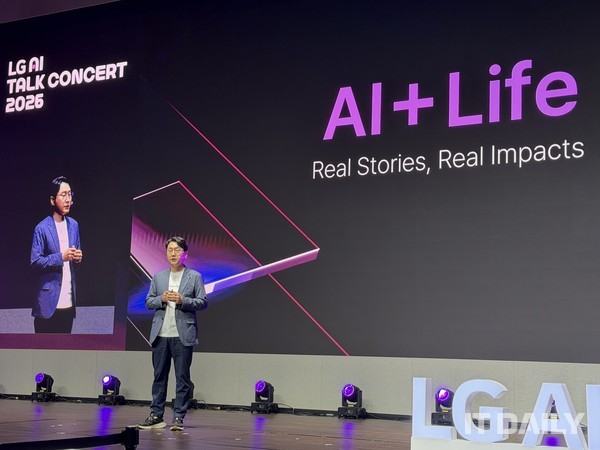
On the 14th, LG AI Research held “LG AI Talk Concert 2026” at LG Science Park in Magok, Gangseo-gu, Seoul. At the event, the company unveiled its achievements in developing Expert AI for manufacturing, science, and finance, along with its future technology direction.
At the keynote speech for “LG AI Talk Concert 2026” on the 14th, Im Woo-hyung, co-head of LG AI Research, said that while building a good AI model is important, LG AI Research’s mission is to solve difficult problems that have remained unresolved in industrial settings for a long time. The event photo was taken by Yang Seung-gab.
LG AI Research said that general question-and-answer capabilities alone are limited in addressing the complexity of industrial sites, and it has placed “Expert AI” at the center of its strategy. While general-purpose AI is strong at answering common questions, the company believes industrial settings require the ability to understand and judge multiple variables and exceptional situations.
Im said that in the field, plausible answers alone cannot meet demand, and that AI is needed that can understand and judge countless variables, including even 1% outliers.
LG AI Research was established in December 2020, and Im said the organization has solved more than 100 industrial problems since its founding. The areas cited included battery life and capacity prediction, defective product screening, optimization of product production and materials management plans, and discovery of new drug candidates.
It has also published 368 papers at top global AI conferences and filed 1,080 patents domestically and overseas.
Based on its capabilities, LG AI Research is planning to expand into AI with expertise in each industry. It is also pushing in the direction of developing AI into agentic AI that can organize problems on its own, plan solutions, and carry out actions.
In manufacturing, the company is shifting from a post-incident approach of analyzing causes and responding after problems occur to an AI-based approach that predicts anomalies and takes necessary actions. The goal is to develop AI technology that can understand and predict the data accumulated on manufacturing floors.
To that end, LG AI Research is using “EXAONE Tabular,” an AI foundation model specialized for manufacturing. “EXAONE Tabular” analyzes structured data from manufacturing sites.
The data analyzed includes temperature, pressure, process conditions, and quality inspection results. “EXAONE Tabular” examines various structured data to identify relationships and patterns among variables. Based on this, it predicts the likelihood of defects in advance and derives optimal conditions to improve quality and efficiency.
LG AI Research has unveiled its foundation model portfolio, which consists of the general-purpose EXAONE series, domain-specialized models, and the global frontier-level high-performance model “K-EXAONE.” For vision inspection applications, it presented “Omni-Inspect.” Traditional vision inspection required initial data collection whenever a new product or process was added, and model retraining was also necessary. By contrast, “Omni-Inspect” does not require separate retraining when the inspection target changes, and it can be applied using only images and prompts.
Looking ahead, the company presented a direction in which AI agents autonomously perform data sampling, autonomously carry out labeling, and autonomously train models. Through this, continuously advancing inspection models was presented as a future development direction.
Im said the manufacturing sector’s goal is to shorten decision-making time, and explained that the future of manufacturing lies in shifting from post-event response to preemptive action. He said this vision is linked to the goal of enabling faster judgment on the manufacturing floor and moving response methods from after-the-fact handling to preemptive action. The photo was provided by Yang Seung-gab.
AI use in science is focused on expanding the possibilities for discovery and shortening research time. The targets for AI use are the structuring of paper and patent text, as well as formulas, tables, images, and molecular structures, with the flow aimed at speeding research by prioritizing highly promising candidate materials.
LG AI Research announced that it is using “EXAONE Discovery” in collaboration with LG Household & Health Care. In that process, it predicted material design and synthesis outcomes, and within one day it identified promising candidates from more than 420,000 review candidates.
The material discovered through this effort is the hair-loss treatment “Lamsidil,” and the company is currently preparing to commercialize it. This achievement came from applying “EXAONE Discovery” to candidate exploration.
In addition, the research team is building a 24-hour autonomous experiment-and-learning system. In this system, the model predicts the synthesis results of new materials, robotic arms and automated equipment carry out actual experiments, and AI relearns the experiment results to design the next experiment.
Im Woo-hyung, co-head of LG AI Research, said the company is pushing to use AI in medicine to design treatment strategies for each patient and reduce the time needed for analysis and decision-making. He said patients are the ones who most urgently hope for such time savings.
Im said that the company is co-developing a cancer agent based on “EXAONE Path” with Vanderbilt University Medical Center in the United States. The cancer agent aims to design personalized treatment strategies by comprehensively analyzing tissue pathology images, genetic information, and drug response data.
Im said this is a method in which multiple AI agents divide up the roles of analysis, verification, design, and decision support. He also said that human medical experts make direct judgments at each stage and that a four-layer safety system has been built.
Im said the goal is to shorten a process that usually takes more than 4 weeks to 1 day. He explained that this is to secure the golden time for patients. The photo was taken by Yang Seung-gab.
In finance, there are cases where AI has delivered real results. One such case is the financial AI solution “EXAONE BI (Business Intelligence).” The solution’s scope includes data analysis, inference, prediction, and explanation based on a multi-agent collaborative structure.
The competitive edge of “EXAONE BI” lies in its “explainability,” which provides the reasons behind its judgments. Its explanation method takes the form of commentary at the level of a financial expert. The model applied to “EXAONE BI” is “EXAONE Forecast,” an AI foundation model that understands changes in information over time.
The service is currently being provided to global investors through London Stock Exchange Group (LSEG). For expansion in the domestic market, the company is cooperating with Koscom.
Im said the company is continuing its research with the goal of preemptively identifying future changes through AI and supporting better human decision-making. He added that finance is the field that has first proven in reality what once seemed impossible.
Im said that over the past 6 years the company has built AI’s ability to understand industrial problems, and that it is now preparing for AI’s stages of autonomous judgment and action. He described the direction of expanding AI from a stage where it understands industrial problems to a stage where it judges and acts on its own.
This direction is leading to the development of a robot foundation model capable of understanding, judging, and acting in the real world. Im said the goal is to develop robot intelligence that autonomously learns physical laws and behaviors from real-world experience without direct human instruction.
Im said that based on a robot foundation model, the company aims to move beyond automation of individual robots and toward autonomous factories where the entire factory moves as one intelligence. Accordingly, he explained that the development direction leads to implementing integrated intelligence across the factory based on robot intelligence and robot foundation models that handle the real world.
Im said LG AI Research aims to create AI that makes human work more valuable and enriches life through deeper understanding, autonomous judgment, and real-world connected intelligence. He also said the company’s policy is to connect AI’s potential to better life changes so that anyone can become an expert and experts can open new horizons.
Source: IT DAILY · Yang Seung-gab
Original: https://www.itdaily.kr/news/articleView.html?idxno=241579
References
This article was produced with the help of an automated content generation algorithm.
Source: IT DAILY
View originalThis article was summarized and organized by BizCrush based on the original article from IT DAILY. For exact quotations and full details, please refer to the original article.