Hyundai Motor Group Kicks Off 'Data Flywheel,' Unveils First Autonomous Driving L2++
TECHWORLD ·
✦ AI Summary
Hyundai Motor Group held an autonomous driving media day at 42dot's headquarters and unveiled its autonomous driving technology development strategy and mass-production roadmap.
Hyundai Motor Group said it will repeatedly use driving data for AI training, validation, and vehicle deployment centered on its Data Flywheel, while also pursuing collaboration with NVIDIA and in-house Atria AI development.
Its mass-production plan calls for Level 2+ application in the first half of 2028, Level 2++ mass-production vehicles in the second half of 2028, and Atria AI-based Level 2++ vehicle mass production in the second half of 2029.
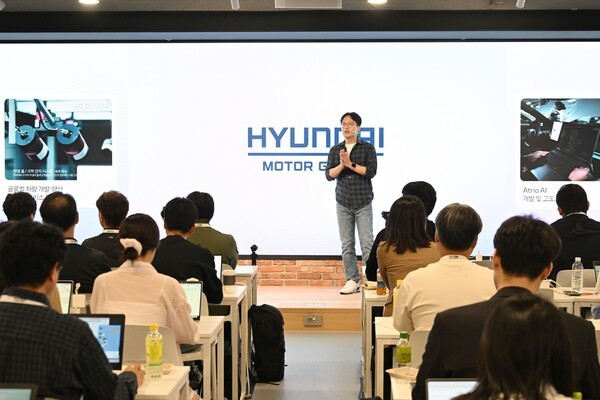
Hyundai Motor Group held the "Hyundai Motor Group Autonomous Driving Media Day" on the 11th at the headquarters of 42dot in Seongnam, Gyeonggi Province, and unveiled its autonomous driving technology development strategy and mass-production roadmap. At the event, it also unveiled autonomous driving L2++ for the first time.
Hyundai Motor Group said it will fully activate its "Data Flywheel," positioning the rapid learning and performance improvement of data as the core of autonomous driving development. The "Data Flywheel" is a structure in which real-world driving data is linked to AI training, validation, and deployment in vehicles.
The development method uses driving data collected by vehicles for AI training and validation, then reapplies the improved model to vehicles and secures new data after reapplication. Hyundai Motor Group said it is advancing autonomous driving development through this repeating structure of training, validation, application, and data acquisition.
To this end, Hyundai Motor Group said it is working with NVIDIA to accelerate the timing of autonomous driving mass production, while also advancing its own developed "Atria AI" in parallel. At the event, it also first unveiled video of an SDV testbed equipped with "Atria AI" driving through downtown Seoul without driver intervention.
Its mass-production strategy takes a two-track approach, combining external technology adoption and in-house development. On the external technology side, the company will move forward by integrating NVIDIA's in-vehicle AI computing platform, autonomous driving software, and SDV vehicle architecture. Based on this, it plans to apply Level 2+ features in the first half of 2028 and launch Level 2++ mass-production vehicles in the second half of 2028.
On the in-house technology side, Hyundai Motor and Kia's AVP Division and 42dot will jointly develop Atria AI based on E2E. The two organizations aim to launch Level 2++ vehicles based on Atria AI in the second half of 2029 by integrating their development environments, work processes, and information-sharing systems.
Data Flywheel was presented as the foundation of this two-track strategy. Hyundai Motor Group is operating more than 40 data-collection vehicles. These vehicles are used to secure edge cases in real-world road situations such as road construction zones, bad weather, abrupt lane changes, and parked vehicles on back roads.
Hyundai Motor Group is using the collected driving data for repeated AI learning in situations that are difficult to judge. In this process, it is shortening development cycles by applying Hard Example Mining to identify vulnerable situations and Continuous Training to feed the selected situations back into model training.
Situations that are difficult or dangerous to repeat on public roads are being validated in virtual environments. Hyundai Motor Group uses a method that reconstructs real driving data in three dimensions, and is reproducing various edge cases using technologies such as 3D Gaussian Splatting. In addition, its development bases in Korea and the United States are continuing development using a Follow-the-Sun approach that takes advantage of time differences.
Hyundai Motor Group is also expanding real-world road verification. By the end of the year, it plans to deploy a validation vehicle based on an SDV equipped with Atria AI in demonstrations with the Ministry of Land, Infrastructure and Transport and the integrated special city of Gwangju, Jeollanam-do, to verify Level 4 autonomous driving technology. It also plans to use data secured during the verification process for subsequent AI training and performance improvement.
42dot is developing Vision-Language-Action (VLA) models as next-generation autonomous driving technology. VLA is a model that integrates visual perception, language-based reasoning, and action generation.
The purpose of VLA is to understand a vehicle's driving situation and determine its actions. 42dot's VLA-based autonomous driving technology is currently in the simulation verification stage.
42dot is developing its existing E2E model and VLA in parallel. The company plans to launch a development process including real-vehicle testing by the end of this year or early next year.
Park Min-woo, head of Hyundai Motor and Kia's AVP Division and CEO of 42dot, said the focus of autonomous driving competition is not superiority in a specific function, but rather the ability to secure data, speed up learning, and reflect the results in products and services. He added that the essence of autonomous driving competition is a race over learning speed. He said Hyundai Motor Group plans to rapidly develop autonomous driving technology that customers can trust based on a repeating virtuous cycle of data, AI, and verification.
Source: TECHWORLD · Kim Seung-gi
Original: https://www.epnc.co.kr/news/articleView.html?idxno=406860
References
This article was produced with the help of an automated content generation algorithm.
Source: TECHWORLD
View originalThis article was summarized and organized by BizCrush based on the original article from TECHWORLD. For exact quotations and full details, please refer to the original article.