Genome AI Trained on Evolutionary Information Speeds Up Disease Variant Discovery
AI TIMES ·
✦ AI Summary
According to AI TIMES, UC Berkeley researchers on the 9th presented an AI model called "GPN-Star" in Nature that identifies disease-related…
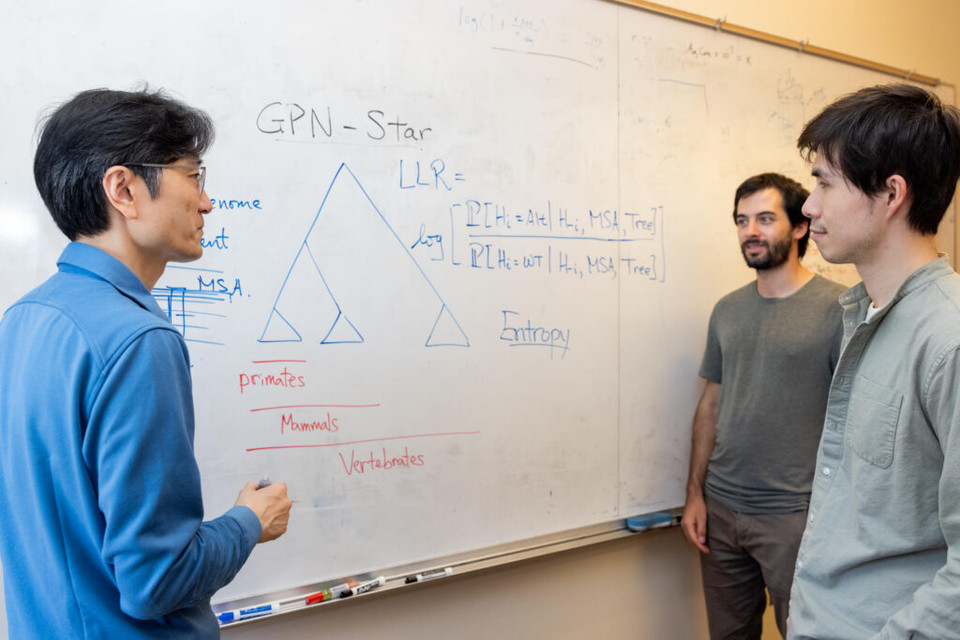
According to AI TIMES, UC Berkeley researchers on the 9th presented an AI model called "GPN-Star" in Nature that identifies disease-related variants across the human genome, including noncoding DNA. The model learns not only the patterns in about 3 billion base sequences themselves, but also evolutionary information that has been conserved or changed across species, allowing it to predict functional regions with less computation than existing large genome models. Its key feature is the use of whole-genome alignment data that maps genomes from multiple species against one another. The researchers said this improved learning efficiency and interpretability by first reflecting biological clues instead of simply letting the AI search for important regions. They also said the types of variants the model captures well differ depending on which evolutionary timescale it is trained on, and that training focused on closely related species appeared more useful for interpreting complex human traits. The researchers expect the prediction data and code, which they released together, to be used to set priorities for follow-up experiments.
Perspective
The significance of this issue is that competition in genome AI is moving away from a simple race to build larger models and toward how precisely domain knowledge is incorporated into the learning architecture. In particular, if it can pursue both performance and usability with less computation, access could expand to smaller research teams, and disease research may shift in a way that reduces the bottleneck in the early stage of selecting experimental targets.
This perspective is BizCrush's own commentary and is not part of the reporting by AI TIMES.
This article was produced with the help of an automated content generation algorithm.
Source: AI TIMES
View originalThis article was summarized and organized by BizCrush based on the original article from AI TIMES. For exact quotations and full details, please refer to the original article.