“A Leap Beyond Fast Networks”: AI Networks Emerge for Physical AI
IT DAILY ·
✦ AI Summary
The Korea Real-World AI Network 2026 (KRAIN 2026) was held in Gangnam-gu, Seoul, on the 11th. The event was organized to share the current status of AI network R&D and demonstrations, as well as the network infrastructure technologies required to implement physical AI. Samsung Electronics, SK Telecom, and KT each presented their strategies for implementing physical AI based on AI networks, including software-centric networks, AI-RAN, and participation in demonstration projects.
As an AI network for physical AI emerges as the next leap beyond fast networks, the "Korea Real-World AI Network 2026 (KRAIN 2026)" was held on the 11th in Gangnam-gu, Seoul. The event was organized to review the current status of physical AI demonstrations based on AI networks.
KRAIN 2026 was held to share the current status of AI network R&D and demonstrations, and to discuss the network infrastructure technologies required to implement physical AI. The event brought together the R&D and demonstration progress of AI networks and created a venue to share the network technology requirements needed to implement physical AI.
The event was hosted by the Ministry of Science and ICT. It was organized by the AI Network Alliance (AINA), the Physical AI Alliance, the National Information Society Agency (NIA), the Institute for Information & Communications Technology Planning & Evaluation (IITP), and the Electronics and Telecommunications Research Institute (ETRI).
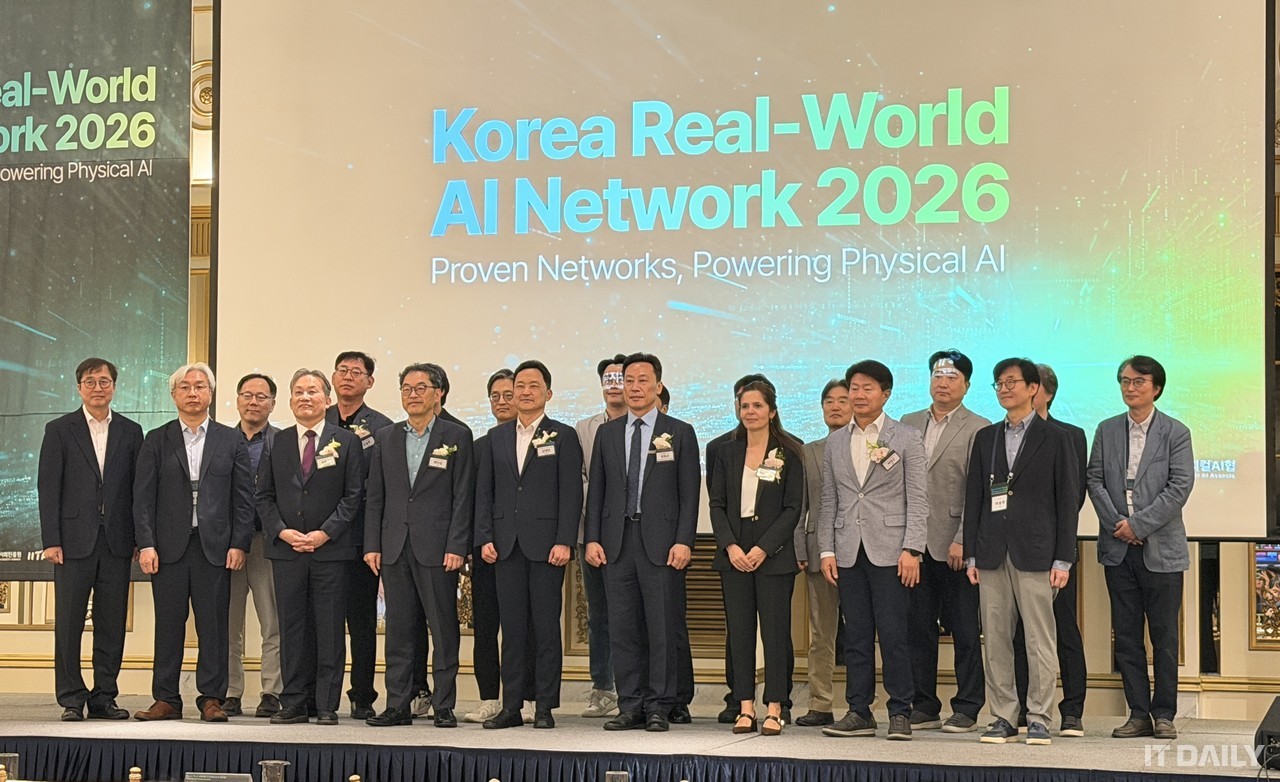
The event provided a forum for discussions on demonstrations and infrastructure connecting physical AI and AI networks, and officials from "Korea Real-World AI Network 2026 (KRAIN 2026)" posed for a commemorative photo.
A robot displayed at the SapphireStreamTechnology booth performed a Michael Jackson dance. The robot model is Booster Robotics K1 (Booster Robotics K1), and it is equipped with the Qualcomm Dragonwing QCS8550 chip. The photo was taken by reporter Seong Won-young.
Industry experts identify AI networks as core infrastructure for implementing physical AI. As AI transformation (AX) spreads worldwide, there is growing recognition that networks and operating systems are needed for AI to deliver performance and meaningful results in factories and other industrial settings.
Against this backdrop, Samsung Electronics also took part in the event. In relation to the direction of network transformation, Samsung Electronics presented the view that a software-centric structure from core to transport is important.
Samsung Electronics said an AI-optimized network structure is likely to take the form of a software-based system that connects and controls the entire network end to end. This is in line with the gist of the subtitle that Samsung Electronics' network transformation direction is 'SW-centered' from core to transport.
Lee Dong-woo, head of Samsung Electronics' Network Business Division, explained that existing networks have been built separately with hardware and software combinations by element, such as core, transport, and baseband. He then said that an AI-optimized network is suited to a software-based Universal platform.
A Universal platform is a concept that does not fix network functions to a specific hardware combination. The way to implement it is to build a common foundation based on software virtualization. The implementation scope of the Universal platform is end-to-end.
He said the scope of virtualization extends to core, wireless access network (RAN), and transport areas. He also said the ultimate goal is to implement an end-to-end software-defined network.
SK Telecom divided AI networks into two categories: 'AI for network' and 'network for AI.' 'AI for network' means applying AI to network operations.
The purpose of 'AI for network' is to improve efficiency and productivity. The core of this approach is the autonomous network. By contrast, 'network for AI' refers to the evolution direction of network equipment for AI.
As hardware and infrastructure for AI computation such as GPU have been deployed, the role of networks has expanded beyond simple connectivity to encompass AI infrastructure functions. Na Min-soo, a director at SK Telecom, explained that on-premises AI infrastructure and hyperscaler AI infrastructure are collectively referred to as 'AI-RAN.'
A key task from the telecom carrier perspective is generating revenue through AI-RAN. Telecom carriers are increasingly emphasizing the potential for monetization in AI-RAN.
As an example of this trend, SK Telecom is taking part in a demonstration project to build an 'AI-RAN-based hyper AI network.' SK Telecom serves as the consortium leader in the project and works with four infrastructure vendors: Ericsson, Samsung, Nokia, and HFR.
The collaboration approach differentiates the hardware configurations of each vendor. The goal is to derive the optimal KPI (performance indicator).
KT sees the network for robots, autonomous driving, and smart factory sensing as more than just a high-speed wireless network. KT explained that volatile AI workloads require a stability-focused deployment. Emphasizing connect, control, and compute, KT said connect means quality formation, control means establishing an automatic response system, and compute means carrying out actual AI inference. KT's plan is to secure the stability of AI workloads by combining these three elements into an integrated operating platform.
KT is taking part in the AI-RAN-based infrastructure-building demonstration project and, as the consortium leader, will divide verification targets by site. At the HD Hyundai Samho shipyard, it plans to verify AI welding and painting robots, while at KT telecommunication offices, it plans to verify AI asset inspection robots and facility inspection robots.
Source: IT DAILY · Seong Won-young
Original: https://www.itdaily.kr/news/articleView.html?idxno=241560
References
This article was produced with the help of an automated content generation algorithm.
Source: IT DAILY
View originalThis article was summarized and organized by BizCrush based on the original article from IT DAILY. For exact quotations and full details, please refer to the original article.