MoumAI: “Physical AI Expansion Requires an AI Network That Understands Robot Tasks”
TECHWORLD ·
✦ AI Summary
MoumAI said on the 11th that large-scale operation of physical AI robots requires a network that goes beyond simple communication connectivity.
Sohn Byung-hee, head of MoumAI’s Defense AI & Robotics division, presented a distributed architecture dividing functions among the Robot Edge, Edge and MEC, and Cloud at KRAIN 2026.
He said robots should request the communication and computing they need according to mission and situation, and the network should search for and connect suitable resources.
MoumAI said on the 11th that physical AI robots require a network that goes beyond simple communication connectivity in order to operate at scale in industrial settings. The company suggested that expanding physical AI will require a network capable of understanding robot tasks and situations, as well as linking AI computing resources.
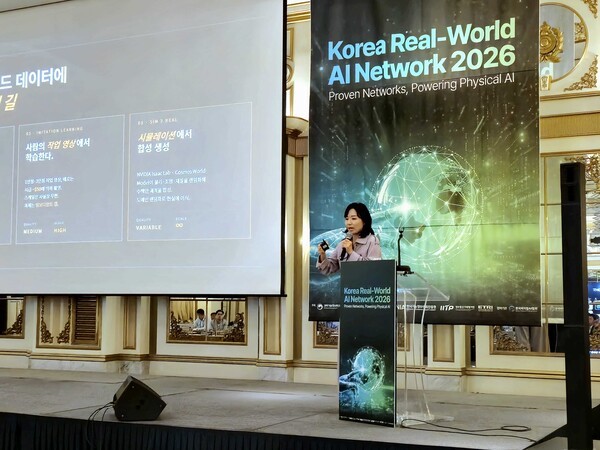
Sohn Byung-hee, head of MoumAI’s Defense AI & Robotics division, outlined the direction for a physical AI network at the event with a presentation titled “Real-Time Connected Humanoids in Industrial Environments: System Architecture, Control, and Edge-Cloud Integration” at the first Korea Real-World AI Network(KRAIN) 2026 on the 11th. In his talk, he presented the direction of a physical AI network.
Sohn explained that the network environment for physical AI robots differs from that of smartphones and IoT devices. He said this is because robots perceive their surroundings through various sensors such as cameras and LiDAR, and operate in a structure that connects AI judgments to real-world actions. He added that network latency, disruptions or shortages in computing resources directly affect mission execution and safety.
He then pointed to operating location and robot scale as variable factors in communication conditions. He said the required bandwidth and latency differ across factories, hazardous areas, campuses, and public spaces. He also explained that multiple robots cooperate by sharing spatial and situational information, and that network resource demand increases as collaboration among more robots expands.
As a response, Sohn proposed a distributed architecture for physical AI intelligence. He said the components of the distributed architecture are “Robot Edge-Edge, MEC, Cloud.”
Robot workloads are divided into on-device, Edge and MEC, and Cloud depending on immediacy, collaboration needs, and whether large-scale computation is required. Immediate judgment tasks are handled by on-device AI at the Robot Edge, such as obstacle avoidance and safety control. Real-time collaborative processing among multiple robots, shared-intelligence processing, and high-performance AI inference are handled by Edge and MEC. Large-scale AI model training, simulation, and data analysis are handled by the Cloud.
This structure allows robots to maintain basic safety and autonomy even when the network is unstable or disconnected. It also makes it possible to use external AI computing resources when computational demand rises, for the purpose of supplementing performance.
Sohn said that in the era of physical AI, networks need to provide not only Connectivity but also Computing and Context. He explained that networks must identify a robot’s location, status, and current mission, and allocate the necessary communication quality and computing resources appropriately for the situation.
During routine patrols, the core of robot operation is internal on-device AI. When complex situations arise and VLM and VLA judgments are needed, the structure can leverage nearby Edge and MEC resources.
When multiple robots collaborate, they share spatial and situational information and adjust missions in real time. More broadly, the desired structure moves away from a model in which robots directly search for and use specific servers or GPUs. Instead, robots present required latency, bandwidth, security level, and computing performance, and the network searches for and connects the appropriate resources.
This distributed structure has the effect of easing the burden of having to equip every robot with all AI models and computing resources. It is designed with power use, heat, weight, computing costs, and overall system operating efficiency in mind for environments where dozens or hundreds of robots are operated simultaneously.
Sohn said that for robot operators, simply renting a few GPUs is not enough. He said what is needed is AI computing and network infrastructure that allows robots to use the AI intelligence they need, when and where they need it.
Sohn presented Robot Edge as the location for immediate judgment in physical AI, Edge and MEC as the location for real-time collaboration and shared-intelligence processing, and Cloud as the location for large-scale training and simulation. He added that the role of the AI network is to connect these heterogeneous execution domains as if they were one intelligence.
Sohn said that in the past, robot network access was the key point. But in the era of physical AI, the key point is the network’s understanding of robot missions, he said, adding that a structure is needed in which robots request the communication and computing they need according to mission and situation, and the network searches for and provides the optimal AI resources. He added that once such a structure is built, tens or hundreds of physical AI systems will be able to collaborate in real industrial and urban spaces.
The speaker proposed a distributed intelligence structure as a condition for physical AI to scale, saying that robot reflexes should be placed on-device, real-time collaboration and shared intelligence at the Edge, and large-scale training in the Cloud, with an AI network linking on-device, Edge, and Cloud. He added that he hopes KRAIN 2026 will become a venue where the telecommunications, AI, and robotics industries discuss a new architecture for networks dedicated to physical AI.
Source: TECHWORLD · Kim Seung-gi
Original: https://www.epnc.co.kr/news/articleView.html?idxno=406852
References
This article was produced with the help of an automated content generation algorithm.
Source: TECHWORLD
View originalThis article was summarized and organized by BizCrush based on the original article from TECHWORLD. For exact quotations and full details, please refer to the original article.