Public AX Needs an AI Execution Layer for Connecting, Running, Controlling, and Monitoring AI Agents
IT DAILY ·
✦ AI Summary
It said that using AI agents in public institutions requires an execution layer that goes beyond simple question-and-answer functions and connects administrative data and internal systems to real work flows.
At the 8th AI Government Innovation Conference, IdeaTek explained that administrative data, internal rules, legacy systems, and ERP must be organically connected, and that access permissions, approval procedures, execution history, and monitoring must be managed in an integrated way.
In the survey, the main difficulties in real-world application were cited as individual implementation of API and MCP integration for each LLM, agent, and external service, inter-system connectivity, and workflow reconstruction, while error response and integrated monitoring were also identified as challenges.
Interest in generative AI and AI agents is growing among public institutions. However, AI agents need to go beyond simple question-and-answer functions, and when they are expected to carry out real work, they require access to administrative data and internal systems. There are also many challenges to solving for real-world task execution.
Public-sector operating environments bring together administrative information systems, databases, electronic approval systems, internal portals, and external public data, and each system is built differently. For this reason, using AI agents requires more than data retrieval. There is growing recognition that an execution layer is needed to connect system-specific APIs, authentication methods, user permissions, and work procedures.
Against that backdrop, the 8th AI Government Innovation Conference was held in Sejong on August 27. The theme of this year's event was, "Government innovation completed through execution and results beyond AI transformation." Officials from central government agencies, local governments, and public institutions, as well as representatives from private ICT companies, attended.
The event was a venue to share public-sector AI utilization strategies and policy directions, and to discuss ways to connect AI to actual administrative work and outcomes.
The keynote was delivered by IdeaTek, an AX iPaaS specialist that provides an AI execution platform. IdeaTek emphasized that, as a prerequisite for AI agents in administrative settings to perform meaningful work, administrative data, internal rules, legacy systems, ERP, and other work environments must be organically connected.
IdeaTek also explained that integrated management of access permissions by user and agent, approval procedures, execution history, and monitoring is necessary. It then said that an "AI execution layer" is needed beyond simple system connectivity.
The company described the "AI execution layer" as having the functions and purpose of supporting the safe use of diverse AI data and systems and underpinning the performance of actual administrative tasks. A key challenge related to this was presented as linking existing systems and data with AI agents in public AX.
According to the photo caption, the item that drew the most responses regarding the difficulty of applying AI agents to work was "individual API and MCP development for each LLM, agent, and external service."
The survey was conducted among government and public institution officials attending the 8th AI Government Innovation Conference. About 28% of respondents selected "individual implementation of integration between a large language model (LLM), agent, and external service-specific APIs and Model Context Protocol (MCP)" as the biggest difficulty in applying AI agents to real work.
Respondents also said that additional development is needed when connecting different DBs, legacy systems, and external APIs. Another major difficulty cited was the need to rebuild workflow processes that link multiple agents and systems each time.
These results show that in the use of AI agents by public institutions, connecting existing data and business systems is just as important as agent performance. They also show that it is important to build and operate a workflow framework for multi-step task execution.
Public-sector work cannot be completed by calling a single system alone; AI execution is completed through workflow connections across multiple systems. Such work proceeds through multiple consecutive steps, including retrieving required information, checking internal standards, entering data into other systems, review and approval by the person in charge, and recording the final result.
One example of this flow is an AI agent that supports business trip requests. The AI agent checks event information, retrieves internal travel policies, verifies transportation and lodging costs, checks budget standards, then drafts the business trip request form and asks for electronic approval.
In this process, the results of each step must be passed to the next system, and the prescribed order must be followed. In other words, retrieval and standard checks, document drafting, and electronic approval requests proceed step by step, with the results of prior processing moving to the next stage and the next system.
In addition, the workflow must include elements that determine the execution path based on the user's department, position, budget range, and the approval result from the person in charge. Conditional branching, approval waiting, error handling, and exception handling must also be built in.
It was pointed out that security controls and integrated monitoring are essential for task-executing AI agents.
A representative from IdeaTek explained that, unlike the simple information search and delivery stage, the actual task execution stage adds the reflection of retrieval results into internal systems, review by the person in charge, approval, and the process of generating final results. The representative also said that this process requires multi-system integration and workflow management.
The representative said that a workflow orchestration framework is needed to configure and manage the order of data, systems, and AI calls, as well as execution conditions, as a single business flow for the actual task execution of AI agents.
The representative also explained that when an AI agent queries an administrative system or carries out work, the accessible data and execution scope must be limited according to the user's affiliation, role, and work authorization.
When asked about the biggest problem if an error occurs during AI agent execution, the most common response was "hard to tell." The source of the related photo is IdeaTek.
Public institutions handle personal data and internal administrative information by nature. Accordingly, API key control is needed, authentication information control is needed, and approval-process control by the person in charge is needed. These control standards are the institution's security policy.
At the same time, rapid error response is an important operational task. When an agent performs work through multiple systems and APIs, there are many potential points of failure. These include the agent, LLM, API, authentication process, and database.
If an AI execution layer is not in place, staff must check logs for each system separately. In addition, if the responsible departments are divided, it may take extra time to identify the stage at which the problem occurred and to restore service.
According to public institution officials who took part in the survey, there are cases in which it is difficult to immediately identify the stage at which a problem occurred when a work disruption happens. They said that checking system-specific logs and searching for the responsible department are factors that delay recovery.
In AI agent operations, reducing errors alone is not enough. It is necessary to check the systems the agent called and to identify failed stages quickly. It is also necessary to integrate and review the full execution history, and to check the error status in one place. In addition, an operating environment is needed where recovery can begin from the failed task stage.
Public institutions need an AI execution layer for AI agents. An IdeaTek representative said what public institutions need goes beyond simply adding AI agents; they need to build a foundation that allows various AI agents to safely use existing administrative systems and data to perform actual work.
The IdeaTek representative explained that, for this purpose, system and data integration, workflow execution, access control, error tracking, and operational monitoring need to be managed within a single structure.
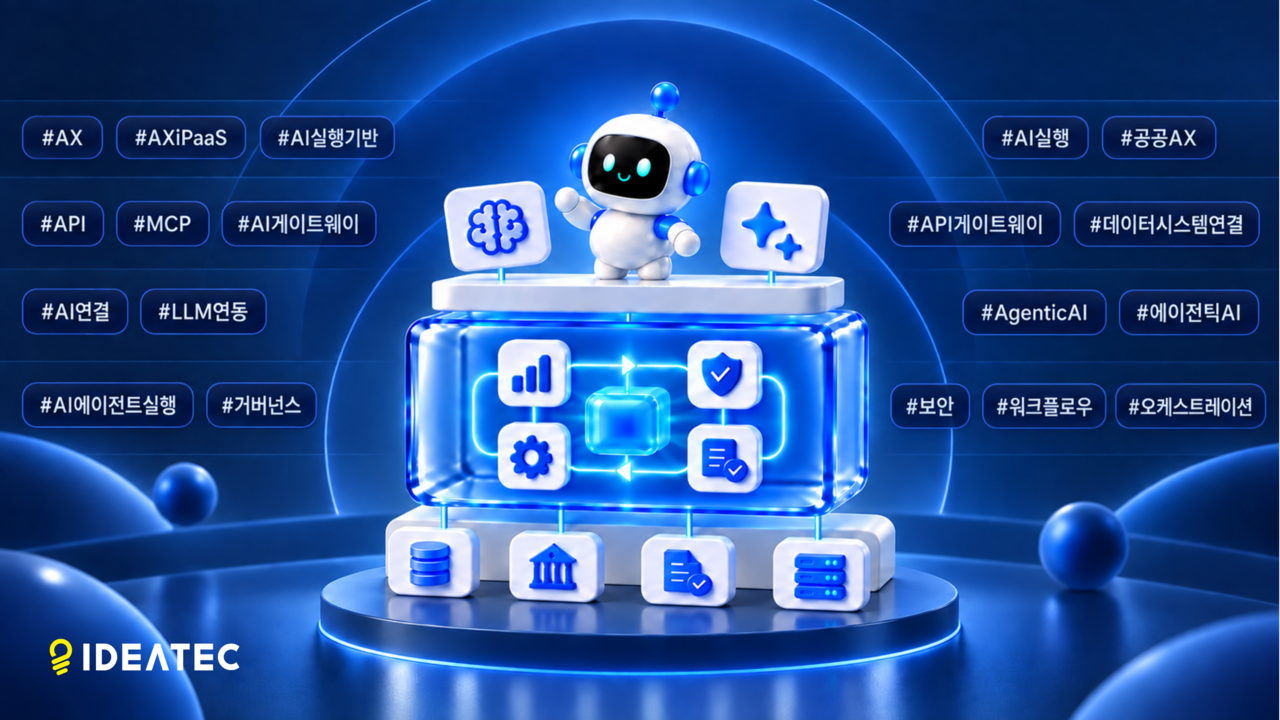
IdeaTek AX iPaaS provides an AI execution layer that connects various LLMs and agents with the existing work environment of public institutions, including data, APIs, and legacy systems.
This structure is not dependent on any specific LLM, agent, or business system. Based on this, new agents and systems can be added flexibly, and work flows spanning multiple systems can also be configured as a single workflow.
The article noted that public AX is not completed simply by introducing AI agents. To achieve results, AI agents must safely use existing administrative data and systems, and they must perform actual work according to a controlled workflow.
It said that when these conditions are met, it becomes possible to deliver results such as improved administrative efficiency and better services. It also presented AX iPaaS as an AI execution layer that supports this transformation, stressing the need to prepare an environment where real work can be carried out, not just AI adoption.
Source: IT DAILY · Seong Won-young
Original: https://www.itdaily.kr/news/articleView.html?idxno=241549
References
This article was produced with the help of an automated content generation algorithm.
Source: IT DAILY
View originalThis article was summarized and organized by BizCrush based on the original article from IT DAILY. For exact quotations and full details, please refer to the original article.