Hanwha Systems Unveils
TECHWORLD ·
✦ AI Summary
Hanwha Systems first unveiled its "space AI solution" in overseas markets on the 9th (local time) at the defense industry exhibition "MSPO 2026" in Kielce, Poland. The solution uses AI to interpret image data transmitted by satellites to ground stations and automatically perform object detection, situational pattern analysis, and anomaly detection. Hanwha Systems is pursuing a concept that links integrated EO and SAR satellite image analysis, low-Earth-orbit SAR satellites, and a space AI data center to combine satellite data collection, analysis, and utilization into a single infrastructure.
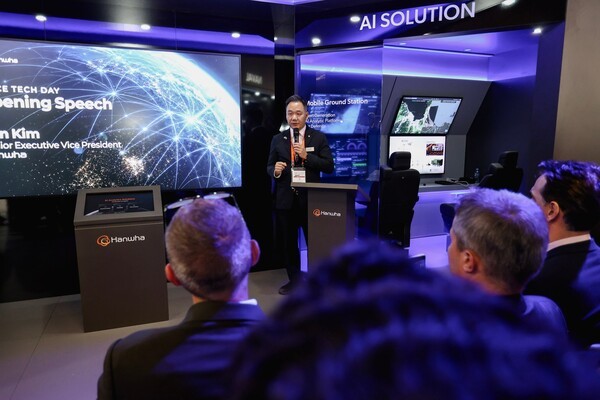
Hanwha Systems first unveiled its "space AI solution" in overseas markets on the 9th (local time) at the defense industry exhibition "MSPO 2026" in Kielce, Poland. Hanwha Systems held a launch event for the space AI solution at the event.
Hanwha Systems demonstrated the AI analysis process using imagery of Eastern Europe captured by an operational satellite. The solution is designed to have AI interpret image data transmitted by satellites to ground stations and extract key information.
The solution automatically performs object detection, situational pattern analysis, and anomaly detection. Through this, it integrates the operational flow from satellite image collection to analysis and decision-making support.
The solution extracts, in real time, the information needed for military and disaster situations through AI analysis of satellite imagery. In the military field, it can be used to track troop and equipment movements and routes of movement, and in disaster and catastrophe response, it can be used to compare building and terrain changes in specific areas to assess the scale of damage.
The analysis targets electro-optical (EO) satellite imagery and synthetic aperture radar (SAR) satellite imagery. SAR satellites are relatively less affected by weather and day-night conditions, but they also have limitations in that their black-and-white radar imagery is difficult to interpret visually.
Hanwha Systems plans to use AI to address this limitation. The company plans to design the system to identify aircraft, ships, vehicles and other objects in SAR imagery within seconds, while also improving image resolution. It will also apply a method that complements the two sensors by analyzing EO satellite imagery, which can capture high-resolution images, in parallel with EO and SAR data.
This approach can be applied to Hanwha Systems' 1m, 0.5m and 0.25m-class small SAR satellites, as well as the 0.15m-class VLEO UHR SAR satellite now under development. The system is configured to instantly analyze data collected by satellites using AI, with a focus on improving the speed at which reconnaissance information can be used.
Hanwha Systems is also pushing to link the system with ground weapon systems. The company is implementing a dedicated interface that connects the K9 self-propelled howitzer, the Chunmoo multiple launch rocket system, and the fire control system (FDC), and is working to build a framework linking satellite reconnaissance, target identification and strike-system operations.
As a future concept, the company is pursuing a single infrastructure that links low-Earth-orbit SAR satellites with a space AI data center to combine satellite data collection, AI analysis and the use of ground systems.
In connection with this, a Hanwha Systems official said the space AI solution has integrated EO and SAR satellite image analysis technology and described the technology as world-class. The official added that the value of satellite data has moved beyond simple collection and that satellite data can be converted immediately into reconnaissance and tactical information. The official also called the space AI solution a game-changer and said Hanwha Group is investing in the space sector and aims to lead the global defense and space markets by completing a proprietary "space-ground convergence infrastructure" that links low-Earth-orbit SAR satellites and a space AI data center.
Source: TECHWORLD · Kim Seung-gi
Original: https://www.epnc.co.kr/news/articleView.html?idxno=406823
References
This article was produced with the help of an automated content generation algorithm.
Source: TECHWORLD
View originalThis article was summarized and organized by BizCrush based on the original article from TECHWORLD. For exact quotations and full details, please refer to the original article.