Hyundai Motor Group, LG Energy Solution, Wonik P&E Begin ESS Pilot Using Used EV Batteries
TECHWORLD ·
✦ AI Summary
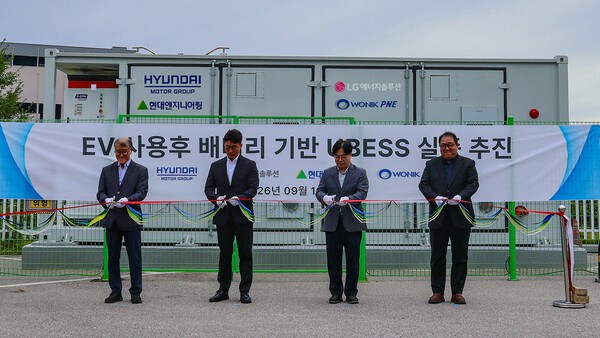
Hyundai Motor Group, LG Energy Solution, Wonik P&E, and Hyundai Motor, Kia, and Hyundai Engineering have begun a pilot project to reuse used EV batteries for ESS.
The pilot will operate a 200 kWh UBESS linked with EV fast chargers at Wonik P&E's Dongtan plant in Hwaseong, Gyeonggi Province, to verify the reusability of used batteries and the operational efficiency of charging infrastructure.
Using battery packs recovered from E-GMP vehicles, the project was presented as the first case in Korea, and participating companies will examine charge and discharge control algorithms, system safety and reliability, battery performance retention characteristics, charging service quality, and operational efficiency.
EV Used Battery-Based UBESS Pilot Cooperation,
and Hyundai Motor Company and Kia announced the start of the pilot project.
This pilot project reuses used batteries recovered from electric vehicles as energy storage systems. The system has a capacity of 200 kWh and operates as a
used battery energy storage system (UBESS),
linked with EV fast chargers. Power stored in the used batteries will be used for EV fast charging, with the goal of verifying the reusability of batteries and the operational efficiency of charging infrastructure.
The pilot uses used battery packs recovered from vehicles built on Hyundai Motor Group's EV-only platform, E-GMP. It was presented as the first case in Korea to use used batteries from E-GMP vehicles.
The project will store electricity during off-peak hours when rates are low and supply it to fast chargers during peak-rate hours. Through this structure, the goal is to confirm the potential to reduce load during periods of concentrated power demand and to verify in a real-world environment the potential to cut charging station operating costs.
The pilot will assess whether vehicle-recovered batteries can be used stably after recovery. Participating companies will examine charge and discharge control algorithms, system safety and reliability, battery performance retention characteristics, charging service quality, and operational efficiency.
The division of roles was set based on each company's technology and business experience. Hyundai Motor and Kia will verify used battery utilization technologies and develop business models. LG Energy Solution will produce the UBESS based on the battery packs it receives and support battery diagnostics as well as system performance and safety verification.
Hyundai Engineering will review the business viability in a real-world business environment based on its EV charging infrastructure operating experience and examine the potential for linkage with charging infrastructure deployment projects. Wonik P&E will be responsible for operating the pilot facility and verifying the technology, using its capabilities in EV charger manufacturing and infrastructure construction.
This pilot is a step toward fleshing out a business model for recycling used batteries outside vehicles, and the participating companies plan to assess the technological feasibility and business viability of UBESS linked with fast-charging stations. They also plan to examine the potential for expanding battery reuse and broadening the resource circulation system.
The demonstration will verify whether batteries can be used stably after being recovered from vehicles. Participating companies will check charge and discharge control algorithms, system safety and reliability, battery performance retention characteristics, charging service quality, and operating efficiency.
The division of roles was based on each company’s technologies and business experience. Hyundai Motor and Kia will verify technologies for using used batteries and develop business models. LG Energy Solution will produce UBESS based on the battery packs it receives and support battery diagnosis as well as verification of system performance and safety.
Hyundai Engineering will assess business feasibility in a real-world business environment based on its experience operating EV charging infrastructure, and will review the possibility of linking the project with charging infrastructure deployment initiatives. Wonik P&E will handle demonstration facility operations and technology verification by leveraging its capabilities in EV charger manufacturing and infrastructure construction.
This demonstration is a step toward defining a business model for recycling used batteries outside vehicles, and the participating companies plan to confirm the technical and commercial viability of UBESS linked with fast-charging stations. They also plan to review the potential for expanding battery reuse and the resource circulation system in the future.
Source: TECHWORLD · Kim Seung-gi
Original: https://www.epnc.co.kr/news/articleView.html?idxno=406809
References
This article was produced with the help of an automated content generation algorithm.
Source: TECHWORLD
View originalThis article was summarized and organized by BizCrush based on the original article from TECHWORLD. For exact quotations and full details, please refer to the original article.