Shipyard Welding Robots to Get an AI Boost as Government Verifies KT Consortium Trial Site
IT DAILY ·
✦ AI Summary
On the 10th, the Ministry of Science and ICT and NIA visited HD Hyundai Samho Shipbuilding in Yeongam County, Gwangju Metropolitan City, Jeonnam, to inspect the site of the KT consortium's "High-Performance AI Network Infrastructure Project." During the visit, they checked a physical AI demonstration site based on AI-RAN. The government also discussed ways to apply physical AI robots along with the site inspection.
The Ministry of Science and ICT inspected the site of the KT consortium's "High-Performance AI Network Infrastructure Project." The ministry also discussed how physical AI robots could be applied as part of the inspection.
The focus of the latest move was on the government directly checking the KT consortium's AI network trial site and, as an extension of that effort, examining the potential application of physical AI robots. The site inspection and discussion of application measures were carried out together.
An intelligent base station (AI-RAN) is a technology that applies AI to a radio access network (RAN). The intelligent base station (AI-RAN) aims to advance communication quality and network efficiency.
5G standalone mode (5G SA) is a 5G-only core network-based system that does not use LTE. The AI autonomous operations network can analyze network conditions in real time and predict and recover from failures. It also automatically optimizes traffic and resources.
The Ministry of Science and ICT and the National Information Society Agency (NIA) visited HD Hyundai Samho Shipbuilding in Yeongam County, Gwangju Metropolitan City, Jeonnam, on the 10th. The purpose of the visit was to check a physical AI demonstration site using AI-RAN.
The Ministry of Science and ICT and the National Information Society Agency (NIA) confirmed a physical AI demonstration based on AI-RAN at HD Hyundai Samho Shipbuilding. The visit took place as part of the broader effort to inspect the KT consortium's "High-Performance AI Network Infrastructure Project" site and discuss ways to apply physical AI robots.
The "High-Performance AI Network Infrastructure Project," led by the Ministry of Science and ICT and NIA, is being promoted to verify whether AI networks can be applied in industrial settings. The project involves the SK Telecom consortium and the KT consortium as implementing entities.
The latest site is the execution site for the KT consortium. The KT consortium is made up of KT, SOLiD, Samsung Electronics, and HD Hyundai Samho.
KT has built a high-performance AI network at HD Hyundai Samho Shipbuilding. Based on this, it plans to demonstrate physical AI technologies such as AI welding robots.
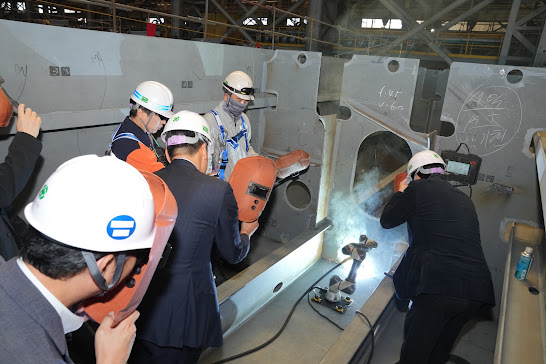
The shipyard is expected to deploy 5G standalone mode (SA), network slicing, GPU-based AI computing infrastructure, AI-RAN, and autonomous network technology. On the 10th, Ministry of Science and ICT and KT officials listened to an explanation about welding robots at HD Hyundai Samho Shipbuilding in Yeongam, Jeonnam. The photo was provided by KT.
Government officials checked the existing welding robot workflow at the inspection site. The purpose was to review how the related technology could be applied in actual work. At present, welding robot operations are semi-automated, require direct human transport, and also require human response in unexpected situations.
With AI introduced, it will become possible to automatically operate robots by analyzing real-time video and sensor data from the work process over the network. KT plans to use network slicing based on 5G SA. KT will apply a method that separates and provides the communication resources for AI welding robots from those of other services. The aim is to maintain stable communication quality for robot control even when data usage rises inside the shipyard. Network slicing is a technology that divides one physical network into multiple virtual networks for different purposes.
Under the operating plan, tasks requiring rapid judgment will be handled by the robot itself or by on-site servers, while large-scale analysis and training will be performed in data centers. The aim is to improve AI response speed and efficiency.
KT plans to use AI-RAN. It plans to jointly manage communication resources and GPU-based AI computing resources, and allocate the communication capacity and AI computing volume needed for the robots according to each work situation. This is intended to support the harmonious operation of network and AI infrastructure.
KT will also apply an autonomous network. By analyzing network traffic and quality information in real time, it plans to automatically adjust communication resources and maintain quality on its own by detecting abnormal situations such as network congestion and quality degradation.
Meanwhile, the SKT consortium is building a high-performance AI network that reflects site demands from SK Incheon Petrochem and KG Mobility. Based on this, it plans to implement a quadruped patrol robot that patrols hazardous areas inside factories, and the robot will detect dangerous situations through AI analysis. It also plans to implement an autonomous vehicle transfer service that does not require human intervention.
Source: IT DAILY · Seong Won-young
Original: https://www.itdaily.kr/news/articleView.html?idxno=241531
References
This article was produced with the help of an automated content generation algorithm.
Source: IT DAILY
View originalThis article was summarized and organized by BizCrush based on the original article from IT DAILY. For exact quotations and full details, please refer to the original article.