K-NPU Export Expansion Hinges on Building a “Full-Stack Ecosystem”
IT DAILY ·
✦ AI Summary
Experts said that to expand into the global market, domestic NPUs need to move beyond single-chip competition and build a Full-Stack system ecosystem integrating ultra-high-speed networks, storage, and system SW.
At the forum, participants said domestic NPUs have proven computational performance and power efficiency, but remain weak in the complete infrastructure competitiveness required by data centers.
The government and related agencies said they would promote a K-AI semiconductor Full-Stack brand that brings together the capabilities of NPU, DPU, storage, and system SW companies, along with large-scale Rack- and cluster-level commercial validation support programs.
To expand the global market for domestically developed neural processing units (NPUs), experts have argued that the industry must move beyond single-chip competition led by individual fabless companies. As the key to boosting NPU exports, they pointed to building a “Full-Stack” system ecosystem that integrates ultra-high-speed networks, storage, and system software.
The assessment comes as global big tech companies dominate the market not through standalone accelerators, but through Rack-scale integrated infrastructure. As overseas firms secure an edge with integrated infrastructure, the need for a domestic ecosystem shift to respond has also been raised.
There was also an assessment that Korea’s ecosystem itself needs to form a complete, all-in-one package through a one-team approach. The direction set out was to establish a framework in which multiple companies and institutions participate together to support expanded NPU exports and diversify sales channels.
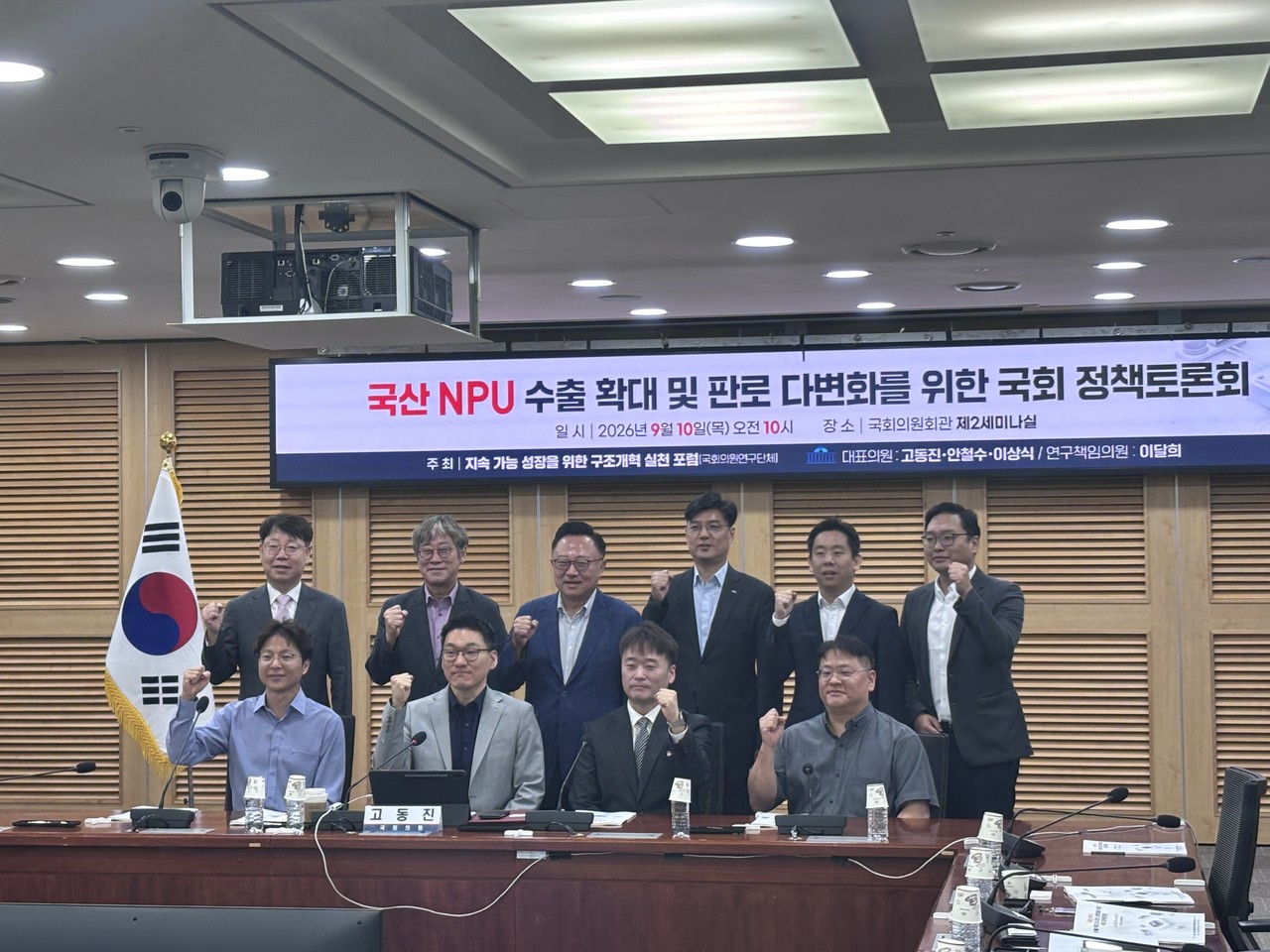
The remarks were made at a policy forum on “Expanding Exports and Diversifying Sales Channels for Domestic NPUs” held on the 10th at the National Assembly Members’ Office Building. The forum was attended by People Power Party lawmaker Koh Dong-jin, along with Rebellions, FuriosaAI, DEEPX, HyperAccel, MangoBoost, the Ministry of Science and ICT, the Ministry of Trade, Industry and Energy, and NIPA, and participants took a commemorative photo.
At the forum, participants said domestic NPUs have proven their computational performance and power efficiency across first- and second-generation products, but still fall short in terms of the “complete infrastructure” demanded by data centers. While the chip-level performance of domestic NPUs has been demonstrated, the broader competitiveness of the full infrastructure remains insufficient, they said.
The backdrop to this discussion was the rapid growth of AI models. As models grow larger, scale-out, which links dozens to hundreds of accelerators as a core infrastructure element, and optimization of inter-node communication have come to the fore, prompting criticism that Korea’s ecosystem remains overly focused on single-chip development.
Kim Jang-woo, CEO of MangoBoost, and An Gi-hyeon, executive vice president of the Korea Semiconductor Industry Association, pointed out that Nvidia is combining NVLink and DPU-based ultra-high-speed networks while dominating infrastructure such as GB200 NVL72 at the Rack level. They said in common that, given data center architecture, simply replacing existing GPUs with domestic NPUs would not be a workable response.
Accordingly, the proposal was made that horizontal alliances are needed rather than isolated efforts by individual startups. The conclusion was that NPU, DPU, storage acceleration, and system SW companies should join forces to complete an integrated system capable of demonstrating end-to-end token services.
As a solution for AI semiconductor exports, participants suggested avoiding direct competition with general-purpose big tech firms and targeting domain-specific inference markets. Kim Joo-young, CEO of HyperAccel and a professor at KAIST, proposed focusing on small and mid-sized enterprise-grade inference data centers such as LLMs tailored to local languages in the Middle East and public-sector and smart city projects in Southeast Asia, rather than ultra-large general-purpose infrastructure. He also proposed pursuing a turnkey export strategy by packaging “NPU-optimized SW-lightweight models.”
In response, the government and related agencies said they would completely shift the policy paradigm to match industry demands. Hong Sang-kyun, head of NIPA’s AI Semiconductor Division, and Lee Kang-yong, director at the Ministry of Science and ICT, said they would move beyond fragmented, small-scale PoCs and build a “K-AI semiconductor Full-Stack brand” by combining the capabilities of NPU, DPU, storage, and system SW companies. They also said they would promote support programs for large-scale Rack- and cluster-level commercial validation starting next year.
Choi Hyo-woong, director of advanced industry policy at the Ministry of Trade, Industry and Energy, said at the forum hosted by lawmaker Koh Dong-jin that the government would review expanding the adoption of domestic NPUs in industrial-complex-centered edge AIDCs and would also consider launching a dedicated export voucher.
Lawmaker Koh Dong-jin said that patriotic marketing of the “please use it because it’s domestic” variety is no longer acceptable in the market, and that even if building with domestic products takes additional time compared with Nvidia, the market needs strong cost efficiency and maturity sufficient to endure that time. He also stressed the need for proactive large-scale reference deployments by public institutions and research organizations, and said he would swiftly support the legislative and budgetary measures needed for that.
Source: IT DAILY · Kwon Young-seok
Original: https://www.itdaily.kr/news/articleView.html?idxno=241536
References
This article was produced with the help of an automated content generation algorithm.
Source: IT DAILY
View originalThis article was summarized and organized by BizCrush based on the original article from IT DAILY. For exact quotations and full details, please refer to the original article.