AI Can Sense and Interpret Human Brain Waves Without Spoken Commands or Actions
IT DAILY ·
✦ AI Summary
A joint research team from Professor Lee Sang-wan's group at KAIST and Microsoft Research Asia developed Neural Value Alignment (NVA).
Using human brain waves and EEG, NVA distinguishes whether AI behavior reflects a misunderstanding of the goal, an error in the method, or both errors at once, and corrects it in real time.
The team said the technology uses the brain's cognitive error signals as AI feedback without verbal instructions and could be applied to Physical AI and autonomous driving.
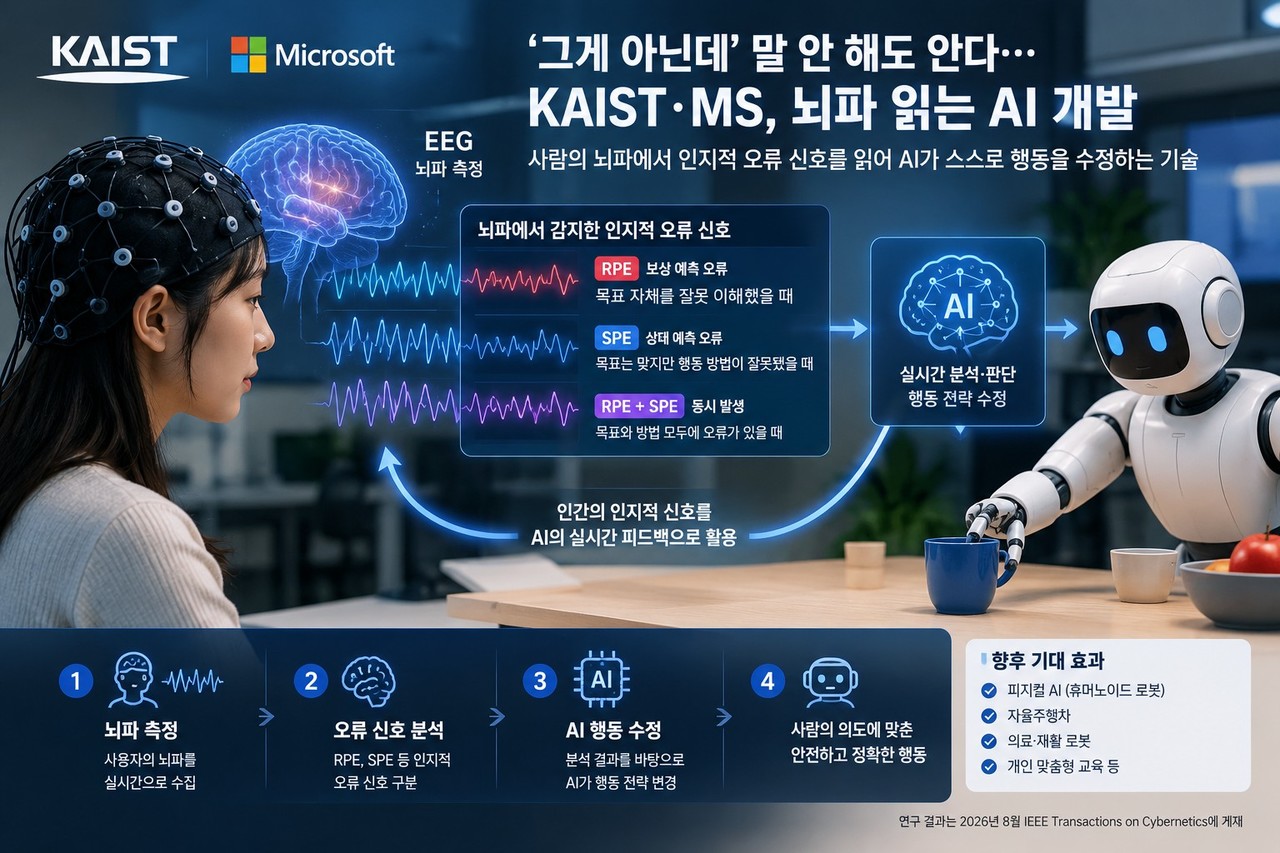
A joint research team from the Department of Brain and Cognitive Sciences at the Korea Advanced Institute of Science and Technology (KAIST), led by Professor Lee Sang-wan, and Microsoft Research Asia has developed a technology that enables AI to capture and decode human brain signals, recognize its own misbehavior, and autonomously correct itself without direct verbal or behavioral instructions from humans. The image was created with AI.
The technology developed by the team is called Neural Value Alignment (NVA). It uses human EEG to adjust AI behavior in real time so that it aligns with human intent.
The new technology differs from existing approaches in that it goes beyond simply interpreting a person's spoken or behavioral commands. It is designed to use the cognitive response itself that a person has while watching AI behave as the basis for correction.
The research team said the technology does not stop at interpreting commands, but connects human cognitive responses to AI behavior with real-time adjustments. In that sense, it is described as a next-step AI that communicates with human brain waves.
At present, AI infers user intent based on externally observable information such as voice commands, hand gestures, and actions. But there is a limitation in that intent is difficult to determine accurately from behavior alone. For example, simply seeing someone pick up a cup makes it hard to tell whether they intend to drink water or hand it to someone else.
The researchers focused on solving this goal-action ambiguity. To do so, they targeted prediction error signals in the brain that arise when people watch AI act, and conducted an experiment in which they measured participants' EEG in real time while they watched AI carry out tasks.
The results showed that the brain signals that appear when AI behavior differs from user expectations were not singular. The team classified them into two types of prediction error signals. Reward Prediction Error (RPE) was the signal seen when the AI misunderstood the goal it was trying to achieve, while State Prediction Error (SPE) was the signal seen when the AI understood the goal correctly but chose the wrong method to achieve it.
Using EEG analysis, the researchers confirmed that AI error types can be distinguished. Specifically, they were able to tell whether the AI misunderstood what it should do or whether it understood the goal but made an error in choosing the method. They also identified a separate EEG pattern when both errors occurred at the same time.
The study then expanded to a stage in which those signals were interpreted through deep learning. Applying deep learning, the researchers developed a technology that analyzes how humans accept AI behavior using only EEG signals. In this process, when an SPE signal from the AI was detected, it was judged that the goal was appropriate but the action method was wrong, and the system was made to change its action strategy. By contrast, when an RPE signal was detected, it was judged that the target goal itself had been misunderstood, and the system was made to re-identify the goal the user wanted.
The team then transmitted the EEG interpretation information to the AI in real time. Based on this, they presented an NVA-based human-AI collaboration algorithm in which the AI corrects its own behavior.
In existing AI correction methods, users often had to re-enter information or directly point out malfunctions, which limited the system's ability to respond to corrections because users had to give instructions again in words or directly identify errors. In contrast, the NVA approach uses the brain's cognitive error signals as AI feedback without any separate verbal instructions. The research team conducted simulations that included sudden changes in user goals and partial signal loss, and the results showed that the NVA approach adapted more quickly to changed intent than existing methods.
Physical AI was presented as a promising application field for this technology. Humanoid robots, autonomous vehicles, medical robots, and rehabilitation robots were identified as potential targets, and these fields require judgment and action in the real world. In such processes, AI may misunderstand human intent or behave unexpectedly, and immediate correction is needed in those cases. NVA suggests the possibility of using not only speech and gestures but also the cognitive signals behind actions as real-time feedback for AI.
The technology also points to possible use in autonomous driving. The main text suggested that AI based on brain responses could potentially understand a driver's changing intent and judgment without voice commands or manual operation.
Professor Lee Sang-wan explained that the significance of the study lies in the fact that AI's estimation of human intent goes beyond observing external behavioral outcomes and expands into human collaboration that directly communicates with the brain's cognitive signals.
The researchers said they expect the study to expand into Physical AI, BCI, autonomous driving, precision personalized education, medical robots, and human-computer interaction in the future. The paper was published in the online edition of IEEE Transactions on Cybernetics, and its title is Neural Value Alignment: Human–AI Collaboration Under Goal–Action Ambiguity. The DOI is 10.1109/TCYB.2026.3722605.
Source: IT DAILY · Jo Min-su
Original: https://www.itdaily.kr/news/articleView.html?idxno=241530
References
This article was produced with the help of an automated content generation algorithm.
Source: IT DAILY
View originalThis article was summarized and organized by BizCrush based on the original article from IT DAILY. For exact quotations and full details, please refer to the original article.