Kuntech Launches NEXA 1.0, a Data and AI Security Collaboration Platform
IT DAILY ·
✦ AI Summary
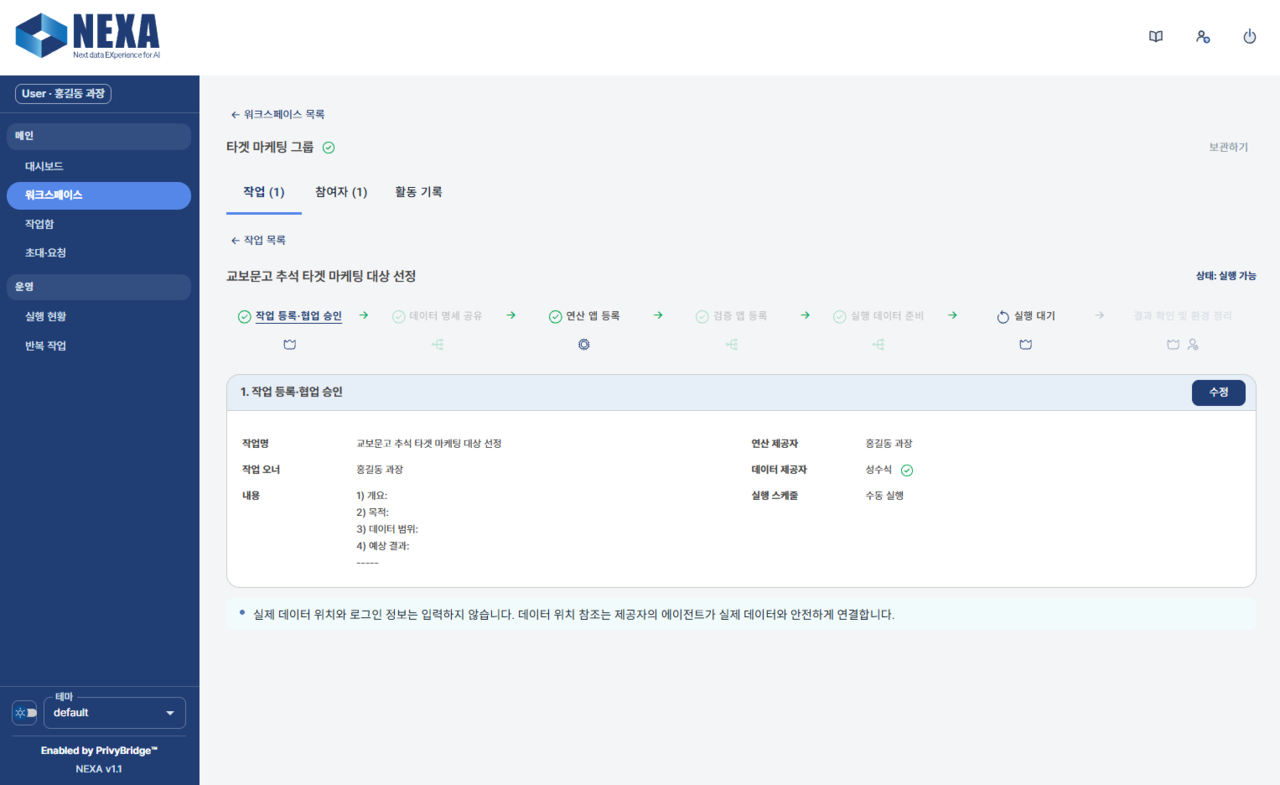
Kuntech announced the launch of NEXA(NEXA·Next data EXperience for AI) 1.0, a data and AI collaboration platform.
NEXA 1.0 is a Trusted Execution Environment(TEE) based service that applies PrivyBridge, a technology developed by the laboratory of Seoul National University Professor Baek Yoon-heung.
NEXA enables collaboration while keeping data and AI and logic assets confidential, and has implemented the Mutual Privacy and Delegated Private Computing(DPC) concepts as a real service.
Kuntech announced on the 10th that it had launched NEXA(NEXA·Next data EXperience for AI) 1.0, a data and AI collaboration platform. To enable collaboration without exposing sensitive data and AI assets externally, Kuntech applied PrivyBridge, a technology developed by the laboratory of Seoul National University Professor Baek Yoon-heung, to NEXA 1.0.
NEXA 1.0 is a service based on a proven Trusted Execution Environment(TEE·Trusted Execution Environment). NEXA is designed to perform only the necessary computations and exchange only permitted results.
Through this, data providers and AI and logic owners can collaborate through the solution while keeping their assets confidential. Medical records, financial transaction data and manufacturing process data are cited as examples of data with high value for AI use. The greater the value of data for AI use, the stronger the need to protect personal information and trade secrets, which makes external transfer difficult. AI companies also find it difficult to disclose model weights and business logic.
Existing methods of exporting data have security limitations. Once data is transferred, it can be copied and reused, and it is difficult to verify whether copies have been removed based only on a later deletion request.
To protect the assets of both data providers and AI and logic owners at the same time, NEXA applies a Mutual Privacy structure. NEXA also implemented the PrivyBridge-based concept of Delegated Private Computing(DPC·Delegated Private Computing) as a real service. This is an application case aimed at solving the protection issues between data providers and AI and logic owners.
DPC is a security technology that keeps original data from being exposed even when data processing is entrusted to an untrusted external server, such as the cloud. Professor Baek Yoon-heung of Seoul National University explained that PrivyBridge is a security-based technology designed so that sensitive data, core AI and business logic can perform only the necessary computations in a verified execution environment without directly disclosing them. Professor Baek Yoon-heung said NEXA is a real-world service implementation of that architecture.
The Trusted Execution Environment that makes this possible uses hardware protection features in the central processing unit(CPU). A Trusted Execution Environment isolates code and data in execution from access by server administrators and external software. It also extends protection beyond storage encryption and Transport Layer Security(TLS) to data while it is in use.
NEXA is presented as a means that can be applied to intercompany collaboration because it allows computation and use without sending data outside. In particular, it can address cases involving data that are difficult to export externally, such as manufacturing process and equipment data, medical records and financial transaction information. Through this structure, participating organizations can use AI analysis and training while maintaining control over their domain. It can also reduce the risk of in-house documents and images being exposed to external services through RAG indexes and prompt paths.
Kuntech CEO Bang Hyeok-jun said NEXA provides an environment in which data providers and AI logic owners can collaborate without disclosing their core assets. He added that the company plans to further advance audit and evidence functions and to expand into a usage-based settlement and compensation model.
Source: IT DAILY · Kim Ho-jun
Original: https://www.itdaily.kr/news/articleView.html?idxno=241522
References
This article was produced with the help of an automated content generation algorithm.
Source: IT DAILY
View originalThis article was summarized and organized by BizCrush based on the original article from IT DAILY. For exact quotations and full details, please refer to the original article.