Apple Unveils Its First Foldable, the “iPhone Duo,” in a USD 1,999 Bet
IT DAILY ·
✦ AI Summary
Apple unveiled its first foldable smartphone, the “iPhone Duo,” at Apple Park in Cupertino, California, the U.S., on the 9th, local time.
The iPhone Duo has a 5.4-inch external display and a 7.6-inch internal display, and can run two applications at the same time when unfolded.
The U.S. launch price starts at USD 1,999 for the 256GB model, with preorders starting in South Korea on October 16 and sales starting on the 23rd.
According to IT Daily, Apple unveiled its first foldable smartphone, the “iPhone Duo,” at the “Surprise and shine” event held on the 9th at Apple Park in Cupertino, California, the U.S., local time. The event was the first product launch led by John Ternus, who took office on the 1st as Apple CEO.
Apple entered the foldable market as a latecomer and highlighted user experience based on OS and app redesign rather than folding hardware as its differentiator. The iPhone Duo can be used like a regular iPhone when folded, and when unfolded it switches to a large screen and can run two applications at the same time.
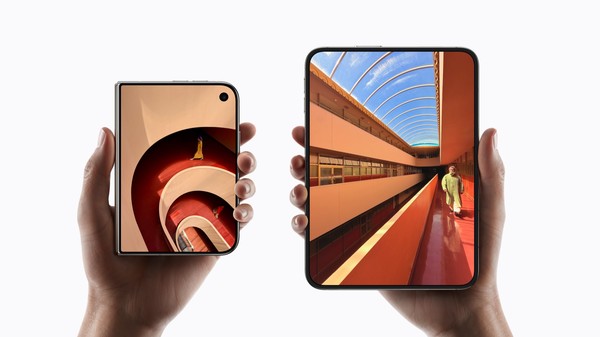
The iPhone Duo has a 5.4-inch external display and a 7.6-inch internal display. When unfolded, it switches to a 7.6-inch large screen. The price starts at USD 1,999. Photo courtesy of Apple.
The iPhone Duo has a book-style foldable design that opens left to right. When folded, it features a 5.4-inch external Super Retina XDR display, and the external display area is about 90% of the iPhone18 Pro. When unfolded, it uses a 7.6-inch internal display, and the internal display area is expanded by 50% compared with the iPhone18 Pro Max.
The same aspect ratio is applied to both the external and internal displays. Apple said this is to ensure a natural continuity in content ratio and layout when switching between folded and unfolded states. Both displays also support ProMotion with a variable refresh rate of up to 120 Hz and Always-On display (AOD), and the outdoor peak brightness is 3000 nits.
The internal display uses a nano-texture finish. This reduces light reflection and also softens the visibility of the crease at the fold. The FaceTime camera is placed under the screen so it is not visible when not in use. Apple also plans to support an USB-C Apple Pencil within this year.
The defining feature of the iPhone Duo lies in how it uses the unfolded display. This is also where its distinction from a regular iPhone becomes apparent.
To that end, Apple is adjusting the screen layout and app behavior in iOS 27 to fit the foldable structure. Along with that, it is introducing “Split View” for the first time on iPhone.
“Split View” is a feature that runs two apps side by side. Users can change the position of the two apps. It is also possible to run two windows of the same app at the same time. For example, two Safari windows can be used to compare different web pages. A feature that saves frequently used app combinations is also being added. It also enables use cases such as checking content on one side of the screen while simultaneously talking with “Siri AI” on the other side.
Support for external apps is also included. Netflix, Zoom, and Slack support interfaces tailored to the iPhone Duo’s screen structure. Zoom offers an interface that displays shared materials and meeting participants at the same time. Slack provides more workspace on the unfolded screen.
The device reflects its folded state and the configuration inside and outside the screen in the interface. The device’s folding angle is reflected in the UI, and video viewing and FaceTime calls are possible while it is propped up without being fully unfolded. The StandBy function can be used regardless of whether it is charging, and it supports both the internal and external displays.
The camera is configured to make use of both screens together. The rear camera consists of a 48-megapixel Fusion main camera and a 48-megapixel Fusion ultra-wide camera, and the main camera supports 2x optical-quality zoom.
The external display is also used to confirm the subject and take selfies. In “Duo Preview,” the subject can check their own image in real time on the external display, and the external display viewfinder can also be used when taking selfies with the rear camera. “Kid Cue” displays a Peanuts animation on the external display when photographing children to encourage them to look at the camera.
It also includes on-device AI-based camera features. “Smart Take” analyzes the movement of the subject and automatically takes a photo when it determines the user is ready to shoot.
Apple set the durability of the hinge and the internal display as key tasks to address durability, which has long been cited as a weakness in foldable phones. Accordingly, it applied a design intended to enhance stability across the entire mechanism.
The body uses grade 5 titanium. The hinge is made up of more than 100 parts, and the design was focused on supporting the center of the display.
Apple added an internal support structure. It reinforced the frame by inserting ceramic fiber elements as a material component.
The internal display has an anti-scratch coating, and a nano-texture polymer cover was also added. Apple said the polymer’s stiffness is up to 40% better than other materials in the industry.
High-strength glass was used for the upper and lower layers of the foldable panel, and separate adhesive structures for each layer were adopted. This separate adhesive structure allows interlayer sliding during folding, helping disperse bending stress. A titanium plate was added as a lower component.
The finish supports IP68 dust and water resistance. For biometrics, Apple did not adopt Face ID and instead applied a side-button integrated Touch ID method. Apple Watch unlock is also supported.
The iPhone Duo is equipped with the same A20 Pro chip as the iPhone18 Pro. The A20 Pro is produced using the latest 2-nanometer process.
The A20 Pro is configured with a 6-core CPU, 7-core GPU, and two 16-core Neural Engines. CPU performance is up to 20% better than the A19 Pro, and GPU performance is up to 40% better than the A19 Pro. Integrated memory bandwidth has increased by 50%.
The Neural Engine has a total of 32 cores. Apple said its AI processing performance is twice that of the A19 Pro.
A custom vapor chamber was applied for heat control, and the A20 Pro is directly connected to the vapor chamber. The goal is to reduce performance degradation during long periods of multitasking, gaming, and AI processing. Apple said sustained performance is up to 35% better than the iPhone17 Pro.
There is one battery on each side of the foldable device. Video playback time on the internal display is up to 31 hours, and video playback time on the external display is up to 44 hours. If the internal and external displays are used at similar ratios, battery life on a single charge is up to 24 hours.
For charging performance and connectivity, Apple said wired charging can take the battery to 50% in 20 minutes. With MagSafe and Qi2 wireless charging, it can reach 50% in 30 minutes.
For wireless communications, the device is equipped with Apple-designed N1 chip and C2 cellular modem. The standards supported by N1 include Wi-Fi 7, Bluetooth 6, and Thread.
It also removes the physical SIM slot. As a result, it will be sold worldwide as eSIM-only.
The photo introduced an example of running two applications side by side at the same time through “Split View” on Apple’s iPhone Duo. Photo courtesy of Apple.
Apple’s entry into the foldable phone market comes in the 8th year since commercialization. Samsung Electronics launched the Galaxy Fold in 2019, and major manufacturers such as Huawei, Motorola, and Xiaomi have expanded their foldable lineups.
Apple’s strategy was presented as prioritizing the connection between the folded and unfolded user experiences rather than the foldable form itself. The usability in the folded state is closer to that of existing iPhones, while the unfolded experience is geared toward strengthening multitasking and large-screen content consumption.
In the foldable market, price and whether the market expands are seen as key variables. The U.S. launch price of the iPhone Duo starts at USD 1,999 for the 256GB model. That is USD 100 higher than the U.S. launch price of Samsung Electronics’ Galaxy Z Fold8, released in July, at USD 1,899.
Foldable smartphones still account for only a limited share of the overall smartphone market. However, market research firms see Apple’s entry as an opportunity to expand the market size.
Counterpoint Research forecast that cumulative shipments of foldable smartphones worldwide will surpass 100 million units by the end of this year. It projected this year’s shipment share by manufacturer at 38% for Samsung Electronics, 25% for Apple, and 22% for Huawei. If this forecast holds, Apple could rank second in its first year of launch, behind Samsung Electronics.
Counterpoint Research expected global foldable shipments next year to increase 37% from this year. The key to market expansion is whether Apple can not only absorb existing foldable users but also attract iPhone users.
The iPhone Duo will be released in Star White and Night Sky colors. Storage options are 256GB, 512GB, 1TB, and 2TB. South Korea is included in the first wave of launch countries, with preorders starting on October 16 and sales starting on the 23rd.
Along with that, an executive assessment describing the product’s stature was also presented. CEO Ternus said the iPhone Duo is the biggest change since the original iPhone.
CEO Ternus also said the iPhone Duo is a product that shows the possibility of co-design between hardware and software. As a result, the product drew attention not only for its sales information but also for the significance of its scale of change and design direction.
Source: IT DAILY · Kim Byung-joo
Original: https://www.itdaily.kr/news/articleView.html?idxno=241513
References
This article was produced with the help of an automated content generation algorithm.
Source: IT DAILY
View originalThis article was summarized and organized by BizCrush based on the original article from IT DAILY. For exact quotations and full details, please refer to the original article.