Ternus’s First iPhone Event as Apple CEO Puts AI at the Center as a “Personal Hub”; Siri AI to Add Korean Support in October
IT DAILY ·
✦ AI Summary
Apple held its product launch event, “Surprise and shine,” at Apple Park in Cupertino on the 9th and unveiled the iPhone 18 Pro, iPhone 18 Pro Max, iPhone Duo, Apple Watch Series 12 and AirPods 5.
Apple CEO John Ternus presented the iPhone as an “Intelligent Personal Hub” and introduced the new Siri, which can understand personal context and on-screen content such as messages, email and photos to carry out tasks.
Apple said it is advancing AI based on its own chips and on-device computing, and expanding AI use from the iPhone to the Apple Watch and AirPods.
At his first product event after taking over as CEO from Tim Cook, Apple’s John Ternus presented the iPhone as an “Intelligent Personal Hub.” Ternus, who led his first product launch event since becoming CEO, said the new Siri understands users’ personal context across messages, email, photos and more, understands what is on the screen, and carries out needed tasks. Apple said it is advancing AI based on its own chips and on-device computing, while expanding AI use from the iPhone to the Apple Watch and AirPods.
On the 9th (local time), Apple held its product launch event, “Surprise and shine,” at Apple Park in Cupertino, California. It was the first product event led by John Ternus, and Apple unveiled the iPhone 18 Pro, iPhone 18 Pro Max, iPhone Duo, Apple Watch Series 12 and AirPods 5.
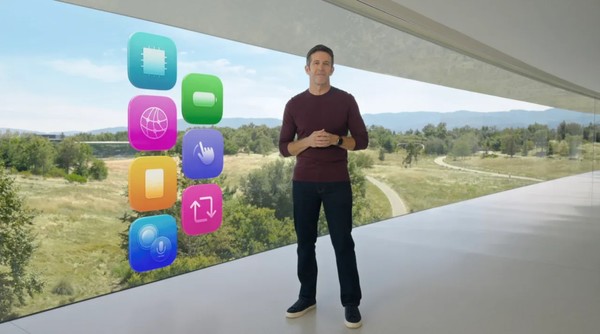
At the product launch event on the 9th (local time), Apple CEO John Ternus introduced the company’s iPhone-centered AI strategy. The photo from the event was captured from Apple’s event video.
At the event, CEO Ternus put privacy front and center as the key emphasis in AI. He stressed that the more AI relies on users’ personal data, the more important data control becomes.
CEO Ternus said trust has limits if data is outside users’ control. He also explained that Apple Intelligence runs on-device whenever possible.
Apple’s principle for AI processing is to perform as much computation as possible on the device itself. For tasks that require larger models, it uses its own cloud AI infrastructure, “Private Cloud Compute (PCC).” Apple’s AI architecture is designed to use personal data while minimizing the information sent to external servers.
Apple unveiled “Siri AI” alongside iOS 27. The existing Siri was centered on voice commands. In iOS 27, Apple expanded Siri from a voice-command-focused tool into an AI assistant that handles personal information and on-screen context together.
“Siri AI” has expanded personal context understanding and now also expands screen understanding. It also expands in-app task execution. Through this, it can provide answers by combining information from messages, email and photos.
“Siri AI” recognizes content displayed on the screen. It can search for information based on what the user is currently viewing and also carry out related tasks based on that same context. It also responds to general knowledge questions.
A “Siri Camera” mode has been added to the camera. “Siri Camera” recognizes objects seen through the camera and provides object-recognition-based question-and-answer support. It also performs related tasks based on object recognition. Users can also request writing support based on explanations of what they need.
Apple also introduced a separate Siri app. In the separate Siri app, users can review previous conversations and start new ones. Conversation history is privately synchronized across Apple devices through iCloud.
Siri AI will be offered as an English-first beta alongside iOS 27. Korean, French, Japanese, Portuguese and Spanish are scheduled for support in October.
At the iPhone 18 Pro, Apple presented use cases for Siri AI, which searches for and answers questions based on personal context. The rollout of Siri AI was presented as beginning with an English beta and then expanding to other major languages.
Apple presented its in-house designed chip as the foundation for this expanded AI functionality. The iPhone 18 Pro, iPhone 18 Pro Max and iPhone Duo will be equipped with the “A20 Pro,” built on a 2-nanometer process.
The A20 Pro consists of a 6-core CPU and a 7-core GPU. It also uses two 16-core Neural Engines, giving the A20 Pro a total AI processing capacity of 32 cores.
According to Apple’s announcement, the A20 Pro’s AI processing performance is 2 times that of the A19 Pro. The A20 Pro’s memory bandwidth increased by 50%, and GPU performance improved by up to 40%. Apple positioned the A20 Pro as the basis for doubling AI performance and expanding on-device computation.
Apple said it integrated neural accelerators into the CPU to raise on-device AI processing capability. Through this, Apple said it would expand the range of complex AI models and computational photography tasks processed on the device itself.
Apple also applied a new thermal management structure to the iPhone 18 Pro. It said the A20 Pro is directly connected to a next-generation vapor chamber, with the goal of dispersing heat generated during long AI computations and gaming.
Apple said this configuration improved sustained performance by up to 40% compared with the previous generation.
Apple explained that stronger on-device AI performance is also linked to its privacy approach. It said that as more processing is handled on the device itself, fewer tasks need to be sent to the cloud.
Apple placed the iPhone at the center of personal AI. At the same time, it showed a trend of expanding touchpoints between users and AI through the Apple Watch and AirPods.
The Apple Watch Series 12 is equipped with a “health sensing system” and the S11 chip. Using an optical heart rate sensor, it measures heart rate every 5 seconds throughout the day, and measures heart rate variability (HRV) at intervals of up to 5 minutes. Apple said the HRV measurement frequency has increased by up to 24 times from before.
Apple is adding and expanding new features in the health management and hearing assistance areas. In health, it is introducing a new “Readiness” feature. This feature analyzes activity, workout load, biometric indicators and sleep scores as inputs and displays the day’s physical condition on a 0 to 10 scale. It also suggests recommended states for each result: “recovery,” “pace yourself,” “ready,” and “active.”
Apple will also revamp the Health app within this year. The revamped Health app will apply Apple Intelligence and analyze long-term accumulated health data to present major changes for the user. It will also offer a “Health Age” feature. The “Health Age” feature compares actual age with health indicators.
“Audio Intelligence” will be added to the Apple Watch. “Audio Intelligence” treats ambient sounds and conversations as processing targets, and supports recognition and alerts for sirens, alarms, doorbells and baby cries. It also supports “Live Rewind,” allowing users to review missed parts of a conversation in text. The review range for “Live Rewind” is up to 15 seconds earlier. It also supports “Siri Recap,” which provides a summary of key points.
Apple said that with Audio Intelligence it does not create or store voice recordings. The original audio is processed in the S11 chip’s hardware-isolated area and deleted after processing.
Apple is pursuing a structure that divides AI roles by device. The iPhone is the central device linking personal information with AI processing. The Apple Watch is the touchpoint that receives health data. AirPods are the touchpoint that receives voice.
Under this structure, AirPods 5 make Siri AI voice activation possible. AirPods 5 also support checking personal schedules and message-related information. AirPods 5 also support real-time translation.
Apple’s AI technology includes cooperation with Google. Apple will disclose related details at the Worldwide Developers Conference (WWDC26) in June. Cooperation with Google is also taking place in the process of building next-generation Apple foundation models.
In this process, technology based on the Gemini family of models is being used. However, Google AI models are not being built into the iPhone as a separate service. Apple is using external-based technology.
The technology being used is integrated into Apple’s own foundation models and operating system. The integration targets are the iPhone’s personal context, apps, in-house chips and Private Cloud Compute. The AI delivery path at the user touchpoint is Siri, Apple Intelligence and iOS.
This differs from the approach of competitors that place their AI models themselves at the forefront of their services. Apple is taking a structure in which it uses external-based technology, including cooperation with Google, but does not expose it as a separate service and instead integrates it into its own models and operating system.
In the first product lineup under the Ternus era, that integrated structure was made concrete. Apple showed this by dividing roles by device while also using the screen, AI and apps together.
The iPhone was assigned the role of connecting personal information and apps. The Apple Watch took on the role of sensing health and the surrounding environment, while AirPods handled voice and translation. The first foldable phone, iPhone Duo, was designed to let users use other apps and Siri AI at the same time on its unfolded screen.
This configuration showed a change in how AI features are used. The integrated structure shown in the first product lineup under the Ternus era was presented as a direction that combines device-specific division of labor with simultaneous use.
Within this trend, Apple presented an integrated structure for AI competition that combines its own chips, devices, operating system and app ecosystem rather than relying on individual models. It is a way of placing the core of AI competition in the combination of its own hardware, software and ecosystem rather than in the performance of individual models.
At the same time, Apple announced that it will impose daily usage limits on some Apple Intelligence features that use server-based models. The features subject to the daily limit include Siri AI, intelligent photo editing features, Image Playground and the AFM 3 cloud model used in Shortcuts. Usage limits vary based on feature, request complexity and system demand.
Apple plans to offer “Expanded Access,” which provides additional use rights for the relevant features, on a paid basis in the future. The plan is to place daily limits on server-based AI features and expand additional usage through a separate paid model.
Apple said it is not making Apple Intelligence entirely paid. Basic AI features provided on the device will remain available, while separate charges will apply to additional usage of certain features that use server resources. Apple formally presented this future billing approach for AI services.
This measure is the first concrete step toward linking a separate revenue model to the high computational costs of Apple’s generative AI. Apple has been pushing a service model that ties in with hardware such as the iPhone and Mac, and this plan was presented as an extension of that effort. It also aligns with the AI strategy unveiled for the first time under the Ternus era.
Apple’s AI strategy focused not on placing a new model at the center, but on the personal context accumulated on the iPhone and the connection between its own chips, operating system and surrounding devices. As a result, whether the actual use of the new Siri can prove the advantages of that structure was presented as the next task for Apple’s AI strategy.
Source: IT DAILY · Kim Byung-ju
Original: https://www.itdaily.kr/news/articleView.html?idxno=241514
References
This article was produced with the help of an automated content generation algorithm.
Source: IT DAILY
View originalThis article was summarized and organized by BizCrush based on the original article from IT DAILY. For exact quotations and full details, please refer to the original article.