Apple Moves AI Photo Verification Upstream to the Moment of Capture
IT DAILY ·
✦ AI Summary
Apple unveiled Apple Reference Image, an image authenticity verification feature, together with the iPhone 18 Pro and Pro Max.
The feature signs sensor data at the pixel level at the moment of capture to create a non-changeable reference image, and supports SynthID for AI-generated and edited images.
In the Photos app and external applications, users can compare ordinary photos with reference images to check whether they were altered after capture.
As generative AI makes it easier to create and edit photos, technologies that can verify image provenance and whether an image has been altered are becoming more important. In response, Apple has proposed a verification framework that records evidence for authenticating an image from the moment of capture, rather than analyzing a finished photo afterward, and attaches separate identification information to images that have been touched by AI.
On the 9th local time at Apple Park in Cupertino, California, Apple unveiled the iPhone 18 Pro and Pro Max, along with Apple Reference Image, an image authenticity verification feature. Apple Reference Image is a technology in which the new camera sensor signs capture data at the pixel level, and the signed capture data is turned into a separate reference image that cannot be changed. Through this, an actual captured image preserves a benchmark from the moment it was taken.
Apple also supports SynthID, a technology for identification information for AI-generated and edited images. As a result, identification information is added to images involving AI, creating an overall structure that can verify both image provenance and whether it has been modified.
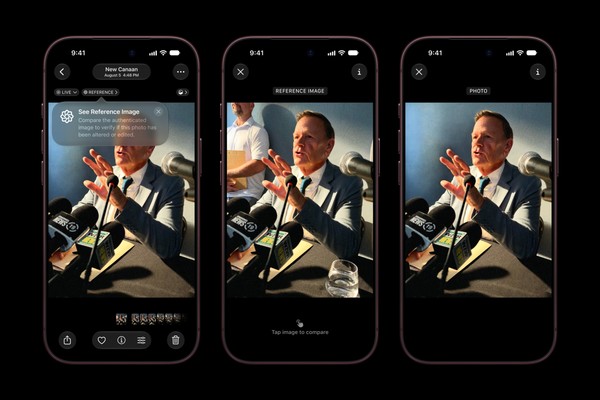
As a photo example, Apple presented the iPhone 18 Pro's Apple Reference Image feature. The company introduced it as a way to compare a reference image with an edited photo at the time of capture.
The starting point for Apple Reference Image is the new image sensor in the iPhone 18 Pro's 48-megapixel Fusion Main camera. Apple said the sensor can sign data collected at the moment of capture at the pixel level.
When a user shoots in Reference mode, the camera simultaneously generates signed sensor data. In this way, the feature signs sensor data at the time of capture to create a separate reference image.
The signed data is processed in PCC, Apple's secure cloud computing framework. A non-changeable reference image is generated as the result within PCC.
This reference image is preserved separately from the ordinary photo as a standard for verifying what the sensor captured at the time of shooting. Apple likened it to the negative of a film photograph.
In the Photos app, the ordinary photo and the reference image can be viewed side by side. This makes it possible to visually compare the two images and check whether the photo was altered after capture.
Some AI image detection technologies analyze the characteristics of a finished output to determine whether it may have been generated or manipulated. By contrast, Apple chose a method that records verification data from the moment an image is created. Unlike approaches that look for AI traces in a finished photo, Apple's verification standard is to build a benchmark against what the camera sensor captured at the time of shooting.
In this process, the captured image takes on the character of a reference image. The reference image serves to preserve the benchmark from the moment the camera took the shot.
On the other hand, SynthID is applied to AI-edited images. SynthID is a technology for identifying AI-generated and edited content, and provides clues for identifying AI-generated and edited content. Depending on the editing method, most images modified by AI include SynthID.
Apple uses Apple Reference Image, image metadata, and SynthID together. Image metadata is additionally used for multi-step verification of the actual capture and subsequent editing process.
Based on this structure, Apple plans to enable users to verify both the moment of capture and the editing history that followed. It plans to support SynthID through a software update later this year.
Apple is expanding its AI-powered photo generation and editing features. Apple is broadening the scope of AI photo generation and editing, and that includes the expansion of Apple's AI photo editing features.
In iOS 27, it will offer Spatial Reframing, a feature for changing the composition after shooting. In iOS 27, it will also offer Extend, a feature that generates areas outside the image. In iOS 27, it will also offer Cleanup, a feature for removing objects from photos.
Image Playground supports realistic image generation. Accordingly, Apple is broadening the use of AI across photo generation and editing.
Apple is also preparing tools that can distinguish between actual photos and AI-involved outputs. Apple Reference Image can also be used outside the Photos app.
Apple will provide a reference image display API for external applications in iOS 27, iPadOS 27, and macOS 27. This allows third-party apps to compare ordinary images with reference images captured at the time of shooting.
In its official announcement, Apple explained the importance of reference images to photojournalists, photographers, and ordinary users. It presented the feature against the backdrop of an environment in which it has become harder to distinguish AI-generated images from real photographs.
Apple said reference images could potentially be used in news and documentary photography to verify whether a photo was altered after it was taken. The point is that, amid the spread of generative images and the resulting difficulty in determining authenticity, the feature provides a means of examining whether a photo has been changed.
Apple said it will also provide an API. This lays the groundwork for expanding use to third-party photo editing programs and content services, and media outlets and content platforms can implement a reference image verification function within their own services if they adopt the API.
However, Apple did not announce the adoption of related systems by media outlets or content platforms. The actual scope of use will depend on whether third-party companies adopt the API and on support-device penetration.
In addition, reference images are not a technology for proving the event itself shown in a photo. Accordingly, the scope of verification for reference images needs to be distinguished carefully.
This feature provides a benchmark for verifying what the iPhone 18 Pro sensor captured at the moment of shooting. By comparing it with the later photo, users can identify changes made to the image after capture.
A photo alone cannot prove the authenticity of the event in the image, nor can it confirm whether a scene was staged before capture. It also cannot verify what happened outside the camera's frame or the context before and after the photo, so a photo by itself cannot guarantee the truth of an event.
Because of these limitations, reference images are less a technology for certifying the truth of a photo's contents and more a technology that provides evidence for verifying whether the image changed between the information collected by the sensor at the time of capture and the later image.
That said, reference images are an optional feature that users must activate themselves, and there are regional restrictions on availability. In China, a release date was not provided due to regulatory requirements, and in the European Union (EU), reference image capture on the iPhone 18 Pro was not supported at launch.
There are also differences in availability by platform. In iOS 27, iPadOS 27, and macOS 27, it is possible to process and view reference images that have already been created. At the same time, a variable aperture has been applied, and manual camera controls have also been expanded.
The iPhone 18 Pro expands the range of shooting controls. The device is equipped with a 48-megapixel Fusion Main camera and applies the first variable aperture on an iPhone. It uses 6 aperture blades, and the aperture settings are offered in 4 steps: ƒ/1.48, ƒ/1.8, ƒ/2.8, and ƒ/4.0.
The iPhone 18 Pro also offers a new Pro Control. Through it, users can directly adjust the aperture, shutter speed, and white balance. Histogram-based exposure checking is also supported.
This continues a trend in which the iPhone camera is expanding manual control features even as it develops around automated computation. Through the variable aperture and Pro Control, the iPhone 18 Pro has increased the number of items users can directly handle while shooting.
At the same time, an environment has formed in which AI makes it easy to generate images and convert real photos. In such a situation, it is difficult to determine provenance and whether an image has been edited based on the finished image alone. In response, the camera has introduced a function that separately records information from the moment of capture.
Apple has moved the starting point for verification to the shooting stage. The iPhone 18 Pro has expanded its functions to preserve not only the final output but also information from the moment of capture, in order to verify provenance and editing history. As a result, the iPhone 18 Pro has broadened the scope of smartphone camera competition from image quality and shooting performance to technology for verifying image provenance and editing history.
Source: IT DAILY · Kim Byeong-ju
Original: https://www.itdaily.kr/news/articleView.html?idxno=241515
References
This article was produced with the help of an automated content generation algorithm.
Source: IT DAILY
View originalThis article was summarized and organized by BizCrush based on the original article from IT DAILY. For exact quotations and full details, please refer to the original article.