AI Starts Working: Konan Technology Expands Agents Into Power Generation, Justice, and Manufacturing
TECHWORLD ·
✦ AI Summary
Konan Technology held the "Konan AI Summit 2026" on the 9th at the EL Tower in Yangjae-dong, Seoul, and unveiled AI application cases in the power generation, judicial, and manufacturing sectors, along with agentic AI strategies.
Korea Western Power is applying its generative AI platform "Wepivot" to actual power generation work, while the Supreme Court's Court Administration Office is building a trial support AI in 4 stages.
Seoyon E-Hwa has set 2026 as the first year of AX and is developing 4 AI agents, while Konan Technology introduced the integrated platform for building and operating industry-specific AI agents, "Agent-X," and the multimodal AI agent "VisionFlow."
Konan Technology said it is pushing to expand the scope of enterprise AI use, laying out a direction that broadens AI's role from assisting work to carrying it out. The company has also moved to target the agentic AI market.
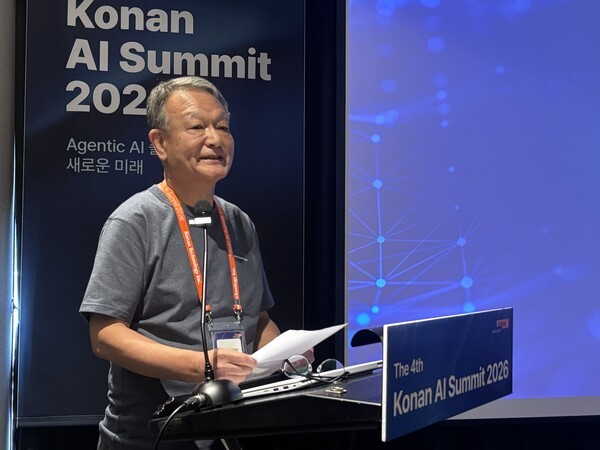
Konan Technology held the "Konan AI Summit 2026" on the 9th at the EL Tower in Yangjae-dong, Seoul. The event showcased AI application cases in the power generation, judicial, and manufacturing sectors, along with agentic AI strategies.
On site, the company introduced AI deployment experiences under way at Korea Western Power, the Supreme Court's Court Administration Office, and Seoyon E-Hwa. Through these cases, Konan Technology presented AI application and implementation experience in a connected way.
Kim Young-seom, CEO of Konan Technology, said enterprise AI use is moving beyond simple question-and-answer tasks and into autonomous judgment and work execution. He outlined a plan to expand technologies and implementation experience accumulated in the public sector into industrial settings such as power generation and manufacturing. He added that the shift from companies using AI to companies in which AI actually works has begun.
Yang Seung-hyun, COO of Konan Technology, said the performance gap among frontier AI models is narrowing and that corporate attention is shifting from model selection to work execution architecture. He explained that judging with an LLM and actually completing tasks are separate issues. He then proposed an "enterprise agent architecture" that includes execution, verification, and recovery as necessary elements.
Yang said the scope of work automation should be set not at the level of an entire job, but at independently verifiable units. He explained that if multiple stages of work are assigned at once, an error in the middle can spread to later processes, so a structure is needed that checks results at each stage and retries when problems occur.
Yang also highlighted the "harness" as a key element that controls agent execution and verifies results. He said, in effect, that the companies that will lead in the future will not be the ones that simply use more AI, but the ones that redesign workflows so AI can work.
Korea Western Power disclosed its real-world deployment experience with "Wepivot," its in-house generative AI platform. Wepivot began construction in August 2025 and went through a pilot launch in December 2025. It then completed a first launch in May this year and was converted to official service on June 30.
The project cost is KRW 4.7 billion. The infrastructure consists of a total of 3 GPU servers. Of these, 2 servers are equipped with 8 H200 units each, and 1 server is equipped with 8 B300 units.
Wepivot is being used in conjunction with the power plant equipment management system. It is used for power generation and safety Q&A and for document drafting. It also supports compiling malfunction briefings and equipment briefing notes.
It also supports work related to the TBM before work begins. Its mobile functions organize meeting topics based on recorded meetings and also organize follow-up actions based on those recordings.
In addition, the mobile features detect risk factors by analyzing on-site photos and standard operating procedures, or SOP. It also applies a function that identifies safety issues based on photos taken during construction.
In the process of operating AI at power plants, AI sometimes misunderstood the plants' own terminology. This also led to cases in which equipment information was summarized incorrectly.
As a result, a key task for improving actual usability was identified as accurately reflecting on-site terminology and work context in AI. The errors revealed during operations made clear the core tasks needed to improve usability.
Jang Seung-gyu, head of Korea Western Power's AX Promotion Division, said there was no detailed alternative for the target of the initial build from the start. He added that the current system took shape through continued pilot operation and additional feature rollouts.
Meanwhile, the Supreme Court's Court Administration Office is gradually building a generative AI-based trial support AI. The target is trial work, the project period is from July 2025 to December 2028, and the project scale is about KRW 14.5 billion.
The project is being carried out in 4 stages. Stage 1 covers legal information search and research, Stage 2 covers summarizing trial materials and analyzing issues, Stage 3 covers support for drafting and reviewing court documents, and Stage 4 applies agentic AI; the goal of Stage 4 is to advance the system for supporting the full workflow.
The project is currently moving into Stage 2 while the intelligent legal information search and research functions built in Stage 1 are being used in practice by judges and staff nationwide.
The trial support AI was designed to analyze user queries, then search relevant laws, precedents, literature, and commentaries through hybrid search before generating LLM responses. It also allows users to check the source materials behind the answers, with a focus on improving reliability for legal work.
Given the sensitive nature of handling case information and personal information, the system established its own closed-network environment. At the data layer, it uses a case information data warehouse and a big data platform, while the internal infrastructure consists of GPU, storage, and access control systems.
Work is also under way to reduce errors in order to curb cases where nonexistent precedents or incorrect laws are presented. To that end, the relationships among cases, precedents, laws, and applicable statutes are being structured in an ontology format, and the system is designed to re-search or stop generating an answer if search results fall short of the standard.
Auto parts maker Seoyon E-Hwa set 2026 as the first year of AX and has begun a project to connect existing work systems with AI agents. The company judged that the burden of responding with a workforce-centered work method had increased amid expanding overseas production bases, a growing product lineup, and shorter development cycles for finished vehicles.
Accordingly, Seoyon E-Hwa has been carrying out an AI implementation project with Konan Technology since June this year. The company already has work systems and databases established during its existing DX process, and it is advancing the project by linking them to an AI platform.
The platform has a structure in which it secures needed data from existing work systems, performs agent orchestration, and then provides results through search and reasoning. It is not limited to adding a separate chatbot, and instead focuses on connecting accumulated manufacturing data to actual work flows.
Seoyon E-Hwa is developing 4 types of agents. It is developing an agent for automatically generating test plans, an agent for supporting the drafting of improvement measures documents, an assembly process design agent, and an agent for recommending causes and countermeasures for equipment failures.
The test plan agent creates a plan by combining product specifications, test standards, and equipment availability schedules. The improvement measures document agent searches past quality issues and response cases for roughly 2,000 documents drafted annually and proposes response measures and drafts.
The assembly process design agent recommends multiple design options based on product specifications and past process cases. The equipment agent analyzes failure and maintenance histories to suggest the cause of current problems and response measures.
The proposed results from these agents are reviewed and revised by the person in charge before being finalized. The processing results are then stored back in the system.
This approach produces a structural effect in which the know-how held by a specific expert is turned into organizational knowledge so that other staff members can use it as well. Hong Seok-hwan, head of Seoyon E-Hwa's AX Promotion Team, said he expects AI agents to play a very important role in responding to rapid changes in the environment.
Konan Technology introduced "Agent-X," an integrated platform for building and operating AI agents by industry. The company said it prioritizes an approach that designs in advance the tasks to be delegated, the level of autonomy, and the verification standards, rather than a method that first applies AI functions.
Agent-X consists of an agent workflow, an agent kernel, and an agent OS. The agent workflow designs the work flow, the agent kernel runs the actual agents, and the agent OS manages the execution process and quality.
The platform is built to link work diagnosis, scope setting, execution, operation, and control into a single system. This allows design, operation, and management functions to be bundled and run within one framework.
Konan Technology has applied harness engineering to this. Harness engineering checks an agent's execution process and results and responds when errors occur. It also aims to manage AI so that it does not exceed the defined authority and scope while using in-house knowledge and existing systems.
Kim Kyu-hoon, head of Konan Technology's AI business division, said safe operation of agents is important through mapping work knowledge and designing AI work paths on top of it.
As the scope of agent applications expands to visual tasks in manufacturing sites, Konan Technology unveiled "VisionFlow," a VLM-based multimodal AI agent. The purpose of "VisionFlow" is to make up for a shortage of on-site data.
"VisionFlow" can analyze images, video, and on-site documents, and supports equipment status checks and work status checks. It also supports document Q&A, SOP generation, work records, and report writing. In addition, it provides real-time interpretation and image reading functions. The supported devices are smartphones, tablets, smart glasses, and body cams.
Rather than waiting for manufacturing-site DX to be completed, Konan Technology proposed preemptively deploying VLM. It also presented a flow in which a VLM that can be used without large-scale training data is introduced first, and data is accumulated during use.
Through this strategy, Konan Technology aims to reduce the time and cost of data building. At the same time, it also proposed a strategy of pursuing DX and AX in parallel.
By showcasing agents and a real-time AI interpretation solution together on site, Konan Technology demonstrated that the scope of generative AI use is expanding. The summit highlighted the trend of expanding generative AI applications, with the direction shifting from general-purpose chatbots and personal productivity gains to industry-specific work processes.
Konan Technology unveiled its real-time AI interpretation solution, "RingoX." "RingoX" supports 32 languages and was applied as simultaneous interpretation during the sessions before the event that day. A demo zone for VisionFlow and RingoX was also set up at the venue.
Yoo Young-wook, head of Konan Technology's AI Device Division, said the responsible party is the human. He explained that the agent's role is to support exploration, understanding, verification, and recording so that people can see and judge more accurately.
CEO Kim said the company aims to be a partner that creates practical change in manufacturing sites beyond the public sector based on technologies that can see, hear, and understand like humans. Through this, Konan Technology showed on site the trend of generative AI applications expanding beyond specific areas into real industrial settings.
In future competition in enterprise agentic AI, stable connection of internal data and legacy systems is expected to matter more than model performance itself. The importance of errors in the execution process and access control was also raised. Among the practical challenges for operations were industry-specific terminology, data quality, and AI result verification systems.
Konan Technology has experience building systems for the public sector, and the key to future business expansion will depend on how much it can connect that experience to private industries such as power generation and manufacturing and use it to improve productivity and work efficiency.
Source: TECHWORLD · Kim Seung-gi
Original: https://www.epnc.co.kr/news/articleView.html?idxno=406759
References
This article was produced with the help of an automated content generation algorithm.
Source: TECHWORLD
View originalThis article was summarized and organized by BizCrush based on the original article from TECHWORLD. For exact quotations and full details, please refer to the original article.