[AI Brief] NIPA Holds ‘Reboot AI Utilization Contest’... Young People and Women Returning to Work Share AI Results
IT DAILY ·
✦ AI Summary
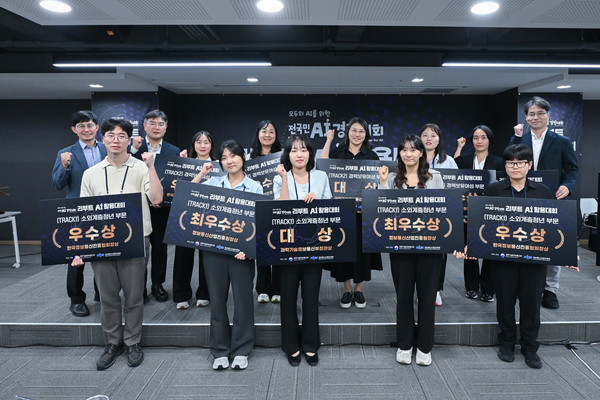
On the 9th, NIPA said through an AI brief that NIPA and the Ministry of Science and ICT held the '2026 National AI Competition Everyday Innovation Track Reboot AI Utilization Contest' at d.camp in Mapo, Seoul, on the 3rd.
The event was held to share the results of generative AI training for young people preparing for independence and women with career breaks, and the training was conducted at ICT Innovation Squares in 5 regions nationwide.
Flitto and the Korea Industrial Safety Association signed an MOU for AI-based multilingual translation and interpretation support to prevent industrial accidents among foreign workers, while ROMIN, Finders AI, and Blux also announced AI-related projects and solutions.
On the 9th, the National Information Society Agency (NIPA) introduced related developments through an AI brief that reviews changes in AI technology and compiles key daily news for easy viewing at a glance.
On the 3rd, the National Information Society Agency (NIPA) and the Ministry of Science and ICT held the '2026 National AI Competition Everyday Innovation Track Reboot AI Utilization Contest' at d.camp in Mapo, Seoul.
The event was held to share the results of generative AI training programs run for young people preparing for independence and women with career breaks. The training was conducted at ICT Innovation Squares in 5 regions nationwide.
The training focused on creative problem-solving based on generative AI and on practical use in daily life and work. Based on this, trainees completed outputs tailored to their own situations and needs and built up experience using AI.
Reported outcomes of the training included creating a website using generative AI and producing personalized work and life templates using Notion AI.
The contest was divided into 2 categories, including 'disadvantaged youth' and 'women with career breaks,' and was conducted in preliminary and final rounds. A total of 107 graduates from training programs in 5 regions nationwide took part in the preliminaries, where their training outputs were evaluated. As a result, 20 finalists, 10 from each category, advanced to the final round.
In the preliminaries, finalists were selected based on the participants' training outputs. The evaluation focused less on the technical difficulty of the outputs and more on the participants' growth process and willingness to use AI. The evaluation criteria were the use of training content, self-direction and effort, practicality and personal applicability, creativity and expressiveness, and understanding and ethics of AI use.
Shin Seong-woo, head of NIPA's Policy Planning Division, said that the value of AI is revealed when it is used as a tool to solve everyday inconveniences and turn ideas into reality rather than as a technology itself. He added that he hopes the contest will give participants the confidence to say, 'AI is my weapon,' and continue taking on new challenges. The photo shows Lee Jeong-su, CEO of Flitto, on the right, and Im Mu-song, president of the Korea Industrial Safety Association, and the photo credit is Flitto.
Flitto will expand AI translation and interpretation support for industrial safety training for foreign workers and into workplace settings. Flitto plans to build a database of industrial safety terminology and strengthen on-site safety communication through real-time translation and interpretation links.
Flitto and the Korea Industrial Safety Association signed an MOU for AI-based multilingual translation and interpretation support to prevent industrial accidents among foreign workers. The announcement of the agreement came on the 9th.
The two companies agreed to build a real-time multilingual translation and interpretation support system for foreign worker safety and health training and to establish a multilingual DB of specialized terms in the industrial safety and health field. They also agreed to pursue ongoing quality management of the multilingual DB of specialized terms in the industrial safety and health field.
In addition, the two companies will link a real-time translation and interpretation API within an industrial safety AI management solution, jointly participate in government and local government support projects, and work to expand results. The two companies will cooperate closely in key areas.
In the training segment, the focus is on designing translation methods by type, such as group training and on-site training. The direction is also to implement an operating system for sites where multinational workers are mixed, so that they can take classes simultaneously in their native languages.
The criteria for expanding supported languages center on the major countries that send workers under the employment permit system (E-9). The plan is to build a multilingual DB of specialized terms related to the Occupational Safety and Health Act, hazardous and risk factors, and work processes, and to continuously improve translation accuracy by reflecting the contents of the multilingual DB in the solution.
The photo credit is ROMIN. ROMIN announced on the 9th that it supplied its document AI agent, 'ROMIN,' to Korea Reinsurance's 'project to build an AI assistant for specialty insurance rate calculation.'
The purpose of the project is to apply AI to rate calculation work in the specialty insurance underwriting process. ROMIN applied document AI to Korea Reinsurance's insurance rate calculation work.
The expected benefits include automating document digitization and automating the search and reference process. This is linked to efforts to introduce AI into rate calculation work at the specialty insurance underwriting stage.
Previously, underwriters reviewed documents such as rate request forms (RQ) and questionnaires, manually searched historical data, calculated rates, and then entered related information by hand.
After the AI assistant was built, the process from document receipt to information extraction, historical data search and reference, and rate calculation was automated. In this process, ROMIN handled retrieval-augmented generation (RAG) pre-processing for the rate calculation AI assistant, classifying and parsing received documents such as rate request forms and questionnaires, extracting needed information, and converting it into structured data.
For multi-page rate request forms, the company developed and applied a multi-page document extraction AI model to automatically extract and consolidate information distributed across pages. As a result, the underwriter's manual work of individually checking and consolidating information was reduced. It also digitized past received documents, enabling the AI assistant to search and reference both past and newly received documents.
Finders AI announced on the 9th that it had built a self-checkout environment for 'Ddeujuru Bread Dolgamajom.' The system was built based on the 'AI Bakery Scanner (VCO).'
The system built by Finders AI is an AI-based self-checkout system for bakery stores. The solution consists of an AI scanner equipped with a camera that supports automatic item recognition and easy payment.
The technologies applied are multi-angle cameras and AI recognition. The VCO introduced here uses a total of 7 cameras on the left, right, and top, and the AI training data used actual products sold by Ddeujuru.
The system can identify items in 1 to 2 seconds. It can distinguish each item precisely, and even when multiple types of bread are inserted at the same time, it can recognize them individually.
It also allows users to select prepared beverages on the screen. As a result, customers can complete the entire process from ordering to payment without employee intervention, enabling unmanned handling of the entire in-store ordering and payment process.
The photo credit is Blux. Blux said on the 9th that it proposed an execution strategy for CRM workflow automation using AI agents.
Blux held a seminar on the 7th at Maru 180 in Gangnam District, Seoul. The audience for the seminar consisted of brand marketers and CRM practitioners.
At the event, Blux unveiled a next-generation CRM execution strategy using AI agents. It introduced AI agent-based CRM execution plans to brand marketers and CRM practitioners.
The presentation was given by Kim Tae-ho, customer success consultant at Blux. Kim pointed to repetitive manual work caused by labor shortages as a reason for marketers' CRM difficulties, and he also cited the limits of average customer-centered rule-based targeting as another factor.
Blux unveiled examples of AI agents being applied directly to marketing operations. Kim Tae-ho also demonstrated the Blux agent.
The Blux agent features a function that identifies, using only natural language commands, the section where conversion rates collapse, which is the cause of stagnant sales, and it also showed a function that presents visualization charts of the detection results. It also demonstrated a function that automatically generates customized promotional materials based on synthesized clothing and model images.
Source: IT DAILY · Yang Seung-gap
Original: https://www.itdaily.kr/news/articleView.html?idxno=241505
References
This article was produced with the help of an automated content generation algorithm.
Source: IT DAILY
View originalThis article was summarized and organized by BizCrush based on the original article from IT DAILY. For exact quotations and full details, please refer to the original article.