MIND AI Unveils JindoBot 'Haechi' at WSCE 2026, Pitches Physical AI Smart City
TECHWORLD ·
✦ AI Summary
MIND AI unveiled JindoBot 'Haechi' at the '2026 World Smart City Expo (WSCE 2026)' on the 9th and announced a physical AI-based smart city strategy.
Sohn Byung-hee, head of MIND AI's Defense AI & Robotics division, presented an 'acting city' in which AI recognizes and judges urban situations before directly acting through robots.
MIND AI is developing a physical AI system that applies Haechi to public-sector uses such as city patrols, facility inspections, and disaster response, while feeding execution results back into learning.
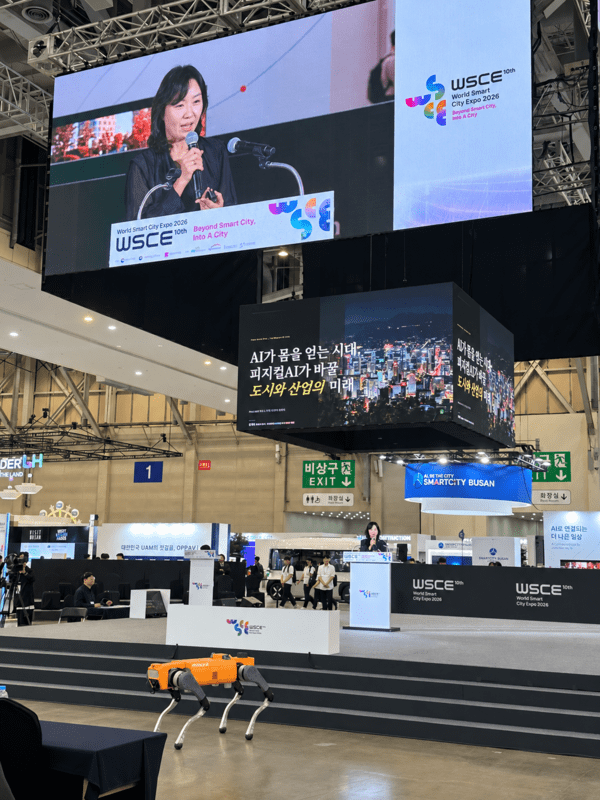
MIND AI unveiled its physical AI-based smart city technology. On the 9th, at the '2026 World Smart City Expo (WSCE 2026),' MIND AI introduced its smart city vision by unveiling JindoBot 'Haechi.' Along with that, MIND AI also announced a physical AI-based smart city strategy.
That day, Sohn Byung-hee, head of MIND AI's Defense AI & Robotics division, took the stage with Haechi and delivered a presentation. Sohn's presentation topic was 'The Future of Smart Cities Transformed by Physical AI.'
Sohn explained that AI technology is expanding beyond the generative AI stage in the direction of recognizing, judging, and acting in the real world. Based on this trend, MIND AI presented an 'acting city' as the direction for future smart cities.
If the conventional approach centered on analyzing data collected by sensors and closed-circuit (CC) TV, the technology unveiled by MIND AI is a structure in which AI recognizes and judges urban situations before directly acting through robots. MIND AI presented a structure in which AI and robots identify city conditions in real time and carry out necessary tasks.
MIND AI is developing physical AI technology. The technology is an integrated system combining AI models, spatial perception, on-device AI, and robot control technologies. The core lies in combining AI that understands real-world data, a robot control interface, and a world model that predicts the results of actions.
Another key element is building a circular structure that feeds execution results back into retraining. MIND AI's core approach is to bundle multiple AI and robot components into a single physical AI framework and feed the outcomes of execution back into learning.
This technological direction is linked to Haechi. Haechi is a quadruped robot under MIND AI's robot brand JindoBot, developed for moving in hard-to-access or dangerous environments. MIND AI is promoting public-sector applications for Haechi, including city patrols, facility inspections, and disaster response.
MIND AI is scheduled to receive the Innovation in Outstanding Companies category at the 'WSCE Awards' on the 10th. Using this event as a springboard, MIND AI plans to expand use cases for physical AI in smart cities and the public sector. Sohn said he intends to appear at WSCE not only with presentation materials but also with the actual moving JindoBot Haechi, explaining that the goal is to directly present the beginning of an era in which AI understands reality and acts autonomously, moving beyond answer generation on screen.
The speaker also outlined a direction of promoting connections between AI models, on-device AI, and robots, saying that based on this, he aims to build a Korean-style physical AI ecosystem that solves real-world problems in areas such as urban safety, disaster response, and facility management.
Source: TECHWORLD · Kim Seung-gi
Original: https://www.epnc.co.kr/news/articleView.html?idxno=406761
References
This article was produced with the help of an automated content generation algorithm.
Source: TECHWORLD
View originalThis article was summarized and organized by BizCrush based on the original article from TECHWORLD. For exact quotations and full details, please refer to the original article.