OpenAI Korea Marks 1st Anniversary, ChatGPT Enterprise Use Jumps 28-Fold
TECHWORLD ·
✦ AI Summary
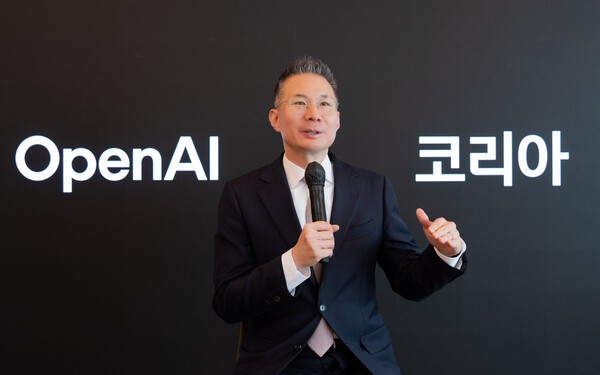
OpenAI held a press briefing at the Josun Palace Hotel in Gangnam District, Seoul, on the 9th to mark the first anniversary of its Korea office and unveiled its performance over the past year and future strategy.
The scale of ChatGPT Enterprise adoption by domestic companies and institutions had expanded 28-fold year over year as of the end of last month, and the weekly active users of ChatGPT Work and Codex in Korea increased roughly 14-fold over the six months since last March.
OpenAI said it is broadening its business base in Korea through domestic data centers, advertising, and cybersecurity, while also unveiling GPT-6 Astra and a counterexample related to the Navier-Stokes equations.
OpenAI held a press briefing at the Josun Palace Hotel in Gangnam District, Seoul, on the 9th to mark the first anniversary of its Korea office. At the briefing, the company unveiled its domestic business performance over the past year and its future strategy.
OpenAI outlined the main achievements of its business in Korea as the first year since the opening of the Korea office came to a close. The company said the scale of ChatGPT Enterprise adoption by domestic companies and institutions, measured by users, had expanded 28-fold year over year as of the end of last month.
OpenAI said the way companies use AI is also changing. Corporate AI use is shifting from supporting tasks such as information search and document writing to carrying out actual work, it said.
It said corporate AI use initially focused on supporting individual tasks such as information search and draft writing. Recently, it said, expanded use cases have emerged in which AI is delegated across multiple stages, including research, analysis, software development, and work automation.
OpenAI said it is also broadening its business base in Korea alongside these changes. The company said it is expanding its business footing into domestic data centers, advertising, and cybersecurity.
Through the press briefing, OpenAI presented its domestic business achievements and next strategy as it marked the first anniversary of its Korea office. It also explained the expansion of ChatGPT Enterprise adoption in Korea and the broader trend of corporate AI use.
Amid changes in usage of ChatGPT Work and Codex, the two services' weekly active users in Korea increased roughly 14-fold over the six months since last March. Codex is a coding agent that performs code writing, editing, and review, while ChatGPT Work is a service that extends Codex agent technology to general office work. ChatGPT Work handles everything in a single flow, from research and analysis using apps and files to final output creation.
Along with this rise in usage, the scope of AI adoption is expanding from specific job categories to entire organizations. AI is being used across departments including legal, sales, finance, marketing, and operations, and Samsung Electronics and Seoul National University were cited as cases that built organization-wide foundations for AI use.
OpenAI said the standards for assessing the impact of corporate AI adoption are shifting to more specific criteria. As a result, the key yardstick is moving from simple answer accuracy to whether AI can complete actual work, while whether people can trust the results and the scale of cost savings including review and rework are also being emphasized.
Kim Kyung-hoon, head of OpenAI Korea, said Korean companies' expectations for AI have become more concrete over the past year. He added that when high-level intelligence can complete tasks, integrate naturally with existing systems, and meet the security and control requirements companies demand, both the speed and depth of adoption expand.
OpenAI unveiled GPT-6 Astra on the 4th and plans to expand the range of tasks companies can delegate to AI based on it. GPT-6 Astra showed improved computer use performance, specialized work performance, scientific performance, coding performance, and cybersecurity performance, and scored 99.9 on ARC-AGI-3.
GPT-6 Astra also includes connector and code support features, and can use the screen interface of existing systems even when there is no separate API. This means AI can directly operate the screen to handle work without completely rebuilding existing systems, and the use of screen interfaces can also expand the scope of automation.
OpenAI is moving to expand domestic infrastructure on the back of rising enterprise customers. Data residency is currently offered to ChatGPT Enterprise, ChatGPT Edu, and API customers, and the feature stores customer content in Korea.
OpenAI is also pushing to support inference residency, which means processing model inference within Korea. It is also preparing to build a domestic data center. The goal is to establish a foundation where both data storage and AI computation are handled in Korea.
OpenAI also set a policy to strengthen its partner ecosystem to support enterprise adoption. Large domestic SI firms, cloud providers, IT operations companies, and AI startups are joining the OpenAI partner network to support implementation, operations, and organization-wide rollout.
OpenAI is advancing a project called 'Daybreak' as part of its efforts to expand its cybersecurity business. The company plans to select at least 5 Daybreak partners in Korea in the future to support AI-based vulnerability detection, verification, and response.
It is also expanding its advertising business on the back of growth in individual users. OpenAI has been offering ChatGPT ads to adults on the free and Go plans in Korea since June 19.
According to OpenAI, weekly active ChatGPT users in Korea rose 35% year over year as of August 25. Worldwide ChatGPT usage exceeds 1 billion people every week. This increase in users is translating into ad revenue.
ChatGPT ads reached an annualized revenue run rate of USD 1 billion before 200 days after their global launch. Currently, there are tens of thousands of advertisers using ChatGPT ads. OpenAI recently expanded its dedicated ad team to Korea and has also begun supporting domestic advertisers and agencies.
Kim said users' process of exploring products and services and comparing options within ChatGPT is becoming a new touchpoint for companies and customers. He also said the pace of that growth is difficult to compare with any existing advertising platform.
As it pushes to expand advertising, OpenAI also emphasized principles for protecting user data. The company said it will clearly distinguish ChatGPT ads from regular answers and will ensure that ads do not affect the content of responses.
OpenAI also said it will not provide advertisers with users' conversation content or personal information. In addition, it set a standard that ads will not be shown in conversations about sensitive topics such as health, mental health, and politics.
OpenAI then unveiled its image generation and editing model, 'ChatGPT Image 2.5.' 'ChatGPT Image 2.5' improves the ability to change backgrounds, styles, and compositions while preserving the features of people and objects in reference images, and it also strengthens iterative editing performance.
OpenAI said the model reduces problems in which elements changed in earlier edits become distorted or image quality deteriorates after multiple revisions. It also said lighting and texture rendering, handling of complex layouts, and transparent background processing have improved.
OpenAI has expanded user intervention features in ChatGPT. As a result, users can now draw directly inside ChatGPT with 'Sketch,' and create final images by referencing hand-drawn pictures. They can also specify edit locations through image comments and use poster and merchandise templates.
OpenAI also unveiled 'GPT-Image-2.5 Flare' and 'GPT-Image-2.5 Sunburst' for developers. 'GPT-Image-2.5 Flare' offers improved image quality over GPT-Image-2, and its generation latency has been reduced by up to 50%. 'GPT-Image-2.5 Sunburst' focuses on precision editing tasks such as advertising and product images.
OpenAI said it generates more than 3 billion images every week through ChatGPT Image and the GPT-Image model in API.
OpenAI also disclosed research results in AI-driven science beyond the image field. An internal AI system found a counterexample related to the Millennium Prize Problem, 'the existence and smoothness of the Navier-Stokes equations.'
The finding points to the possibility of a singularity occurring within finite time.
The issue in the Navier-Stokes problem is whether a smooth initial state in a three-dimensional fluid remains smooth and whether a singularity can occur. OpenAI said it demonstrated the possibility of a singularity by constructing a fluid flow with internal swirling, axial stretching, and sustained velocity increase.
In this flow, changes at the center of the process gradually shrink, and velocity behavior diverges to infinity within finite time, while total energy remains finite. OpenAI said this means singularities can occur even without an external infinite force, and explained that the underlying mechanism is the balance among internal terms in the equations, such as acceleration, pressure, and viscosity, under smooth external forces.
OpenAI presented an analytical proof and Lean formalization as public evidence supporting this. The research used a next-generation internal model with stronger performance than GPT-6 Astra, deployed up to about 10,000 AI agents to conduct parallel searches across different hypotheses and approaches, and derived the solution through sharing and verifying promising results.
OpenAI said it spent about 88 hours after activating the first agent before reaching a solution to the Navier-Stokes problem, and then spent an additional 17 hours on Lean formalization and verification using GPT-6 Astra. The scale of the Navier-Stokes effort amounted to about 2.7 million agent messages and 130 billion output tokens.
However, OpenAI's release of the solution does not directly mean official recognition by the Clay Mathematics Institute as a solved Millennium Prize Problem. OpenAI said the significance of the result lies less in whether it wins the prize than in proving that AI models can explore hypotheses and carry out proofs in complex mathematical problems.
Source: TECHWORLD · Kim Seung-gi
Original: https://www.epnc.co.kr/news/articleView.html?idxno=406746
References
This article was produced with the help of an automated content generation algorithm.
Source: TECHWORLD
View originalThis article was summarized and organized by BizCrush based on the original article from TECHWORLD. For exact quotations and full details, please refer to the original article.