National AI Strategy Committee’s Second Term Shifts to “Publicly Felt” Results, Accelerates “AI for Everyone” and Public AX
TECHWORLD · · 1 views
✦ AI Summary
The National AI Strategy Committee held a first-anniversary performance report session and set its second-term direction around results that citizens and companies can feel.
The past year focused on building strategy, institutions, and infrastructure, and the committee now plans to link the independent foundation model, "AI for Everyone," industrial AX, public AX, and regional AX.
Its second-term operations will shift from a subcommittee-centered model to a project-centered one, with the final deliverable used as the performance review standard.
The National AI Strategy Committee has marked its first anniversary since its launch. For its second term, the committee has set a course centered on results that citizens and companies can feel, and presented strategy, institutions, and infrastructure as the main achievements of the past year.
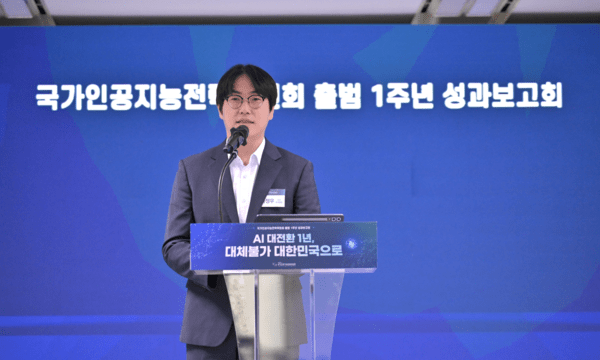
The committee held a first-anniversary performance report session on the 8th at Seoul Square. The event unveiled the achievements and future plans of each subcommittee, special committee, and TF.
Over the past year, the committee focused on laying the strategic, institutional, and infrastructure foundations for policy implementation. Its future priorities include linking the independent AI foundation model, "AI for Everyone," industrial AX, public AX, and regional AX.
Through this, the committee has set the creation of actual services and industrial outcomes as its future goal. Ha Jung-woo, standing vice chair of the National AI Strategy Committee, said the past year was spent building strategy and foundations, and that the next step requires a shift to results-oriented execution, making this the moment to deliver outcomes that citizens can feel and that are practically useful to companies.
For its second term, the committee will shift its operating model from a subcommittee-centered structure to a project-centered one. Accordingly, it plans to operate by having multiple subcommittees and ministries jointly promote a single project. Performance review criteria will be based on the final deliverable.
Vice Chair Ha said the project’s final output needs to be clear. He also said that most projects require cooperation among multiple subcommittees.
As controversy continues over recent evaluations related to the independent foundation model business, the committee plans to revise the project. The reexamination will involve the Ministry of Science and ICT, the committee’s technology innovation and infrastructure subcommittee, and data experts.
The review will cover evaluation methods, criteria, and execution systems. Vice Chair Ha said there were shortcomings in both the first and second rounds of the independent foundation model project.
Ha said that after that, the essential strengthening of frontier AI capabilities will be important. He identified the independent foundation model, public AX, and "AI for Everyone" as targets for the linkage plan.
The committee plans to connect the independent foundation model, public AX, and "AI for Everyone" so that data generated during citizens’ use of AI services can be reused for model training. The purpose of this data reuse is to improve performance and service quality.
Shin Jin-woo, head of the technology innovation and infrastructure subcommittee, said the independent foundation model and public AX need to be pursued in parallel to train for agentic environments. He also said that a data flywheel must be built by using citizens’ data through "AI for Everyone" and feeding that data back into model training.
"AI for Everyone" will serve as the point of contact for AI services directly used by the public. Vice Chair Ha predicted that AI agents linked to "AI for Everyone" and public services will begin in earnest from the second half of the year, and that integrated civil service platforms will also move into full operation from the second half, increasing the number of services people can actually feel.
AI infrastructure policy is moving from the securing stage to the utilization stage. The committee plans to establish a management system that can monitor GPU operations in real time, and also a system that can allocate GPUs based on where they are needed.
Shin Jin-woo proposed securing additional advanced GPUs. He also suggested building a dashboard to monitor real-time computing resource and GPU operation status, as well as establishing principles for the rational allocation of computing resources. The GPU scale in 2027 will be 10,000 units, and the 2027 budget will be KRW 3.9 trillion.
The government is pursuing a plan to broaden the use of the computing resources it has secured beyond AIDC to include domestic AI semiconductors and physical AI. To this end, it will prepare a plan to link frontier models with domestic NPU, and will also push ahead with plans to build sector-specific systems for securing and using physical AI data.
Vice Chair Ha said the proposal is not intended to operate as a data center rental business. He added that linkage among power, memory semiconductors, GPU, domestic AI semiconductors, data centers, foundation models, and frontier models is necessary, and said the goal is to export intelligence.
Based on a system linking models, semiconductors, and data, the government will also expand the on-site application of industrial AX. The sectors targeted for broader on-site deployment of industrial AX are manufacturing, autonomous driving, and humanoids, and corresponding plans include promoting a manufacturing AI strategy, expanding autonomous driving demonstrations, and fostering an ecosystem for the humanoid industry.
At the same time, the government will also work to reorganize computing projects that are currently scattered across ministries. Jo Joon-hee, head of the industrial AX and ecosystem subcommittee, said AIDC-related GPU and NPU projects are fragmented by ministry, and explained that the goal is to improve efficiency by linking this to the establishment of an integrated management system.
While reorganizing ministry-by-ministry computing projects, the government plans to push ahead with establishing an integrated management system. Jo Joon-hee said this reorganization is intended to help cut budgets.
Public AX was presented as a role that connects AI capabilities built in industry with public services for citizens. The presentation for the day was delivered by Ha Yong-ho, a member of the committee, instead of Park Tae-woong, head of the public AX subcommittee. To that end, the government will promote the establishment of a government-wide AI common platform and an integrated civil service platform. Standardization targets for government interfaces include API and MCP.
Ha Yong-ho said the government will work to integrate common platforms for modules shared across multiple ministries. He also said the focus will be on building a structure that can flexibly respond when a better AI emerges.
The government will push to improve the public procurement system, which is not suitable for introducing AI services. It will also work on institutional reforms to make subscription-based AI services easier for public institutions to use, as well as reforms to make usage-based AI services easier for public institutions to use.
Ha Yong-ho said there are many complaints that current procurement rules make it difficult to use monthly subscription AI systems. He added that there are also many complaints that current procurement rules make usage-based AI systems difficult to use. He said the government will expand the ease of using a variety of AI tools by improving the procurement system.
The direction for expanding results that can be felt in everyday life was divided into the regional and medical sectors. In the regional sector, AX for small and medium-sized enterprises was set as a priority task, while in the medical sector, the plan called for a shift from policy design to actual service deployment.
In the regional sector, the plan is to link and promote regional AI innovation belts, AIDC, and national mega projects, while also improving conditions for local companies to participate in government AI projects. The focus is on strengthening the link between infrastructure and business, centered on AX for small and medium-sized enterprises.
Song Hye-ja, head of the regional special committee, said that on the ground there are many cases where small and medium-sized enterprises complain about difficulties adopting AI and a lack of funding. She also said the top on-site task this year is AX for small and medium-sized enterprises, and expressed the intent to expand results by linking national mega projects with regional innovation belts.
Song Hye-ja stressed that it is important to create tangible results by linking field feedback to policy. In the regional sector, this approach is putting emphasis on strengthening the connection between on-site demand and policy implementation.
In the medical sector, the plan shifts from the policy-design stage to the actual-service stage, promoting a public medical AI highway and a one-stop AI platform, while also expanding AI use in regional and medical settings through support for vulnerable medical populations.
Seo Jun-beom, head of the AI basic medical subgroup, said the first-phase plan of the AI basic medical strategy will be pursued as a result that the public can feel. To that end, the health care sector plans to identify and support on-site issues for the purpose of promoting AX.
In the social sector, the government will respond to employment, welfare, and care issues related to the AI transition. It will prepare a plan to stabilize employment during industrial transition, prepare a plan for an AI-based society, and also respond to crimes that abuse AI, such as deepfakes and voice phishing.
Yoo Jae-yeon, head of the social subcommittee, presented a framework for an AI-based society that ensures the broad distribution of the benefits of AI development, and said a promotion plan to build that framework will be established within this year.
In the education and talent sector, the committee will review measures to transition the existing education system to fit the AI era, alongside talent development. It will coordinate government-wide AI talent development projects, promote AI transformation in schools, and review possible changes to grade-level systems, universities, and curricula.
In education, it raised a fundamental question about whether the existing grade system, university system, and curriculum need to remain unchanged in the AI era. Lee Min-seok, head of the education and talent subcommittee, said the committee will review a new education system after prior reviews and model design.
In science, the government will pursue a shift from follow-up R&D to leading R&D through the use of AI. The National Science AI Research Center will serve as a hub connecting research institutes, researchers, data, and computing resources, and AI will also be used to solve major scientific and technological challenges.
Seok Cha-ok, head of the science subcommittee, said that existing follow-up growth strategies alone make it difficult to seize new growth opportunities. He added that the plan is to promote innovation pathways so that scientific discoveries and research achievements lead to solutions for industrial and national and social problems.
In the data sector, the focus of data policy will shift from simple openness to making data genuinely usable by AI. To this end, the government will reform systems for the use of personal information, industrial data, and copyrighted works, and will establish national AI data governance and a data valuation system.
Paik Eun-ok, head of the data subcommittee, said that simply opening and disclosing public officials’ production documents is insufficient. She added that the documents need to be transformed into a format that makes them easier for AI to search, interpret, and use.
This direction is leading to follow-up reforms as AI usage expands. Accordingly, in the defense and security sectors, there is a move to pursue implementation-based reforms in parallel.
In defense, the government is promoting the creation of a defense AX hub and also advancing defense-specific AI. It is also pushing ahead with building an AI data center and linking publicly releasable defense data to the independent foundation model project.
Shim Seung-bae, head of the defense and security subcommittee, said rapid implementation of defense AX and securing safety must proceed in parallel. He also presented a plan to accelerate development of defense models based on the independent foundation model until next year.
In security, the special security committee is working to establish a national common security system to respond to the spread of AI. Alongside this, it is piloting a continuous vulnerability reporting and remediation system, and reorganizing security standards that have been dispersed across ministries into a Korean-style AI cybersecurity framework.
Lee Won-tae, chair of the special security committee, said AI security is not a matter confined to the technology issues of individual ministries or institutions. He stressed the need to make AI security a core foundation of the national AI strategy.
Accordingly, the legal TF has taken on the role of organizing the rapidly growing number of AI-related bills around the AI Framework Act. It will separate areas that require independent regulation, such as defense, and reduce duplicate and excessive regulation in a way that improves predictability for AI businesses.
No Han-dong, leader of the legal TF, explained that control is needed rather than a one-sided rush forward. He said the principle will be to block excessive regulation while also applying a bold adoption principle to areas where urgent intervention is needed, and that a legislative framework based on those principles will be prepared.
The global cooperation subcommittee will take on the role of expanding domestic AI policy and industrial competitiveness through international cooperation. Based on a pan-ministerial AI diplomacy consultative body, it will promote responses to APEC and G20, and has proposed overseas expansion of full-stack and sovereign AI, as well as securing international standard leadership, as key tasks.
Oh Hye-yeon, head of the global cooperation subcommittee, said a single voice is needed in responding to international conferences. She also said a strategic roadmap will be prepared for areas where the Republic of Korea can exercise leadership in standardization over the next 1 to 2 years.
The AI democracy subcommittee is responsible for establishing principles of public participation and democratic control during AI diffusion. It will also work on developing a Korean-style public forum for general-purpose AI, and on elaborating a vision and action plan for K-democracy in the AI era.
Kim Eui-young, head of the AI democracy subcommittee, said that it is necessary to establish AI principles centered on the public. She also set forth the goal of realizing the country that uses AI most democratically.
The committee acknowledged that while it built a policy foundation over the past year, the results felt by the public were insufficient by comparison. Going forward, "AI for Everyone" and public services were presented as the starting point for expanding AI use, and AI adoption is expected to spread to regional areas, health care, welfare, and more. Accordingly, the degree to which expanded AI use changes everyday life is expected to become the benchmark for the committee’s performance.
Vice Chair Ha described the past year as a period of building foundations and setting direction, and said that as a result, there may have been a lack of visible achievements in relation to the past year’s performance. He added that the goal for next year is to create results that more people can feel as improvements and conveniences in their daily lives.
Source: TECHWORLD · Kim Seung-gi
Original: https://www.epnc.co.kr/news/articleView.html?idxno=406698
References
This article was produced with the help of an automated content generation algorithm.
Source: TECHWORLD
View originalThis article was summarized and organized by BizCrush based on the original article from TECHWORLD. For exact quotations and full details, please refer to the original article.