Kakao Expands AI Services and Technologies, From Public AX to Video Generation
TECHWORLD ·
✦ AI Summary
Kakao is expanding support for the AI transition of public services. On the 8th, it selected 30 best practices in the public sector at the “2026 Kakao Public Innovation Awards.” Kakao will unveil its adaptive tokenization technology, “KATok,” at ECCV 2026 to reduce the computational load required for video generation.
Kakao is expanding support for the AI transition of public services. In the public sector, it is identifying and sharing use cases for its services, positioning KakaoTalk and KakaoMap as tools for use in public settings in a bid to discover innovative examples. Kakao is also expanding research into core AI technologies.
In research, it has unveiled a technology that reduces the computational load needed for video generation. While Kakao is broadening use cases in the public sector, it is also presenting technologies to improve computational efficiency in video generation in its research efforts.
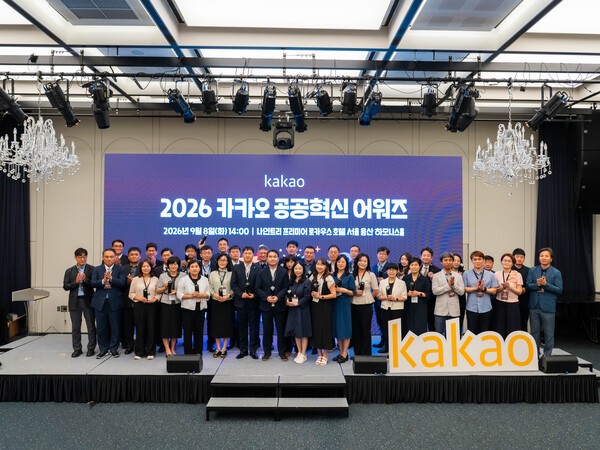
Kakao held the “2026 Kakao Public Innovation Awards” on the 8th. At the event, it shared achievements from central government ministries, local governments, and public institutions. The shared accomplishments were related to the use of Kakao services in administrative services and services for the public.
Kakao said it selected 30 best practices across 9 categories. The 9 categories included resolving administrative inconvenience, improving administrative efficiency, reducing budgets, public-private cooperation, responding to social issues, and strengthening public safety. The selected organizations consisted of 10 central government ministries, 10 local governments, 9 public institutions, and 1 other organization.
The Public Innovation Awards were conducted using press releases and materials made public through the end of last June as source materials for identifying candidates. Final selections were then made after review by external experts. In this way, candidates were narrowed based on public materials, and best practices were selected after external expert review.
Kakao presented healthcare, energy, local lifestyle information public services, and businesses that combine the Kakao platform and AI as representative areas where its platform and AI are connected to public service settings.
In healthcare, the Regional Maternal and Child Medical Center at Chonnam National University Hospital uses a KakaoTalk group chat, and when an emergency patient occurs, it has established a “maternal and child medical cooperation institution hotline” to check which hospitals can accept transfers. In the energy sector, Korea Electric Power Corporation is operating an “electricity bill AI reassurance notification service” that combines AI and KakaoTalk Alimtalk, and the service gives advance notice of possible bill increases to customers expected to use excessive power. In local lifestyle information, Busan Metropolitan City has built a KakaoMap-linked “15-Minute City Living Map,” which provides location and operating information for 1,665 places across 10 categories, including children’s facilities, libraries, parks, and community sports facilities.
Kakao plans to provide advertising Biz coupons worth a total of KRW 300 million to the selected organizations and also operate the “Kakao Tech Public Sector AI Class.” In addition, it plans to publish the “Kakao Public Innovation Report 2026,” which will include public-sector service innovation cases and achievements, at the end of November.
Kakao is pushing to expand the foundation for AI use in the public sector while continuing core technology research to improve the computational efficiency of AI models. As part of that effort, Kakao will unveil its adaptive tokenization technology, “KATok,” at the “European Conference on Computer Vision (ECCV 2026)” currently being held in Sweden. ECCV is regarded as one of the world’s three major computer vision conferences, along with CVPR and ICCV.
“KATok” is a technology that reduces the number of tokens needed for AI video generation. It works by adjusting the number of computational tokens according to the spatiotemporal complexity of a video. It allocates more tokens to scenes with more motion and more information, while reducing duplicate tokens in static or simple areas to use computational resources more efficiently.
The research was led by Lee Yeon-kyung, a Kakao research engineer. Lee Yeon-kyung is scheduled to present the research results in a poster session on the 10th, local time.
Existing dense tokenization compressed video at a fixed ratio regardless of content, which could reduce efficiency. In particular, unnecessary tokens could be generated even in scenes with little motion. Accordingly, KATok was designed to select only the necessary tokens according to each video’s characteristics, with a focus on lowering the computational burden by choosing tokens based on scene features.
The experiments confirmed the results achieved by applying KATok to a video generation pipeline. Compared with the existing method, training speed for the video generation model improved by about 6.9 times, and generation processing speed improved by about 3.2 times.
Kakao plans to verify the technology’s general applicability across various video generation models based on these results. It also intends to expand its scope to high-resolution and long-duration video generation. Choi Dong-jin, Kakao’s lead for applied AI model performance, said the computational savings of KATok’s adaptive tokenization technology become greater in environments where computational loads surge, such as high-resolution and long-duration video, and that the company will pursue verification of its general applicability with various AI video generation models. He added that the goal is to develop it into a core foundational technology for large-scale video generation that both reduces computation and maintains excellent image quality.
Source: TECHWORLD · Kim Seung-gi
Original: https://www.epnc.co.kr/news/articleView.html?idxno=406732
References
This article was produced with the help of an automated content generation algorithm.
Source: TECHWORLD
View originalThis article was summarized and organized by BizCrush based on the original article from TECHWORLD. For exact quotations and full details, please refer to the original article.