Samsung Display’s OLED Surge Narrows Revenue Gap With LG Display in 4 Years
TECHWORLD ·
✦ AI Summary
UBI Research said the growth center of the medium- to large-sized OLED market is shifting from TV to IT and mobility applications such as monitors, laptops, and automobiles.
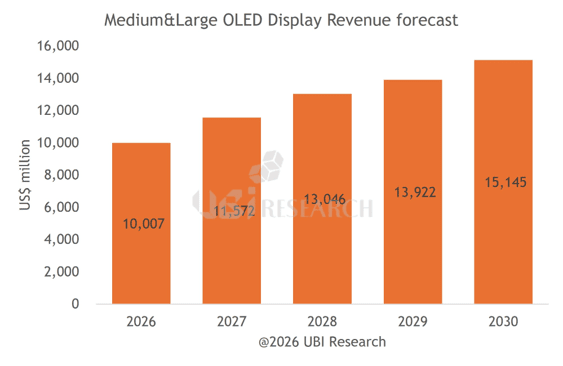
Revenue in the global medium- to large-sized OLED market is expected to rise from USD 10.01 billion in 2026 to USD 15.15 billion in 2030, with monitor OLEDs identified as the key growth area.
Samsung Display’s medium- to large-sized OLED revenue is expected to increase by 68% in 2030 from 2026, and its revenue gap with LG Display is projected to narrow from about USD 970 million in 2026 to about USD 130 million in 2030.
Samsung Display is expected to narrow the revenue gap with LG Display in 4 years. According to UBI Research’s "3Q26 Quarterly Display Market Tracker," the growth center of the medium- to large-sized OLED market is shifting from TV to IT and mobility applications such as monitors, laptops, and automobiles.
Revenue in the global medium- to large-sized OLED market is projected to expand from USD 10.01 billion in 2026 to USD 15.15 billion in 2030. The global medium- to large-sized OLED market is forecast to post a compound annual growth rate of 10.9%. OLED for monitors was identified as the key driver of this market growth.
The OLED market for monitors is expected to expand rapidly. Revenue from monitor OLEDs is projected to rise from USD 1.52 billion in 2026 to USD 4.69 billion in 2030, more than tripling in 4 years. The compound annual growth rate for monitor OLEDs is forecast at 32.5%. As a result, Samsung Display’s medium- to large-sized OLED business is expected to grow faster than LG Display’s.
By 2030, monitor OLEDs are expected to overtake TV OLEDs and emerge as the largest application in the medium- to large-sized OLED market. Over the same period, revenue from TV OLEDs is expected to edge down from USD 4.48 billion to USD 4.35 billion.
The broader adoption of OLED monitors is being driven by high refresh rates, high contrast, and fast response times, with growth centered on the gaming market. Meanwhile, automotive OLEDs are emerging as a major growth area. Revenue from automotive OLEDs is expected to increase from USD 660 million in 2026 to USD 1.38 billion in 2030, with a compound annual growth rate of 20.3%.
These changes indicate that demand in the medium- to large-sized OLED market is rapidly diversifying from its traditional TV-centered structure to one focused on IT and automobiles. Demand for automotive displays is increasing on the back of larger size, curved form factors, and high image quality.
UBI Research projected that Samsung Display’s medium- to large-sized OLED revenue will increase by 68% in 2030 compared with 2026. Over the same period, LG Display’s revenue growth rate is forecast at 34%. Accordingly, Samsung Display’s growth rate is expected to be about twice that of LG Display.
UBI Research also expects Samsung Display to expand revenue in monitor, laptop, and automotive applications. These high-growth segments are expected to drive Samsung Display’s earnings growth in the medium- to large-sized OLED business.
Samsung Display’s revenue from monitor OLEDs is expected to rise from USD 1.2 billion in 2026 to USD 3.12 billion in 2030. Revenue from automotive OLEDs is forecast to increase from USD 320 million in 2026 to USD 770 million in 2030. Revenue from laptop OLEDs is expected to expand from USD 1.35 billion in 2026 to USD 2.08 billion in 2030.
Samsung Display’s recent product and production strategy is moving in line with these market changes. The company is seen as rolling out product and production strategies for its medium- to large-sized OLED business in response to shifting demand.
Samsung Display plans to mass-produce 360Hz QD-OLED monitor panels in 2026. It has also begun developing QD-OLED panels that simultaneously deliver 4K resolution and a 360Hz refresh rate.
Although both Samsung Display and LG Display are working to strengthen the competitiveness of their OLED products, their responses are taking different directions. The difference in the two companies’ growth rates is attributed to differences in their medium- to large-sized OLED product portfolios.
Samsung Display is strengthening the competitiveness of its laptop OLED products. In response to the expansion of the IT OLED market, Samsung Display will begin full-scale supply of tandem OLEDs for laptops from July 2026.
In response to market changes, Samsung Display is increasing the share of high-growth applications such as monitors, laptops, and automobiles. This reflects a move toward expansion centered on IT.
LG Display is strengthening its push into the OLED monitor market. Targeting the high-performance gaming monitor market, LG Display will begin mass production of 240Hz RGB stripe OLED monitor panels in May 2026.
However, LG Display remains burdened by its dependence on TV. More than 60% of LG Display’s medium- to large-sized OLED revenue comes from TV applications.
Because of this structural difference, LG Display’s medium- to large-sized OLED business is expected to be more heavily affected by whether the TV OLED market recovers. Samsung Display, by contrast, is responding to market changes by increasing the share of high-growth applications.
UBI Research said Samsung Display is likely to significantly narrow the gap with LG Display in medium- to large-sized OLED revenue and business scale as it increases OLED sales in non-TV applications. Samsung Display is rapidly expanding OLED revenue outside TV, and as a result, the gap in medium- to large-sized OLED business scale with LG Display is also expected to narrow.
According to UBI Research’s forecast, the gap in medium- to large-sized OLED revenue between Samsung Display and LG Display was expected to be about USD 970 million in 2026. The gap is then projected to narrow to about USD 130 million in 2030.
At the same time, the growth engine of the medium- to large-sized OLED market is not expected to be limited to Korean companies alone. UBI Research forecast that growth among Chinese display companies will accelerate in the medium- to large-sized OLED market.
BOE’s medium- to large-sized OLED revenue was put at USD 210 million in 2026. It is then forecast to reach USD 380 million in 2030, representing an 84% increase from 2026 to 2030.
Everdisplay’s medium- to large-sized OLED revenue is also expected to grow from USD 470 million in the same period to USD 830 million. Everdisplay’s medium- to large-sized OLED revenue is projected to grow 75% over the same period.
As Chinese companies begin entering the IT OLED market in earnest, BOE is moving to expand the OLED market for laptops and tablets. BOE will begin mass production at its Chengdu B16 8.6-generation AMOLED line in June 2026, and customer supply from the same line will also begin at that time.
An 8.6-generation OLED production line uses a large-substrate process and can improve the production efficiency of IT OLED panels. Accordingly, 8.6-generation OLED production lines are seen as a key factor that will determine the competitiveness of the OLED market for IT devices such as laptops and tablets in the future.
The medium- to large-sized OLED market is expected to move away from competition centered on expanding TV panel shipments. Instead, competition to secure high-growth applications such as monitors, laptops, tablets, and automobiles is expected to intensify, and the degree to which companies secure these high-growth applications is expected to determine their performance and market position.
UBI Research said the growth center of the medium- to large-sized OLED market is diversifying from TV to monitors, laptops, automobiles, and other applications. It also analyzed that the expansion of 8.6-generation OLED mass production and the rapid growth of the monitor OLED market will be major variables determining each company’s future market position.
Source: TECHWORLD · Park Gyu-chan
Original: https://www.epnc.co.kr/news/articleView.html?idxno=406713
References
This article was produced with the help of an automated content generation algorithm.
Source: TECHWORLD
View originalThis article was summarized and organized by BizCrush based on the original article from TECHWORLD. For exact quotations and full details, please refer to the original article.