FortyTwoMaru Proposes 'Post-Sovereign AI' National Strategy, Emphasizes Private-Sector AX Expansion
TECHWORLD ·
✦ AI Summary
FortyTwoMaru proposed a "post-sovereign AI" national strategy that links technologies and infrastructure secured through sovereign AI to industrial AX and economic results.
CEO Kim Dong-hwan presented a national AI strategy centered on private-sector AX at the "2026 3rd Global Digital Forum" on the 8th, based on sovereign AI.
He outlined a three-stage strategy and expanded KPI framework that link domestic control over AI models, computing resources, data, and talent to corporate productivity, industrial innovation, and export competitiveness.
FortyTwoMaru proposed a "post-sovereign AI" national strategy that links technologies and infrastructure secured through sovereign AI to AI transformation (AX) on the industrial front line and to economic results. The company unveiled the strategy from the perspective that the capabilities accumulated through sovereign AI must be turned into real industrial and economic gains.
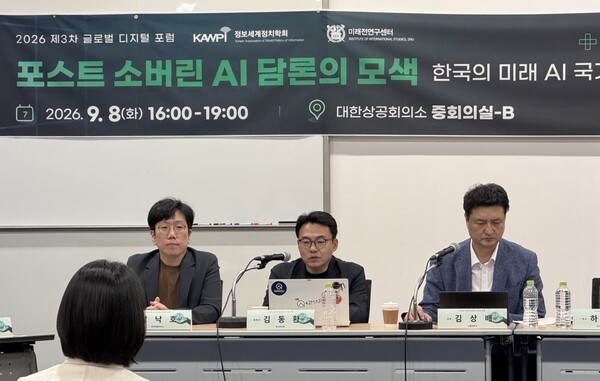
The strategy puts private-sector AX at the center, using sovereign AI as a foundation and presenting it as a flow that connects to corporate competitiveness and industrial innovation in the next stage. CEO Kim Dong-hwan attended the "2026 3rd Global Digital Forum" on the 8th and gave a presentation on the theme of a "national AI strategy centered on private-sector AX."
The forum was co-hosted by the Society for Information World Politics and Seoul National University's Future Warfare Research Center, and its theme was "Exploring the Discourse on Post-Sovereign AI: Where Should Korea's Future AI National Strategy Go?" The forum was held to examine changes in the global security and trade environment driven by the spread of generative AI and agent AI, and to discuss national strategies after sovereign AI.
CEO Kim Dong-hwan described sovereign AI as securing domestic control over AI models, computing resources, data, and talent, and viewed it as the basis for strategic autonomy and data sovereignty. However, Kim stressed that securing AI capabilities alone is not enough, and that they need to be linked to corporate productivity, industrial innovation, and export competitiveness.
Presenting "post-sovereign AI," Kim proposed that the national AI strategy should expand from a focus on securing sovereign AI to AX across the entire industrial sector. He explained that the core of the proposal is not to limit the focus of AI strategy to capability acquisition, but to broaden it to AX on the industrial front line and to the creation of results. To that end, he outlined a three-stage strategy of "sovereignty," "transformation," and "competitiveness," saying that "sovereignty" means securing AI capabilities, "transformation" means internalizing AI within industries and companies, and "competitiveness" means connecting AI use to actual outcomes.
Kim presented five policy tasks for linking industry competitiveness with AI, arguing that the direction of infrastructure and investment policy needs to change. He said AI infrastructure policy should expand from a resource-holding focus to securing accessibility for companies, and explained that AX investment should be broadened beyond R&D to include companies that change work processes by adopting AI.
He also identified manufacturing, finance, logistics, bio, and content as industries that need to connect AX strategies with growth policies. In addition, he proposed risk-based, innovation-friendly regulation and talent policy centered on AI users as necessary measures.
Kim pointed to the AI utilization gap between large companies and small and medium-sized companies, as well as midsize firms, based on an OECD report. He explained that while small and medium-sized companies and midsize firms account for more than 80% of total employment, their AI adoption rate is only about 31%, and stressed that this gap should be treated as a national productivity issue.
A proposal was made to broaden the evaluation criteria for AI policy so that they cover not only supply but also actual usage outcomes. The key point of the proposal is to manage AI policy results not only through supply indicators, but also through actual industrial usage outcomes.
To that end, it was proposed that the core KPI for the national AI strategy should include not only the number of AI models and the amount of GPU secured, but also companies' AI utilization rates, AX transition rates by industry, labor productivity growth rates, and export growth among companies using AI.
Kim stressed that the domestic industrial base should also be leveraged. He identified semiconductors, automobiles, shipbuilding, batteries, electronics, finance, bio, and content as sectors with global market competitiveness, and explained that a strategy to improve competitiveness by applying AI to existing industries alongside the development of frontier AI models needs to be pursued in parallel.
At the forum that day, Son Nak-ho, director at Naver Cloud, Lee Won-tae, a professor at Kookmin University, and Shim Seung-bae, a research fellow at the Korea Institute for Defense Analyses, participated as speakers. Ha Jung-woo, vice chair of the National AI Strategy Committee, delivered congratulatory remarks, and the panel discussion included Han Seo-in, a professor at Hanyang University, Lee Kyung-il, CEO of Saltlux, Choi Jeong-joo, CTO of Konan Technology, and Kim Jeong-geun, executive director of HECTO Group.
Kim defined artificial intelligence as a general-purpose technology that goes beyond technological innovation to reshape industrial competitiveness, national growth potential, security, and the entire social system, describing AI's scope of impact as structural change at the industrial and national level that is broader than individual technological innovation. On that basis, he stressed that the scope of the national AI policy should be expanded from fostering the AI industry to designing and supporting an ecosystem for expanding the base of self-sustaining private-sector AX.
Source: TECHWORLD · Kim Seung-gi
Original: https://www.epnc.co.kr/news/articleView.html?idxno=406702
References
This article was produced with the help of an automated content generation algorithm.
Source: TECHWORLD
View originalThis article was summarized and organized by BizCrush based on the original article from TECHWORLD. For exact quotations and full details, please refer to the original article.