Antropic Korea Head Choi Ki-young: “AX Success Starts With Domain Expertise and Clear Business Goals”
TECHWORLD ·
✦ AI Summary
Choi Ki-young, head of Anthropic Korea, said that when pursuing AX, companies should first define the business problem to solve rather than the AI technology itself, and should also define success metrics in advance.
Using Anthropic's internal cases, he explained that AI adoption has led to improved employee productivity, redesign of existing processes, and the development of new products and business models.
He also said that as frontier model use expands and companies assign more work to AI, safety becomes more important, and that full-lifecycle safeguards are needed from the research stage through deployment in real enterprise environments.
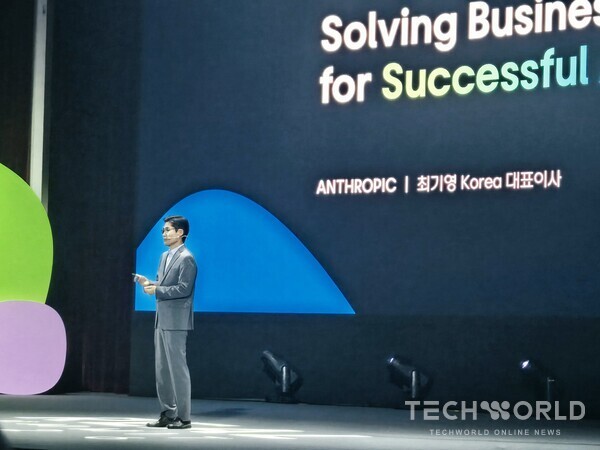
At the "Real Summit 2026" held on the 8th at COEX in Seoul, Choi Ki-young, head of Anthropic Korea, said companies pursuing AX should prioritize the business problem they want AI to solve over the AI technology itself, and that they need to define in advance the metrics for judging AX success.
Choi also introduced Anthropic's internal use cases, explaining that the company’s internal use of AI has led to improved employee productivity and then expanded into redesigning existing work processes, as well as developing new products and new business models.
Based on that, Choi also outlined three stages of corporate AI adoption. Stage 1 is improving employee productivity with AI, Stage 2 is improving existing processes and workflows through the use of agents, and Stage 3 is launching AI-centered products and linking them to new business models.
Choi said multiple stages can proceed at the same time in an AI-driven business transformation, but identified the biggest source of impact as launching AI-native products and creating innovative business models through them. He said all three stages of AI business transformation can unfold simultaneously, but the greatest results come from that point.
He added that as the scope of frontier model use expands and companies assign more work to AI, the importance of ensuring safety grows even more. Choi noted that as frontier model capabilities expand, the importance of safe AI increases, and that when applying it in enterprises, unintended side effects may also occur.
Accordingly, he stressed that safeguards need to extend from the research stage through after deployment in real enterprise environments, and that maintaining safeguards throughout the process is important. As the scope of frontier model use expands and companies assign more work to AI, the possibility of unintended outcomes also rises, making a response across the full lifecycle necessary.
Choi also introduced a case connecting AI with enterprise data. A global automaker linked documents and information related to its painting process to AI and solved a problem that had gone unresolved for 5 years; the long-standing issue was a field problem, and solving it took about 10 minutes.
Choi predicted that such cases will increase as model performance improves. He explained that in real organizations, the importance of selecting the right tasks for AI and connecting them to outcomes is expanding beyond AI’s possible scope of application.
This trend also led to changes in Anthropic's own product development approach. Instead of the traditional method of first finalizing vision documents and detailed specifications before development, Anthropic adopted a process of rapidly building a prototype first and then reflecting real user reactions.
In this process, one engineer built an early prototype over a weekend using the AI coding tool Claude Code. Three people then developed it over about 8 weeks to reach the beta stage, and the team size for product operations and feature improvements was about 5 people.
As a result, the development cycle was shortened, and the pace of incorporating user feedback after launch also accelerated. Choi said 62 feature improvements were reflected based on user feedback within the first 48 hours after the service went live.
The development approach is shifting from procedures that once required a long time to one that first presents a prototype and then improves it by gathering feedback. The speaker said the guiding principle for reflecting feedback was within 24 hours.
This change is also linked to the scale of the development organization affected by AI adoption. In the past, competitiveness depended on having a large development workforce, but if AI is used in development and operations, a small team can build products and scale services.
Choi said that one pillar of software development competitiveness in the past was headcount. He added that now a small number of people can quickly carry out development operations with AI, and that scale can be achieved with only a small team and an idea.
As a prerequisite for connecting these changes to AX, he said the business goal should come before the technology being applied. He also said participation from domain experts with a deep understanding of actual work is necessary, and that they should play a role in defining the challenges to solve and the success metrics. He explained that it is also necessary to use AI repeatedly until the desired result is produced.
Choi said a clear business goal must come first as the starting point for AI use, and that AI can then be used in an iterative loop to produce results. He also explained that it is important to agree on goals and success metrics through conversations and engagement with domain experts, and that repetition is needed until performance indicators are met.
He then raised the challenge of expanding proven use cases into practical work agents. To do this, he said companies should not stop at the PoC stage and should clarify operational goals. He also explained that processes need to be redesigned so that a small number of people using AI can handle larger-scale work.
As a mechanism supporting such expansion, Anthropic's global partner program, the Claude Partner Network, was introduced. Samsung SDS became the first Korean company to secure the Select tier in the program. The Select tier is granted based on criteria such as certified specialists and actual customer adoption cases.
The two companies signed a strategic partnership in San Francisco in the US in July to support AX for Korean companies. Based on that, they plan to discover new AX businesses by combining Anthropic's frontier models with Samsung SDS's industry expertise and systems integration and operations capabilities, while also finding application cases tailored to each company.
Choi said that in such collaboration, it is important to set success metrics through a clear business goal and the participation of domain experts. He added that it is important to repeatedly use AI until the desired results are produced, and expressed his intention to continue AX collaboration with Samsung SDS to solve corporate business problems.
Source: TECHWORLD · Kim Seung-gi
Original: https://www.epnc.co.kr/news/articleView.html?idxno=406695
References
This article was produced with the help of an automated content generation algorithm.
Source: TECHWORLD
View originalThis article was summarized and organized by BizCrush based on the original article from TECHWORLD. For exact quotations and full details, please refer to the original article.