OpenAI and Anthropic Lay Out Corporate AX Playbook at REAL Summit 2026
IT DAILY ·
✦ AI Summary
At the enterprise AX conference "REAL Summit 2026" held on the 8th at COEX in Seoul, OpenAI and Anthropic presented corporate AX solutions. Sam Altman, CEO of OpenAI, cited understanding enterprise operations and the ability to apply new technologies to real work as the basis for the company’s partnership with Samsung SDS. Kim Kyung-hoon, head of OpenAI Korea, and Choi Ki-young, Korea head of Anthropic, outlined stages for connecting AI to actual work and results, as well as directions for enterprise AI business transformation.
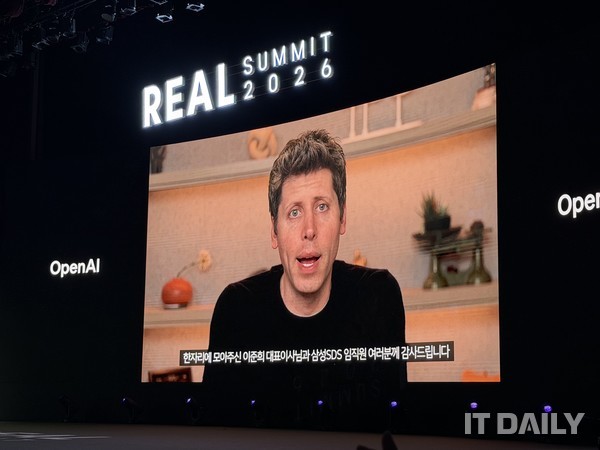
OpenAI laid out practical solutions for enterprise AI transformation. According to IT Daily, the enterprise AX conference "REAL Summit 2026," held on the 8th at COEX in Seoul, featured corporate AX solutions from OpenAI and Anthropic. The photo was credited to reporter Yang Seung-gap.
At the event, Sam Altman, CEO of OpenAI, said in a video message that the background for its partnership with Samsung SDS was its understanding of enterprise operations and its ability to apply new technologies to real-world work.
Altman said AI agents, which are beginning to be adopted in enterprise settings, are having a tangible and positive impact on productivity. He also predicted that this shift will accelerate further.
Altman cited world-class technical talent and infrastructure, strong government support, and a dynamic ecosystem as strengths of Korean companies. He then said he was committed to helping Korean companies lead the next chapter of global AI and added that OpenAI wants to build the future together with Samsung SDS.
During the keynote, representatives from Samsung SDS and its partners, OpenAI and Anthropic, took the stage to present directions for enterprise AI use and business transformation strategies.
The background to this discussion is Samsung SDS's expanded collaboration. Recently, Samsung SDS has been supporting the introduction of ChatGPT Enterprise with OpenAI and participated as a pilot partner for OpenAI's "Daybreak." Samsung SDS and Anthropic also signed a strategic partnership in July to support enterprise AX.
Kim Kyung-hoon, head of OpenAI Korea, then took the stage to present a direction for connecting enterprise AI to actual business results. Kim said the key discussion is what AI actually accomplishes, and outlined three steps: "Turn it on," "Hand it over," and "Leave it."
He explained that the first step, "Turn it on," is the stage of actively using AI in real work and connecting corporate data and business systems with AI. He also said AI is effective only when it is used more frequently and more deeply in the field, and that company records such as internal documents, customer information, and work guidelines need to be connected. Once company records are connected, he said, AI can understand the company's context and perform better work.
The AI utilization stage, "Hand it over," means letting AI carry out actual tasks. Kim said that at this stage, AI can search materials, check systems, and generate outputs. He also said AI can independently identify problems, retry, and improve performance. However, Kim said AI also needs safety mechanisms, comparing them to circuit breakers needed for electricity. While stressing that real work should be handed over to AI, he said appropriate goals and appropriate authority must also be given.
The final stage of AI use, "Leave it," means measuring the actual business results of AI use. Kim said that when evaluating a good factory, power consumption is not used as the benchmark. He added that AI should likewise be judged by actual outcomes, not by the use of tools themselves.
Choi Ki-young, Korea head of Anthropic, presented three directions for AI-driven business transformation. He proposed direction 1 as Empower people, direction 2 as Reinvent processes, and direction 3 as Transform products. He said the starting point of business transformation is improving employees' AI capabilities.
He then outlined the next step as applying AI agents to core tasks, followed by developing AI-native products and services. The photo was credited to reporter Yang Seung-gap.
Choi said the biggest payoff from business transformation through AI use is the launch of AI-native products and the creation of innovative business models through them. He made these remarks while explaining the business results of AI adoption.
He then introduced a case in which Frontier AI solved a complex enterprise problem. At a global automaker, the cause of a quality issue in the painting process had remained unidentified for five years, but after connecting related process data and documents, the company used Claude to diagnose it in about 10 minutes.
Choi said he believes such changes could also alter the way products are developed itself. He said that in the past, scaling up required more people and the necessary capabilities, but now the conditions are fewer people and ideas. He also said real-time user feedback can be reflected immediately in improvements and linked to new features, and that real-time generation and deployment of applications are also underway.
Source: IT DAILY · Yang Seung-gap
Original: https://www.itdaily.kr/news/articleView.html?idxno=241479
References
This article was produced with the help of an automated content generation algorithm.
Source: IT DAILY
View originalThis article was summarized and organized by BizCrush based on the original article from IT DAILY. For exact quotations and full details, please refer to the original article.