Samsung Rolls Out 'Welcome to Foldables' Ads as Makers Crowd Into a 2% Market
IT DAILY ·
✦ AI Summary
Ahead of Apple’s unveiling of its first foldable iPhone, Samsung Electronics ran "Welcome to Foldables" ads at six major landmarks in Seoul, Tokyo, London, and other cities.
IDC forecast global foldable phone shipments this year at 22.9 million units, with growth of 12.6%, and said Apple’s market entry would be a growth driver.
Counterpoint projected this year’s foldable phone market shares at Samsung Electronics 38%, Apple 25%, and Huawei 22%, and estimated Apple’s first-year shipments at up to 6 million units.
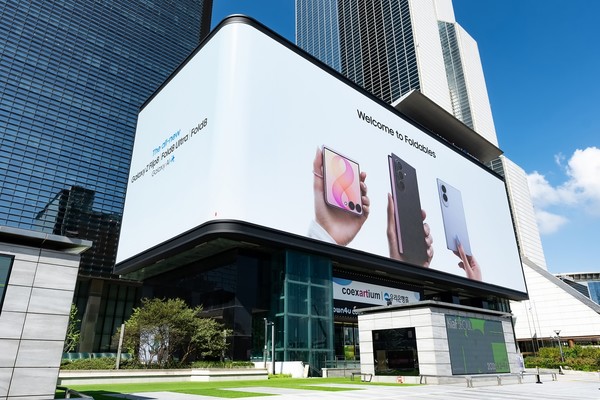
Ahead of Apple’s unveiling of its first foldable iPhone, Samsung Electronics launched ads carrying the phrase "Welcome to Foldables" in major cities around the world. Starting on the 2nd, Samsung Electronics rolled out sequential outdoor advertising for the Galaxy Z Fold8 series at six major landmarks, including Seoul, Tokyo, and London.
An outdoor ad campaign featuring the Galaxy Z Fold8 series and the phrase "Welcome to Foldables" is currently running at Seoul COEX. Samsung Electronics released the first Galaxy Fold in 2019.
Eight years after the debut of the first Galaxy Fold, Apple and major Chinese makers are moving to strengthen their foldable lineups. Huawei and Xiaomi unveiled new foldable phones on the 7th.
Even so, while multiple manufacturers are focusing on foldables, foldable phones still account for only about 2% of total smartphone shipments. Compared with bar-type smartphones, foldables are more expensive, and buyers cite thickness, weight, screen creases, and durability as barriers to purchase.
As the revenue structure of the smartphone market changes, the reasons makers are pushing foldables have become clearer. Smartphones are selling less, but the market is shifting toward higher average selling prices and higher total revenue. According to IDC, global smartphone shipments this year are expected to fall 16.7% from a year earlier, leaving the market at just slightly above 1 billion units. That 16.7% decline is the largest on record.
By contrast, market revenue is expected to rise. IDC forecast that market revenue will increase 6.3% to USD 613 billion, while average selling price, or ASP, will climb 27.6% to USD 581. Even as shipments decline, the market is expanding in value on the back of higher-priced products.
Behind this shift are falling shipments and rising component costs. Memory costs, in particular, are a major factor. According to IDC, DRAM and NAND flash costs have risen more than 300% from a year earlier. As a result, the burden on price-sensitive entry-level Android phones has increased, and the profitability of budget models has worsened.
In response, manufacturers are increasing the importance of premium products and raising the share of high-end models. Within foldables, the focus is shifting more toward high-priced book-type models than clamshells. Manufacturers are targeting products and technology as their focal points and are stepping up book-type-centered efforts.
Foldable phones are presented as a product category that differentiates itself from existing bar-type flagships. If AP, camera, and display performance improvements were the main competitive factors before, foldables add a new variable: the change in screen form. Their usability also lies in maintaining smartphone portability when folded while offering a tablet-like display when opened. For that reason, foldables are also being discussed as a way to move up the price range.
IDC forecast that global foldable phone shipments this year will reach 22.9 million units, with growth of 12.6%. IDC identified Apple’s entry into the market as the key driver of foldable growth this year.
Manufacturer choices in the foldable market are increasingly concentrating in one direction. According to Counterpoint Research, book-type models that unfold sideways accounted for 52% of global foldable phone shipments last year. Counterpoint Research projected that the share of book-type models will rise to 76% this year, while clamshell models that fold vertically will account for 24%.
Selling prices are also on an upward trend. Counterpoint projected that this year’s global wholesale ASP for foldable phones will rise 18% from a year earlier.
Counterpoint said the share of products priced at more than USD 1,600, which made up about one-third of total shipments last year, will rise to 60% this year. By contrast, the share of products priced at less than USD 1,200 is expected to fall below 30% this year.
Compared with clamshells, book-type foldables have a larger screen area and can run multiple applications at the same time. Users can also view documents and videos simultaneously. This large-screen utility is seen as a factor that justifies the higher price of book-type models.
Smartphone AI is evolving from question-and-answer use into agent-style AI that performs tasks by using multiple apps. This shift in AI is closely tied to the use of large screens. As agentic AI spreads, the importance of working with multiple tasks and results on a single screen is also growing.
For manufacturers, the wide screen of book-type foldables is increasingly being linked to productivity. Samsung Electronics has been improving thickness, weight, hinge durability, and display durability, which were cited as weaknesses in early foldables. It has also expanded software and AI features suited to large screens.
Through the "Welcome to Foldables" campaign, Samsung Electronics highlighted thinness, light weight, and durability as its main messages. The Galaxy Z Fold8 series is being sold in 106 markets worldwide.
Apple’s entry into the foldable phone market is expected to reshape market share estimates. Counterpoint released that outlook on the 7th.
Counterpoint put this year’s expected global foldable phone market shares at Samsung Electronics 38%, Apple 25%, and Huawei 22%. Apple’s first-year shipment forecast is up to 6 million units.
For Apple, this means keeping existing iPhone users within the iOS ecosystem and adding an opportunity to expand its ultra-premium lineup. For Samsung Electronics, it means the arrival of a powerful rival and the expansion of the market base for the foldable category it helped cultivate.
Meanwhile, Chinese companies are using foldables in the premium market. Huawei unveiled the tri-fold Mate XT2 on the 7th. The Mate XT2 folds twice, with a G-shaped structure in which both panels fold inward. Prices start at CNY 19,999. Huawei is seeking technological differentiation in China’s premium market through its high price and complex form factor.
Xiaomi unveiled its book-type "Xiaomi 18 Fold" on the same day. The "Xiaomi 18 Fold" is equipped with the company’s self-developed "Xring O3" processor and mobile DRAM from ChangXin Memory Technologies (CXMT). The launch reflects intentions to target the high-end smartphone market, expand in-house semiconductors, and broaden China-based supply chains.
These moves by finished-device makers are spreading into the supply chain. Industry sources say Samsung Display’s shipments of 7.8-inch foldable OLED panels for Apple this year are estimated at 8 million units, and that the company plans to expand that to around 15 million units next year. Total foldable panel shipments across the market are also expected to rise 46% this year.
Software ecosystem changes are also expected. Until now, the foldable market has been led by Android makers, but if Apple enters, foldable users will emerge across both Android and iOS. As the user base grows, app developers’ incentives to optimize for folding screens and large screens will also increase.
Cumulative global foldable phone shipments are expected to exceed 100 million units by the end of this year. The next stage of growth in the foldable market will be driven less by the foldable form itself and more by the usefulness of the unfolded screen. Book-type large screens are used for multitasking and content consumption.
As AI that works across multiple apps emerges, AI-integrated usage experiences are drawing attention. This experience is based on split-screen information viewing and task continuity. Split-screen-based usage is emerging as a new competitive factor.
Accordingly, the standards for hardware competition are also changing. Early competitive factors were hinges, creases, and durability. The elements that determined early product completion were stable folding and unfolding technology.
Today, the competitive focus is shifting toward reducing thickness and weight. Current competition also includes the organic implementation of operating systems, apps, and AI features tailored to foldable screens. The criteria for product utility are hardware lightness and the level of software-AI integration.
Apple’s entry will expand the competitive arena into iOS. The existing rivalry had centered on Android. Manufacturers’ focus on premium book-type models is deepening. As a result, the importance of the price-to-usefulness ratio of large screens is also increasing.
Samsung Electronics’ phrase "Welcome to Foldables" neatly captures the market shift. In the foldable market, the competition used to center on the technology of folding smartphones, but it is now moving toward competition over why a device needs to unfold.
Source: IT DAILY · Kim Byung-ju
Original: https://www.itdaily.kr/news/articleView.html?idxno=241480
References
This article was produced with the help of an automated content generation algorithm.
Source: IT DAILY
View originalThis article was summarized and organized by BizCrush based on the original article from IT DAILY. For exact quotations and full details, please refer to the original article.