Synopsys, Ansys Integration Debuts in Korea: “AI Will Reduce Engineering Complexity”
TECHWORLD ·
✦ AI Summary
Synopsys said on the 8th that it will hold 'Synopsys Converge Korea 2026' at the Grand InterContinental Parnas Seoul for two days, from the 8th to the 9th.
The event combines the 'Synopsys User Group (SNUG)' and Ansys's 'Simulation World,' and it is the first jointly held event in Korea since the Ansys acquisition and integration.
Synopsys presented AgentEngineer-based AI-driven engineering workflows and the Multiphysics Fusion solution as ways to reduce complexity in semiconductor design and verification, advanced packaging and system development.
Synopsys is accelerating efforts to build an integrated engineering ecosystem based on its integration with Ansys. The scope ranges from semiconductor design to system development, and the goal is to ease engineering complexity through the use of AI.
Synopsys said on the 8th that it will hold 'Synopsys Converge Korea 2026' at the Grand InterContinental Parnas Seoul. The event will run for two days, from the 8th to the 9th.
The event combines the 'Synopsys User Group (SNUG)' and Ansys's 'Simulation World.' It is the first jointly held event in Korea since Synopsys's acquisition and integration of Ansys in July last year.
The event is intended for executives, engineers, researchers, partners and technical experts in the semiconductor, AI, automotive, battery, aerospace and defense industries. At the event, they will discuss the direction of engineering innovation in the AI era.
At the event, Synopsys introduced an AI-driven engineering workflow based on 'AgentEngineer.' Synopsys said it implemented Agentic workflows in collaboration with Nvidia, AMD and Microsoft, presenting a new development approach in which AI directly participates in design and verification processes.
This approach is not limited to semiconductor design. The applications include semiconductor design and verification, advanced packaging and system development, with the core aim of reducing complexity across the product development process.
The background for this trend was described as the rapid advancement of semiconductor technologies such as AI semiconductors, high-bandwidth memory (HBM) and advanced packaging. As a result, the amount of data handled in design processes has increased and verification items have multiplied, while in the automotive and industrial sectors, electrification, autonomous driving, hyperconnectivity and software-defined architectures are progressing simultaneously, increasing engineering complexity.
In response to changes driven by the spread of AI, Synopsys is pursuing a strategy that uses AI not as a design aid but as a core technology for transforming engineering work.
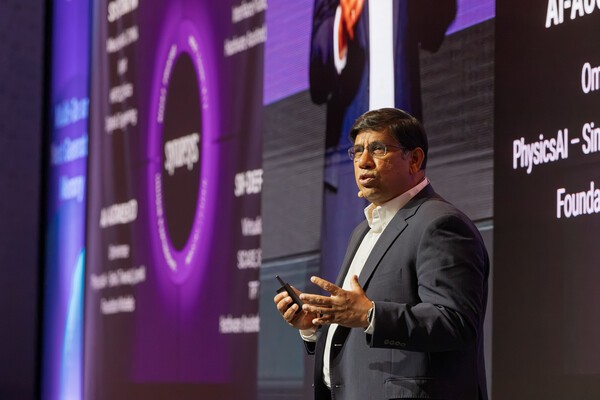
Under this direction, Shankar Krishnamoorthy, chief product development officer at Synopsys, said Korea is leading innovation in key technologies for the AI era, including HBM, advanced memory, AI semiconductors and advanced packaging. He explained that Synopsys plans to support innovation by Korean technology leaders through Agentic AI, multiphysics-based design and Silicon-to-Systems integrated engineering approaches.
Synopsys is pushing ahead with its integration with Ansys. Through this, it is strengthening its multiphysics engineering capabilities beyond semiconductor design, and multiphysics engineering refers to simultaneously considering various physical phenomena.
Synopsys recently also unveiled its 'Multiphysics Fusion' solution. The solution integrates analysis of physical domains such as structural, thermal and electromagnetic, and helps support design decisions from a system-wide perspective rather than for individual components.
As AI and high-performance computing systems become more advanced, semiconductor development increasingly needs to optimize not only semiconductor performance but also system-level physical characteristics such as thermal, power and signal integrity at the same time. This shift is raising the need to address not just chip performance but physical factors at the system level as well.
Accordingly, Synopsys is pushing ahead with its integration with Ansys. The purpose of the integration is to support physics-based decision-making throughout the entire product development process, including design exploration, optimization and verification. Synopsys outlined a vision of connecting silicon, systems, software, physical phenomena and AI into a single engineering environment.
Padmesh Mandloi, vice president in charge of application engineering for the Asia-Pacific region in Synopsys's S&A (Simulation & Analysis) division, said engineering complexity is increasing unprecedentedly as AI, intelligent systems and software-defined products spread. He also emphasized the importance of bringing together customers, partners and technical experts to share insights and seek future directions for innovation.
Synopsys has continuously expanded cooperation with Korea's technology ecosystem. Synopsys began operations in Korea in 1992 and established its Korea R&D Center in 2012. Based on the Korea R&D Center, Synopsys has supported technology development in Korea's semiconductor and engineering industries.
Synopsys currently works with more than 50 universities in Korea and supports more than 5,000 students each year. It has also supported the growth of a total of 72 startups through industry-academia cooperation and startup support programs. Through this, it has broadened cooperation with Korea's technology base.
Synopsys said it plans to expand its AI-based engineering ecosystem through this conference. The expansion targets, in addition to Korea's semiconductor industry, the automotive, battery, aerospace and defense sectors. The scope of AI's spread was also presented as extending beyond semiconductor design automation to engineering as a whole, including system design, physical verification and optimization.
As AI spreads, the competitive arena for EDA companies is also expanding. Against this backdrop, Synopsys presented a strategy to connect chip design and system simulation based on its integration with Ansys and combine that with Agentic AI. Synopsys's goal is to secure the lead in competition for next-generation engineering platforms.
Source: TECHWORLD · Park Kyu-chan
Original: https://www.epnc.co.kr/news/articleView.html?idxno=406675
References
This article was produced with the help of an automated content generation algorithm.
Source: TECHWORLD
View originalThis article was summarized and organized by BizCrush based on the original article from TECHWORLD. For exact quotations and full details, please refer to the original article.